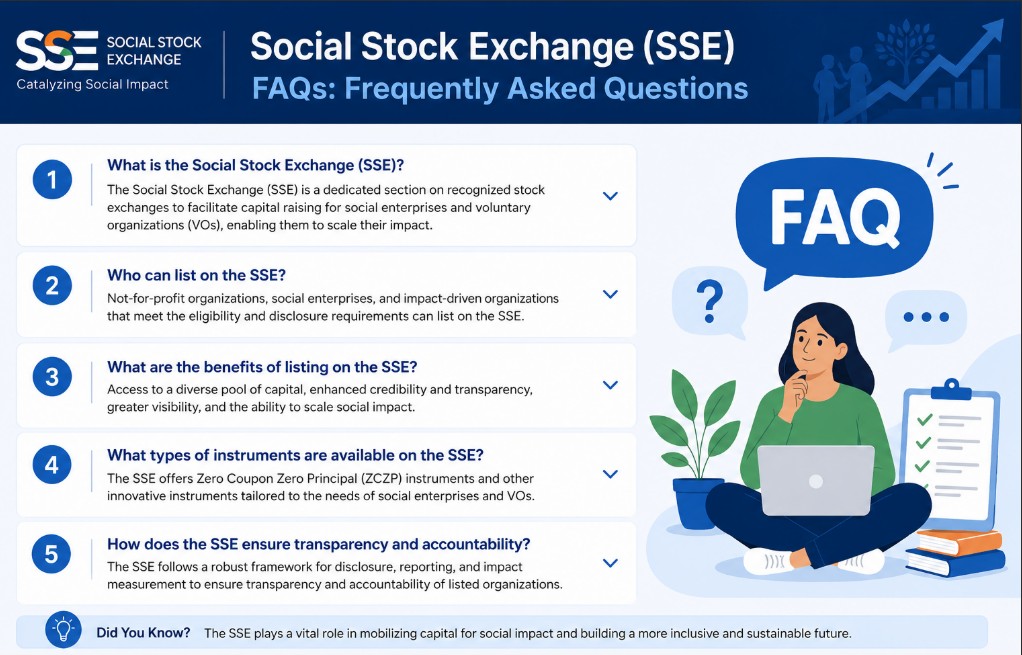
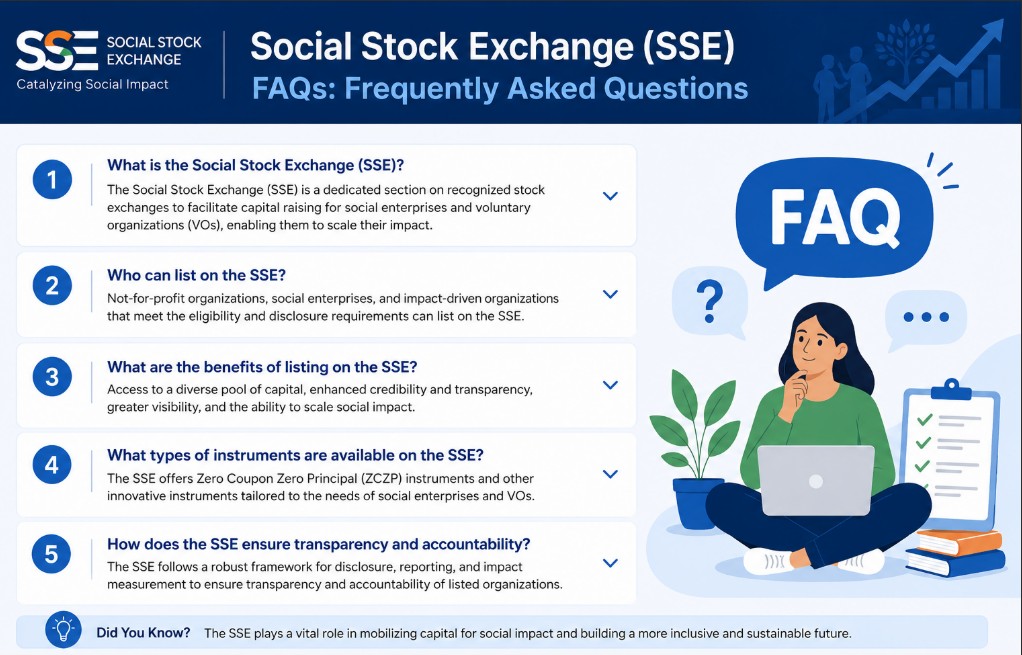
Social Stock Exchange FAQs Frequently Asked Questions
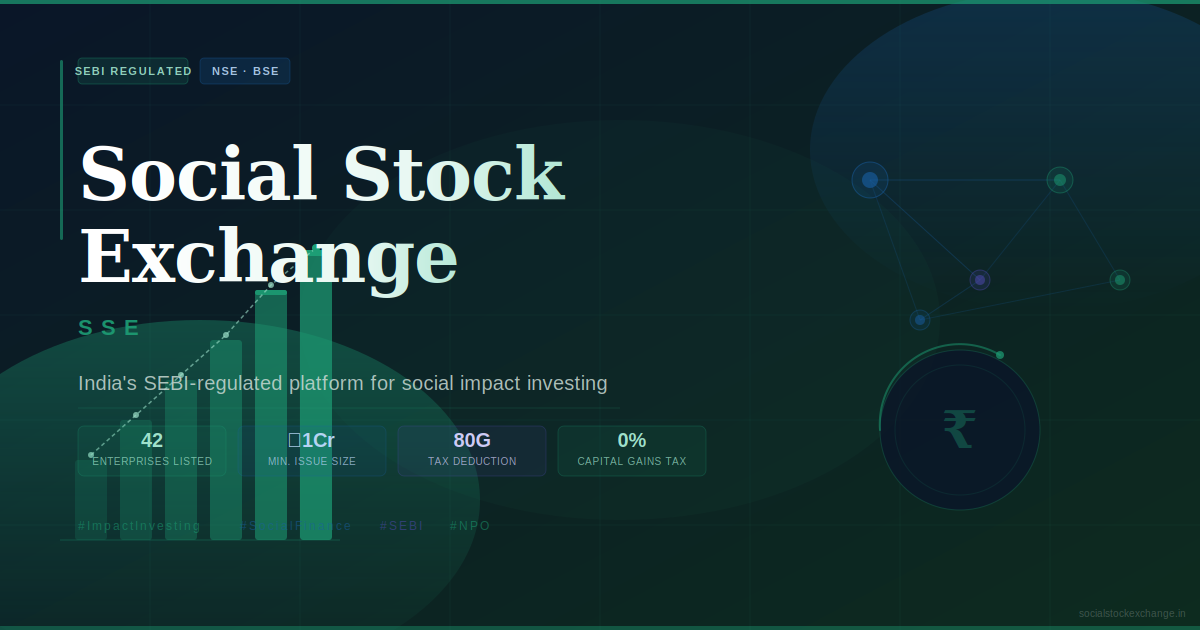
India's Social Stock Exchange (SSE) is a landmark initiative that bridges the gap between purpose-driven organisations and mission-aligned capital. Regulated by the Securities and Exchange Board of India (SEBI) and operational on the NSE and BSE, the SSE enables Not-for-Profit Organizations (NPOs) and For-Profit Social Enterprises (FPEs) to raise funds under a transparent, exchange-regulated framework — bringing the rigour of capital markets to the social sector for the first time in India.
Whether you are an NGO exploring the SSE registration process, a CSR manager assessing funding channels, or an impact investor seeking verified social enterprises, this comprehensive FAQ guide answers the most important questions about the Social Stock Exchange — covering eligibility, Zero Coupon Zero Principal (ZCZP) instruments, social audits, SEBI compliance, and more.
Section 1: Basics of the Social Stock Exchange
Q1. What is the Social Stock Exchange (SSE)?
The Social Stock Exchange (SSE) is a dedicated segment of India's existing stock exchange ecosystem that enables Social Enterprises to raise funds from the public through regulated exchange mechanisms. Operating under SEBI supervision on the NSE and BSE, the SSE acts as a bridge between social enterprises and fund providers, ensuring that entities creating measurable social impact are visible, accountable, and can access capital at scale.
Not-for-Profit Organisations (NPOs) that meet the registration criteria can register on the SSE and make ongoing disclosures about their social impact — whether or not they choose to raise funds through it.
Q2. What is a Social Enterprise in the context of the SSE?
The SSE recognises two categories of social enterprise:
- Not-for-Profit Organizations (NPOs) — charitable trusts, societies registered under the Societies Registration Act 1860, or Section 8 companies.
- For-Profit Social Enterprises (FPEs) — companies or body corporates operating for profit.
To establish primacy of social intent, any entity (NPO or FPE) must meet all three criteria under Regulation 292E(2) of the ICDR Regulations — engaging in prescribed eligible activities, targeting underserved populations, and demonstrating that at least 67% of its 3-year average revenue, expenditure, or beneficiary base relates to those eligible activities.
Corporate foundations, political or religious organisations, professional associations, and infrastructure/housing companies (except affordable housing) are not eligible.
Q3. Which entities are NOT eligible to register or raise funds through the SSE?
A Social Enterprise is ineligible if:
- Any promoter, director, or trustee is debarred from accessing the securities market by SEBI.
- The enterprise, or its key persons, is a wilful defaulter, fraudulent borrower, or fugitive economic offender.
- It has been debarred from carrying out activities or raising funds by the Ministry of Home Affairs or any other statutory body.
Section 2: Social Stock Exchange (SSE) Registration and Eligibility for NPOs
Q4. What are the registration criteria for NPOs on the SSE?
SEBI's circular dated 19 September 2022 prescribes the following minimum requirements for an NPO to register on the SSE:
- Minimum operational age of 3 years (supported by Certificate of Incorporation and 3 years of audited financials).
- Valid certificate under Section 12A / 12AA / 12AB of the Income Tax Act.
- Valid 80G registration.
- Minimum annual spending of INR 50 lakhs.
- Minimum funds received of INR 10 lakhs in the preceding year.
- Mandatory registration on the NGO Darpan portal.
Individual SSEs may prescribe additional requirements beyond SEBI's minimums.
Q5. Is it mandatory for an NPO to register before raising funds through the SSE?
Yes. Registration with the SSE is mandatory before any NPO can raise funds through the exchange. However, an NPO may continue to raise funds through other legally permissible means — whether registered with the SSE or not.
Q6. Is listing mandatory for NPOs registered with the SSE?
No. An NPO may register with the SSE without seeking listing. It may also choose to register and not raise any funds through the SSE. However, any NPO that does intend to raise funds through the SSE must first seek registration.
Even if an NPO does not list instruments, it must comply with all applicable SEBI (LODR) Regulations 2015 and circulars once registered.
Q7. Can an NPO promoted by a corporate body register on the SSE?
If the corporate body provides more than 50% of the NPO's funding or holds a controlling interest in it, the NPO is not eligible to register on the SSE.
Q8. Can international or foreign NPOs register on the SSE?
No. Only Indian entities are eligible to register on the Social Stock Exchange. Foreign investors (FIIs, FPIs, NRI investors) are also currently not permitted to invest in NPO fundraisings on the SSE.
Section 3: Social Stock Exchange (SSE) Zero Coupon Zero Principal (ZCZP) Instruments
Q9. What is a Zero Coupon Zero Principal (ZCZP) Instrument?
A ZCZP instrument is the primary fundraising tool available exclusively to NPOs registered on the SSE. It is a grant-based instrument — investors are treated as donors and receive no coupon (interest) payment and no return of principal. Funds raised are in the form of a grant, not a loan.
ZCZP instruments are issued in dematerialised form only and cannot be traded in the secondary market. However, they can be transferred to legal heirs. They are not subject to Securities Transaction Tax (STT).
Q10. What are the key conditions for issuing ZCZP instruments?
- The NPO must be registered with the SSE.
- The instrument must have a specific tenure and must be issued for a specific project or activity.
- The project must fall within the list of eligible activities under Regulation 292E of SEBI (ICDR) Regulations 2018.
- Minimum issue size: INR 1 crore. Minimum application size: INR 2 lakhs.
- Minimum subscription: 75% of the proposed fundraise.
- An NPO may raise additional funds for the same project, or run multiple ZCZP instruments for different projects simultaneously.
Q11. Can ZCZP instruments be issued via private placement?
Yes. A registered NPO may make private placements of ZCZP instruments to Social Impact Funds (SIFs) registered under SEBI AIF Regulations 2012, as well as to any other person. Private placements made to Social Impact Funds must be compulsorily listed on the SSE.
Q12. What is the procedure for public issuance of ZCZP instruments?
- The NPO files a draft fund-raising document with the SSE along with the prescribed fees.
- The SSE makes the document public on its website for at least 21 days for comments.
- Within 30 days of filing (or receipt of clarifications), the SSE issues its observations.
- The NPO incorporates those observations and files the final fundraising document before opening the issue.
No merchant banker appointment is required. Observations issued by the SSE are valid for 6 months.
Section 4: Social Stock Exchange (SSE) For-Profit Social Enterprises (FPEs)
Q13. Do For-Profit Social Enterprises need to register before raising funds through the SSE?
No. An FPE does not need to register with the SSE before raising funds. However, it must comply with all applicable ICDR Regulations and AIF Regulations before doing so.
Q14. How can a For-Profit Social Enterprise raise funds through the SSE?
- Issue of Equity Shares on the Main Board, SME Platform, or Innovators Growth Platform.
- Issue of Equity Shares to an Alternative Investment Fund (AIF), including a Social Impact Fund.
- Issue of Debt Instruments.
- Any other means as SEBI may specify.
FPEs listing on Main Board, SME Platform, or Innovators Growth Platform must also satisfy the eligibility criteria of the respective platform under SEBI (ICDR) Regulations 2018.
Q15. Can retail investors invest in securities issued by Social Enterprises on the SSE?
Retail investors may only invest in securities offered by FPEs listed on the Main Board. In all other cases — including ZCZP instruments issued by NPOs — only institutional investors and non-institutional investors are permitted to invest.
A retail individual investor is defined as one who applies for securities worth up to INR 2 lakhs.
Section 5: Social Stock Exchange (SSE) Social Audit and Compliance
Q16. What is a Social Audit?
A Social Audit is an independent examination of the social impact of a project or programme executed by a Social Enterprise. It is conducted by a certified Social Auditor — an individual registered with a self-regulatory organisation under the Institute of Chartered Accountants of India (ICAI), who has qualified for the certification programme conducted by the National Institute of Securities Market (NISM).
Q17. What are the minimum reporting standards for Social Enterprises?
The minimum reporting standards benchmark national and international measurement frameworks across three sections:
- Section 1 — Strategic Intent and Goal Setting: the social problem to be solved, target segment, and approach.
- Section 2 — Social Impact Scorecard: extent of target segment served, intensity of impact, dimensions of income, social equity, and diversity.
- Section 3 — General Information: governing body members, prior funding history, financials, and registrations.
Q18. What are the consequences of non-compliance after registration?
SEBI reserves the power to initiate enforcement actions against any Social Enterprise that fails to comply with applicable guidelines. These include administrative warnings, financial penalties under Chapter VIA of the SEBI Act, debarment, and other actions under Section 11 of the SEBI Act.
Section 6: Development Impact Bonds (DIBs)
Q19. What is a Development Impact Bond (DIB)?
A Development Impact Bond (DIB) is a structured, pay-for-success finance product available on the SSE. Under a DIB structure:
- An NPO (service provider) delivers on pre-agreed social metrics at pre-agreed costs.
- An Outcome Funder (donor) makes a grant to the NPO after the social metrics are achieved.
- A Risk Funder finances operations in advance and bears the risk of non-delivery; in return, it earns a small return if the metrics are met.
NPOs registered on the SSE are eligible to issue Development Impact Bonds.
Social Stock Exchange (SSE) QUICK-REFERENCE SUMMARY
|
Question |
Answer |
|---|---|
|
What is the SSE? |
A SEBI-regulated segment of NSE/BSE enabling social enterprises to raise funds from the public. |
|
Who can register? |
Indian NPOs (3+ years old, 80G, INR 50L annual spend) and For-Profit Social Enterprises. |
|
Primary NPO instrument? |
Zero Coupon Zero Principal (ZCZP) — a grant instrument; no interest, no principal return. |
|
Minimum ZCZP issue size? |
INR 1 crore; minimum application INR 2 lakhs; minimum subscription 75%. |
|
Are ZCZP taxable? |
No — ZCZP instruments are not subject to Securities Transaction Tax. |
|
Can FPEs register? |
No mandatory registration needed; FPEs raise funds through equity or debt under ICDR/AIF rules. |
|
Are foreign investors allowed? |
Currently not permitted to invest in NPO fundraising on the SSE. |
|
What is a Social Audit? |
An independent examination of social impact by a NISM-certified Social Auditor. |
Disclaimer: This document is for informational purposes only and does not constitute legal or financial advice. Regulations governing the Social Stock Exchange are periodically updated by SEBI. Readers are advised to refer to the latest SEBI circulars, NSE/BSE SSE portals, and seek professional guidance before making any registration or investment decisions.