What Is a Carbon Credit? A One-Tonne CO2e Building Block

A carbon credit is a tradable unit representing one metric tonne of carbon dioxide equivalent reduced, avoided, or removed, and it forms the basic building block of carbon markets.
Carbon Credits in India’s Climate Economy
A carbon credit is one of the most important concepts in today’s climate economy. As India moves toward a more structured carbon market through its Carbon Credit Trading Scheme, the term is becoming increasingly relevant for businesses, policymakers, sustainability teams, and investors.
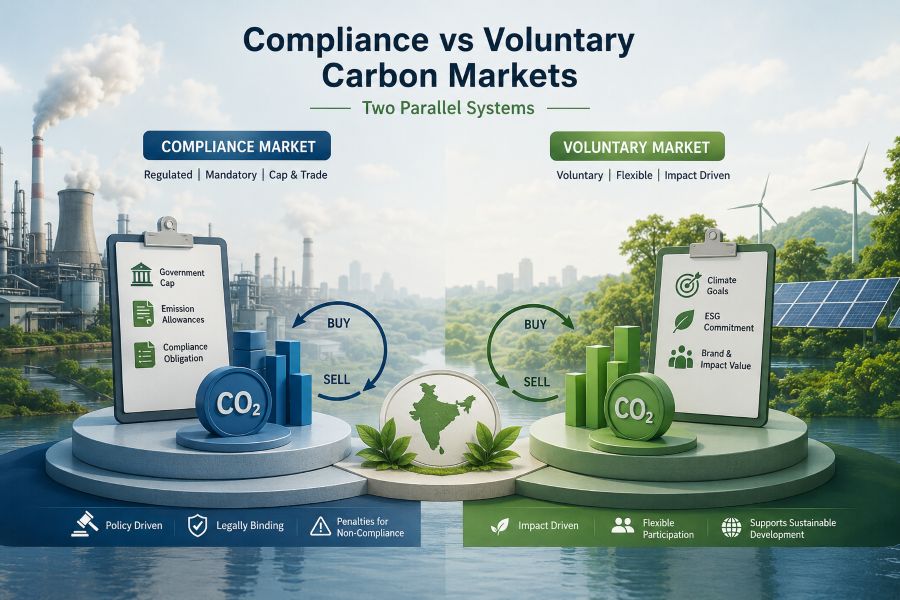
India's Carbon Credit Trading Scheme (CCTS), led by the Bureau of Energy Efficiency (BEE) under the Ministry of Power, aims to establish a national framework for measuring, trading, and incentivising emission reductions. As the system evolves, carbon credits are expected to play an increasingly important role in both compliance and voluntary climate action across sectors.
Understanding carbon credits is important not only for climate policy, but also for ESG strategy, net-zero targets, renewable energy finance, and emerging business opportunities linked to low-carbon development.
What a carbon credit means
A carbon credit is a tradable unit for one metric tonne of carbon dioxide equivalent, or CO2e, reduced, avoided, or removed from the atmosphere. The term CO2e is used because climate change is caused by several greenhouse gases, including carbon dioxide, methane, and nitrous oxide. Since these gases have different warming effects, they are converted into one common unit so they can be measured consistently.
This standardisation makes it possible to compare different climate actions using the same accounting unit. A project may reduce methane emissions from waste, prevent emissions by replacing coal-based electricity with renewable energy, or remove carbon through tree growth. In all of these cases, the climate benefit is expressed in tonnes of CO2e, and one tonne becomes one carbon credit.
For instance, a biogas project that helps rural households replace traditional fuels may reduce methane and other greenhouse gas emissions. Once those reductions are measured and verified, the project can receive carbon credits corresponding to the amount of CO2e avoided.
Different types of carbon credits
Not all carbon credits come from the same kind of project. One major distinction is between credits that reduce or avoid future emissions and credits that remove carbon from the atmosphere. A renewable energy project that replaces coal-based power is an example of an avoidance or reduction credit. An afforestation project that absorbs carbon through tree growth is an example of a removal credit.
Another important distinction is between nature-based and technology-based credits. Nature-based credits are linked to forests, land restoration, soil carbon, or ecosystem protection. Technology-based credits may come from industrial efficiency, methane capture, waste treatment, or engineered removal technologies. This distinction matters because buyers increasingly pay attention to permanence, biodiversity impact, and the reliability of measurement when choosing which credits to purchase.
Carbon credits and offsets are not the same
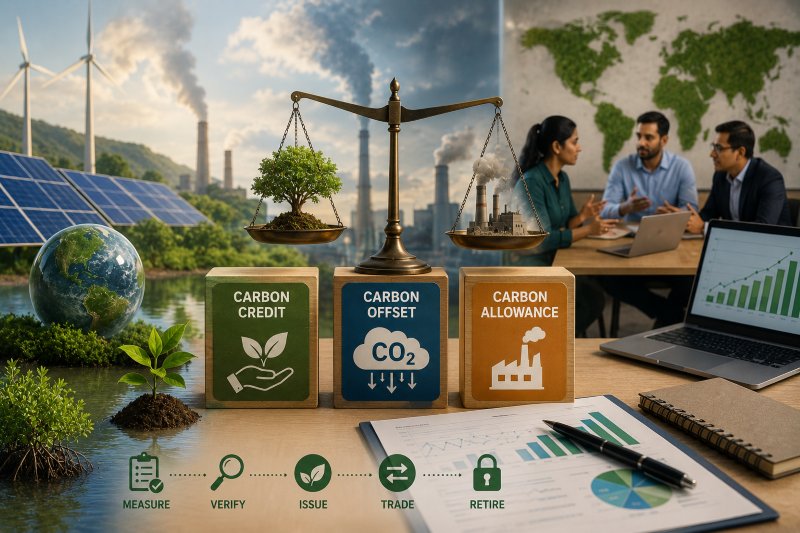
The terms carbon credit and carbon offset are often used as if they mean the same thing, but they are not identical. A carbon credit is the unit itself. A carbon offset is the use of that unit to compensate for emissions produced somewhere else.
This means a project developer creates or sells carbon credits, while a company buys and retires them if it wants to offset part of its emissions footprint. This distinction is important in business communication because buying credits does not automatically make a climate claim credible. The credits must be properly retired, transparently reported, and used in line with recognised standards.
Why credibility and integrity matter
A carbon credit only has value if the climate benefit behind it is real and trustworthy. This is why integrity has become one of the most important discussions in carbon markets globally. High-quality credits are expected to be measurable, independently verified, transparently tracked, and protected against double counting.
One major question is additionality. This asks whether the emission reduction would have happened even without carbon finance. If the project would have gone ahead anyway, then the carbon credit may not represent a genuine extra climate benefit. Other important issues include permanence, accurate quantification, strong verification, and registry systems that prevent the same credit from being claimed more than once.
Concerns around greenwashing have made these issues even more important. Low-quality credits can create the appearance of climate action without delivering meaningful impact. That is why markets increasingly focus on stronger standards, verification systems, and integrity principles.
At the same time, most climate frameworks emphasise that carbon credits should complement, not replace, direct emissions reductions. Companies are increasingly expected to reduce their own emissions first and use credits only for emissions that are difficult to eliminate.
Why carbon credits matter in India
India has a significant opportunity in the carbon economy because many sectors can generate or use carbon credits. Given India's scale, growing renewable energy capacity, large agricultural base, and extensive ecosystem restoration potential, the country is often seen as a major future participant in global carbon markets.
Renewable energy, afforestation, agriculture, waste management, industrial decarbonisation, and community-based climate projects all offer significant opportunities in the Indian context. This is especially important because carbon projects in India can link climate action with rural livelihoods, farmer incomes, women's participation, biodiversity conservation, and local development.
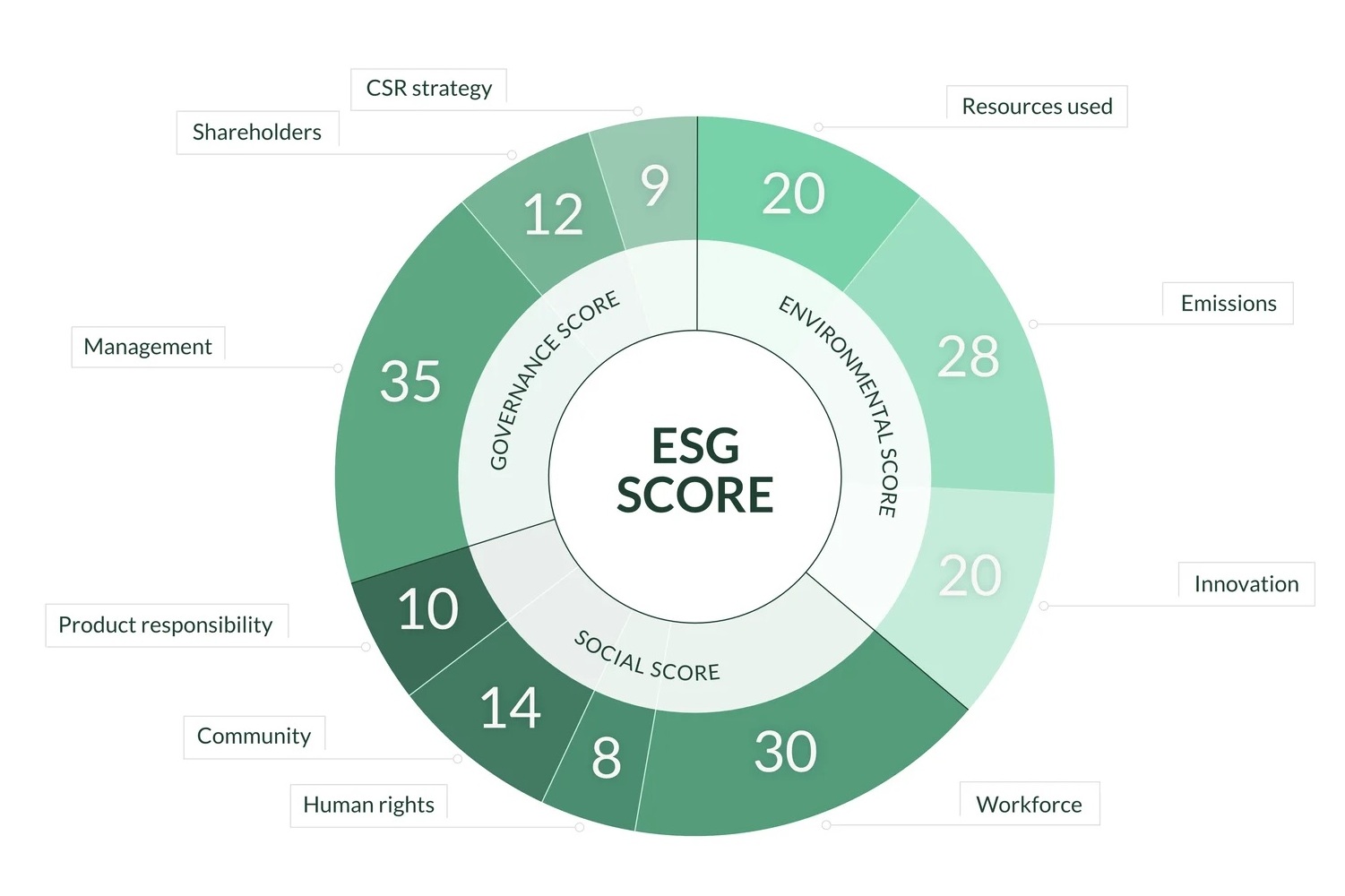
Carbon credits are also becoming more relevant for corporate strategy. They connect with ESG planning, climate disclosures, net-zero commitments, and broader sustainability reporting expectations. For Indian companies, this makes carbon credits more than just an environmental concept. They are becoming part of how businesses think about transition planning, climate claims, long-term competitiveness, and access to emerging low-carbon market opportunities.
Why carbon credits do not all have the same value
Although one carbon credit always represents one tonne of CO2e, not all credits have the same value in the market. Prices vary depending on the type of project, the credibility of the methodology, the quality of verification, the location of the project, the presence of social or biodiversity co-benefits, and market demand.
For example, a high-integrity removal credit with strong safeguards may be valued differently from a lower-confidence avoidance credit. This means carbon credits should not be seen as identical units in business terms, even if they are standardised in accounting terms. Their real value depends on quality, trust, and use case.
Key takeaways
- A carbon credit represents one metric tonne of CO2e reduced, avoided, or removed.
- Carbon credits can come from reduction projects or removal projects.
- Nature-based and technology-based credits are different and are assessed differently by buyers.
- A carbon credit is the unit, while an offset is the use of that unit to compensate for emissions.
- Credit quality depends on integrity factors such as additionality, verification, transparency, permanence, and protection against double counting.
- High-quality carbon credits depend on factors such as additionality, verification, transparency, and protection against double counting.
- In India, carbon credits are relevant to climate policy, ESG, net-zero planning, and opportunities across renewable energy, agriculture, waste, forestry, and community projects.