
Carbon Credits, Offsets and Allowances: Clearing the Jargon
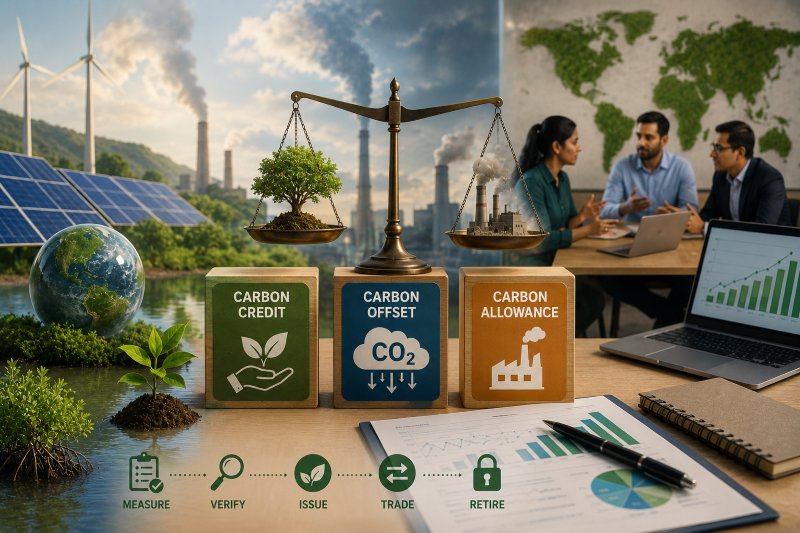
Carbon credits, offsets, and allowances are often used interchangeably, but they serve different purposes within carbon markets. Understanding the distinction can help businesses, NGOs, CSR professionals, and community-development practitioners navigate climate claims, carbon finance, and India's evolving carbon-market landscape.
Why These Terms Matter More Than Ever
A company may say it has become carbon neutral by buying carbon credits, while a factory operating under an emissions trading scheme may need allowances to comply with regulation. At first glance, both situations can sound similar, but they involve different market instruments, different rules, and different purposes.
This distinction matters not only for sustainability professionals but also for businesses, NGOs, CSR teams, social enterprises, and community-development practitioners. As climate action becomes increasingly linked with finance, policy, and development, understanding carbon-market terminology is essential for interpreting climate claims, assessing opportunities, and participating meaningfully in emerging climate-finance ecosystems.
Why the Social Sector Should Pay Attention
Carbon markets are increasingly relevant to the development sector because many climate-mitigation activities overlap with social and economic priorities. Projects linked to afforestation, community forestry, sustainable agriculture, waste management, clean cooking, mangrove restoration, rural renewable energy, and biogas can potentially attract climate finance through carbon-credit mechanisms when they meet approved standards and verification requirements.
For CSR professionals, NGOs, and social enterprises, this creates both opportunity and responsibility. Carbon markets may help channel additional funding into community-development projects and livelihood-linked interventions, but they also require careful design, transparent benefit-sharing, credible measurement, and a realistic understanding of what carbon finance can and cannot deliver.
As climate finance expands, organisations working on environmental restoration, rural livelihoods, and community resilience are increasingly likely to encounter carbon-market concepts in funding discussions, partnerships, and programme design.
Understanding the Three Core Concepts
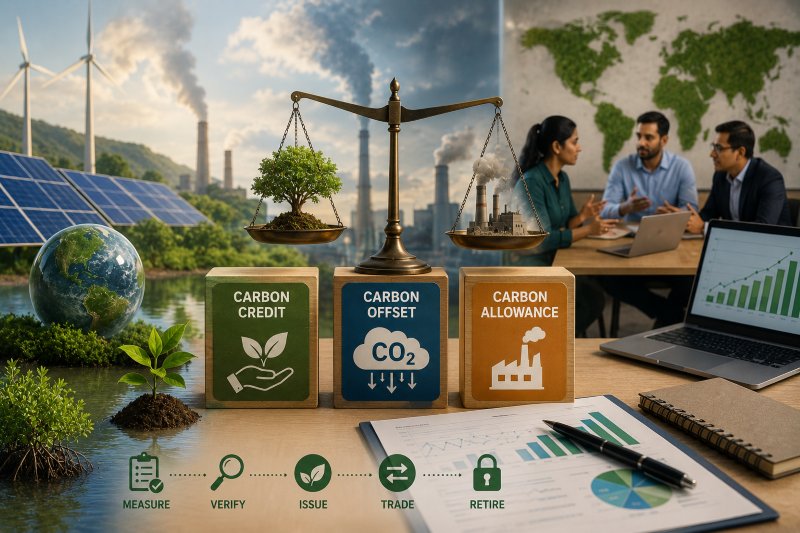
Although the terms are often used interchangeably, carbon credits, offsets, and allowances refer to different instruments and functions within the carbon-market ecosystem.
Carbon Credit
A carbon credit is a tradable unit representing a verified amount of greenhouse-gas emissions that has been reduced, avoided, or removed through a project or approved activity. Examples include renewable-energy projects, methane-capture systems, energy-efficiency programmes, afforestation initiatives, and mangrove restoration efforts.
Once the climate benefit has been measured, verified, and recorded under an approved methodology, the emissions reduction can be issued as a carbon credit. The credit itself is the tradable unit.
Carbon Offset
A carbon offset refers to the use of a carbon credit to compensate for emissions produced elsewhere. In other words, the credit is the instrument, while the offset is the claim or action made when that credit is retired against an emissions footprint.
A company may purchase carbon credits, but those credits only become offsets when they are retired and used to balance emissions that the company has not eliminated directly.
Carbon Allowance
A carbon allowance is a regulatory instrument used within a compliance carbon market or emissions trading system. It gives the holder the legal right to emit a specified quantity of greenhouse gases, usually one tonne of CO₂ equivalent, under a regulated cap.
Unlike carbon credits, allowances are generally not generated by climate projects. They are issued or auctioned by regulators and are used by covered entities to meet legal compliance obligations.
Carbon Credits, Offsets and Allowances at a Glance
|
Term |
What it is |
How it is created |
How it is used |
|---|---|---|---|
|
Carbon Credit |
A verified unit representing avoided, reduced, or removed emissions |
Generated through approved mitigation projects or activities |
Bought, sold, retired, or used for climate finance and carbon claims |
|
Carbon Offset |
The use of a carbon credit to compensate for emissions elsewhere |
Created when an existing credit is applied against an emissions footprint |
Used in carbon-neutral or compensation claims |
|
Carbon Allowance |
A regulatory permission to emit a fixed quantity under a compliance system |
Issued or auctioned by a regulator |
Used by covered entities to meet legal compliance obligations |
Not All Carbon Credits Are Created Equal
Carbon credits can originate from very different types of climate activities, and those differences can influence both quality and market value.
Some credits are linked to avoided or reduced emissions, such as renewable-energy projects, methane capture, energy-efficiency improvements, or clean-cooking interventions. Others are linked to carbon removals, including afforestation, reforestation, mangrove restoration, soil-carbon projects, and emerging engineered-removal technologies.
These project types differ in permanence, measurability, baseline assumptions, environmental integrity, social co-benefits, and risk of reversal. As a result, not all carbon credits are viewed equally by buyers, policymakers, investors, or civil-society organisations.
Understanding these differences is important because the credibility of a climate claim often depends not only on whether credits were purchased, but also on the quality and characteristics of the underlying project.
Related Terms That Often Cause Confusion
To fully understand carbon-market discussions, it helps to be familiar with a few related concepts.
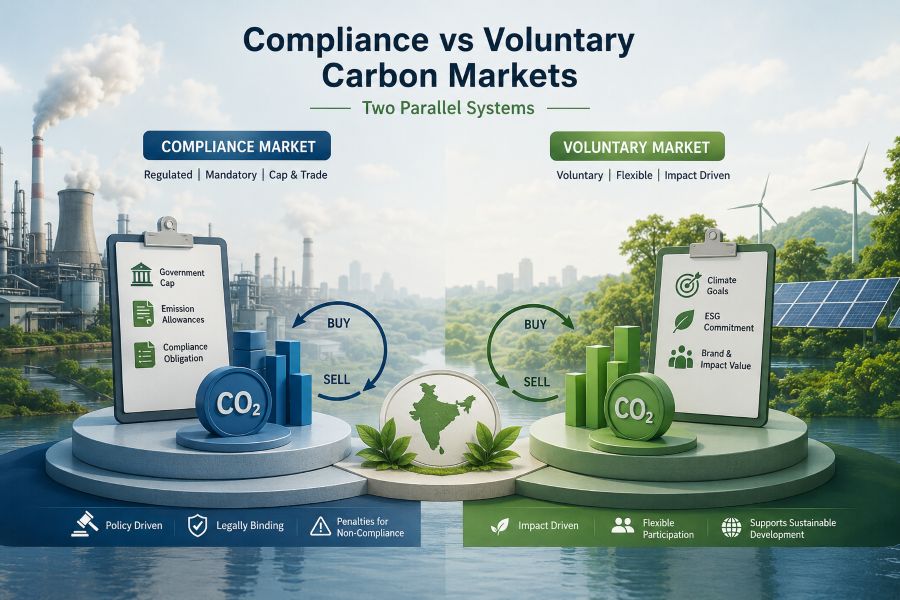
Compliance markets are regulated systems in which covered entities surrender allowances or eligible units to meet legal obligations.
Voluntary markets are systems in which organisations choose to purchase carbon credits, often to support climate commitments, sustainability goals, or project financing.
Registries are tracking systems that record the issuance, ownership, transfer, and retirement of carbon units, helping prevent double counting.
Retirement means a carbon credit has been permanently taken out of circulation after being used for a climate claim or emissions compensation.
Cap-and-trade is a regulatory approach in which a limit is placed on total emissions and allowances can be traded among covered entities.
These concepts help explain why the term "carbon market" can refer to very different institutional arrangements depending on the context.
India's Emerging Carbon-Market Landscape
India's carbon-market ecosystem is evolving rapidly.
On one hand, the country is developing the Carbon Credit Trading Scheme (CCTS), which is expected to create a compliance framework for emission-intensive sectors and strengthen the country's broader carbon-market architecture. Over time, this could bring more companies into formal carbon-accounting and emissions-management systems.
On the other hand, India has already been an active participant in voluntary carbon markets through projects involving renewable energy, afforestation, waste management, energy efficiency, and other climate-mitigation activities.
For businesses, carbon markets are becoming increasingly relevant as both a compliance issue and a strategic issue. Companies may need to understand future regulatory obligations while also navigating voluntary credit use, project development, disclosure requirements, and reputational considerations.
For NGOs, CSR programmes, social enterprises, and community organisations, the evolving ecosystem could create new climate-finance opportunities. At the same time, it will require stronger governance, transparency, community participation, and safeguards to ensure that benefits are distributed fairly and environmental outcomes remain credible.
The Debate Around Carbon Offsets
Carbon offsets remain one of the most debated aspects of carbon markets.
Supporters argue that well-designed offset projects can mobilise finance for climate action, support innovation, and direct resources toward sectors or communities that might otherwise struggle to attract investment. They see offsets as a practical tool for addressing emissions that are difficult to eliminate immediately.
Critics argue that some offset projects have overstated climate benefits, relied on weak assumptions, or allowed companies to postpone direct emissions reductions. Questions around additionality, permanence, transparency, and verification continue to shape discussions about offset quality and credibility.
A balanced view is therefore important. Carbon offsets are neither automatically credible nor automatically ineffective. Their value depends on the quality of the underlying project, the robustness of verification processes, and the way organisations use them within broader climate strategies.
Key Takeaways
- Carbon credits, offsets, and allowances are connected but not interchangeable concepts.
- Carbon credits represent verified emissions reductions, avoidance, or removals generated through approved projects.
- Carbon offsets describe the use of carbon credits to compensate for emissions elsewhere.
- Carbon allowances are regulatory units used within compliance carbon markets.
- Carbon credits can differ significantly in quality depending on project type, methodology, and environmental integrity.
- Carbon markets matter not only for sustainability teams but also for NGOs, CSR programmes, rural livelihoods, and community-development initiatives.
- India is building its domestic carbon-market architecture while continuing to participate in voluntary carbon-market activity.
- Understanding the terminology helps organisations evaluate climate claims, assess opportunities, and engage more effectively with emerging climate-finance systems.