
The World We Share: Rethinking Our Relationship With Nature
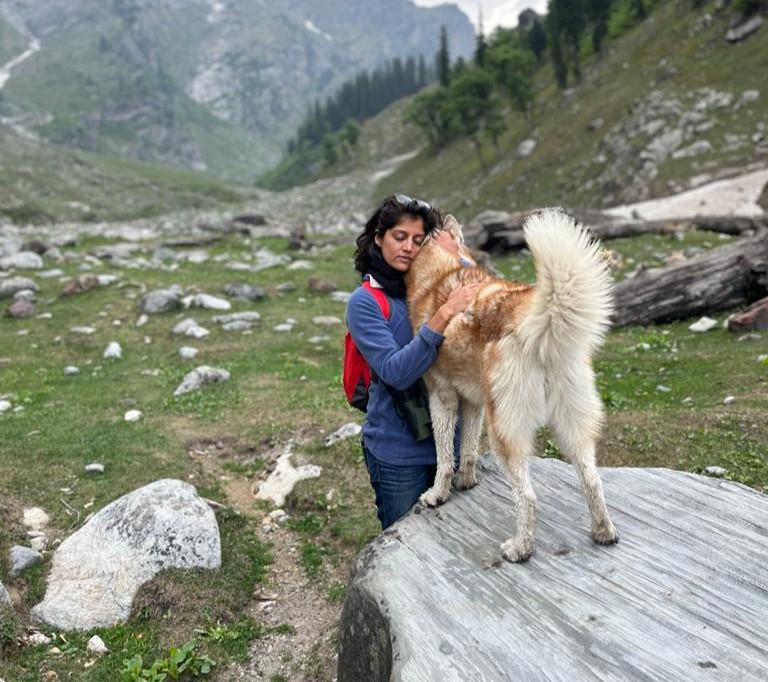
What changes when we stop seeing nature as something outside us and begin to recognise ourselves as part of it? This question lies at the heart of Oslo: A Tail of Promise, a documentary centred on the bond between Pooja Bhale and Oslo, a Siberian Husky, and the larger questions of coexistence, compassion and our relationship with the natural world.
For Pooja, however, these ideas extend well beyond the film. A conservation biologist, environmental educator and founder of Protecterra Ecological Foundation, she has spent nearly three decades helping people reconnect with nature through awareness, education and lived experience. Since 2015, she has called The Farm home, living in a canvas tent alongside more than 40 rescued animals. Through Protecterra, Pooja advocates ‘socio-ecological behavioural change’: encouraging more conscious, compassionate and sustainable choices.
In this thought-provoking conversation, she reflects on the deeper shifts needed for lasting environmental impact, the role CSR can play in enabling them, and why building a sustainable future may require us to rethink how we relate to the world around us.
Read the full interview below:
Q&A
Q. Your journey with Oslo forms the emotional core of this story. How did that relationship deepen your understanding of coexistence and the interconnectedness between humans, animals, and nature?
A. My journey alongside Oslo and back at the farm is pretty much the cornerstone of deepening all my understanding of interconnectedness and coexistence. Once you start living with nature, you realise that we are very much a part of nature. We are not above nature. The very same Earth that we all tread and walk on, and the very same sun that we all stand under, is the same for all of life.
I’m a visitor to this planet for a few decades. The Earth is 5.4 billion years old, and she nourishes us. She doesn’t need us; we need her.
Q. Through your work over the years, what are some of the most common misconceptions people hold about animals, and how do these perceptions influence the way we engage with the natural world?
A. I think the most common misconception humanity holds about animals is that, “Oh, they’re just animals.” They don’t feel deeply, they don’t understand deeply. They’re “just animals”, like they’re some lowly creature.
And it’s the same way we engage with the natural world as well, that nature is ours to use and abuse at will. I think that is a misconception that comes from a lack of connection.
Q. You have spent over three decades working on environmental awareness and coexistence. Do you think our ecological crisis is ultimately a crisis of policy and resources, or a crisis of empathy and disconnection from nature?
A. I’ve spent nearly 30 years working in environmental education and connecting people with nature. I started as a young teenager with my first movement for protecting trees in Pune, and I have been involved in that ever since. I was almost 13.
And I do believe that it’s not a duality of either-or. The crisis of empathy, a lack of compassion, and our requirement for greed, convenience, and swiftness continuously is certainly the driving force behind the larger scheme of things that we see.
But policy and resources most certainly need to be looked at to create change.
There is the inner work that has to be done for humanity on an individual and community level. And then, on a systemic level, systems need to enable more compassionate spaces, spaces that are more inclusive, spaces that hold nature at the centre of decision-making tables because, ultimately, we rely on her.
If our air, water, and food are not clean and safe for us, what is it that we are really aspiring towards?
Q. As organisations increasingly invest in sustainability and community development, where do you see opportunities for CSR initiatives to play a more meaningful role in fostering environmental awareness, coexistence, and behavioural change?
A. Corporate Social Responsibility is an incredible tool for corporations to mitigate their impact without really greenwashing it, but to genuinely pay attention to those players because it takes all kinds to make this human world.
Corporations have their jobs to deliver, and corporations, according to me, are not the evil. I think corporations wield an immense amount of power in doing things right. If they are asking for support, they need to have organisations that support and enable them to get it right and get it more mindful and compassionate.
In terms of specific CSR support, I do find a big gap in the fact that a lot of CSR still chases big numbers and big change. But there needs to be a shift, and it is happening already, towards impact work, long-term impact, and behavioural change.
Because eventually, just showing up and planting a million trees is valuable, but if those trees do not survive, then where have all that funding, all those resources, and all that human effort really gone?
Q. Protecterra advocates ‘socio-ecological behavioural change’. What does this mean in practice, and how do you measure its impact?
A. Our actions on an individual level, on a community level, and on a systemic level affect everything around us.
We are a human planet run by humans, for humans. There’s a beautiful quote that says, “Until the lions learn to write, history will always glorify the hunter,” which means the narratives that we have are also human-driven narratives.
So I genuinely believe that our basic behaviour, our practices, and the way we operate need to start changing towards socially just and equitable, and ecologically just and equitable, behaviours.
Under Protecterra, we run multiple initiatives that help our participants and our community start thinking about the actual impact that we have on the planet. What kind of choices are we making?
If I were to give an example, what we consume, where does it come from, what is the carbon footprint that it has, and how can we reduce that carbon footprint?
I’m not somebody who says, “No, don’t do this.” I believe in providing alternatives. If we don’t want to consume, let’s just take basmati rice. It is grown in a different part from where you are, perhaps, or it’s heavily polished, or it’s gone through several processes, but you still want to consume rice, then what is a more sustainable, local living alternative that we have?
That question can be asked across food, cosmetics, machinery, resources, and even human resources.
So, in practice, it’s having conversations and creating impact work that helps us start thinking, acting, and choosing better.
Measuring this impact is the big numbers game, and I think this is also a big CSR question mark: how do you measure the impact of behaviour?
You can only measure it over the long term. One has to trust the process, and one has to trust the fact that this is moving us towards more sustainable lifestyles, more sustainable thoughts, and more sustainable and mindful living.
There are multiple impact stories that we have: families choosing better options, people choosing to spend more time in nature, people choosing not to shop for animals and commodify them, and people changing their dietary systems.
So impact is measured on an inner and outer scale. How do our actions actually start impacting the planet, and are we able to reduce that impact? And am I experiencing inner change to be able to be more mindful?
Is my own mental health flourishing and improving when I spend time with nature?
There are many impact parameters that we use across all of our programmes.
Q. Many CSR initiatives focus on education, health, and livelihoods. In your view, why should reconnecting children and young people with nature also be seen as an important investment in building a more sustainable future?
A. The amount of CSR wealth and CSR commitment that actually goes towards animals and animal welfare specifically is considerably low.
A lot of money is now being pumped into climate impact because it’s coming home, right?
We spend a lot of CSR funds on STEM education and basic education, so I do think that there is potential for more connection work, for more behavioural change, as we just mentioned, more socio-ecological behavioural change work to really be supported.
Because it’s not a numbers game. It’s not something that’s going to show immediate impact, “Okay, we fed 20,000 people.” As important as that is, socio-ecological behavioural change work doesn’t show that kind of immediate outcome. That’s not the point.
So yes, I do believe that funds and corporations should start looking at investing in and supporting our youth and our children in reconnecting with the Earth and reconnecting with the ancestral values of where they come from in terms of ecology, environment, and coexistence.
Because at the end of the day, we do not only inherit this Earth from our ancestors, we’re borrowing it from our children. And to leave a sustainable planet to our children, we need to leave kinder children to our planet.
Q. At a time when conversations around climate change, biodiversity loss, and mental well-being are becoming more urgent, what role can stories like Oslo play in inspiring people to rethink their relationship with animals and the planet?
A. Oslo: A Tale of Promise and its associated partner movement, The Shared Planet, and everything that we intend to do with the film has a very important role to play.
The film can travel far and wide. There are limitations to individuals being able to travel far and wide. There are limitations to organisations continuously scaling up their work manyfold because scaling up has its own sustainability implications.
So the film can travel, create conversations, and enable people to really start thinking about how they can be changemakers in their own capacities.
The call to action of the film is very simple: Open your eyes.
Open your eyes to the world around you, to the nature around you, and to the animals around you.
It’s very unnatural that we don’t feel connected to nature. Our urban ecosystems and our urbanised lives have taken away our ability to look at our relationship with the planet and with animals.
The separation, the duality of nature and humans, animals and humans, is where a large part of the problem lies.
We are a part of this incredible shared planet. We are not separate from it, and we don’t own it or run it for ourselves alone.



.png)