
From Community Mentors to Changemakers: Two Young Women from Rural Bihar on Agency, Education and Choice
For young women in rural Bihar, education and mentorship can become pathways to greater agency—especially when they are supported by peers and communities that allow them to imagine different possibilities. The stories of Shweta and Rashmi, two former Edu-Leaders from i-Saksham’s Fellowship, illustrate how experiences of mentoring, education and peer support can shape choices around marriage, work and identity. Their journeys, shared at a gathering in Mumbai, also raise broader questions about what sustained support can mean for young women navigating social expectations in their communities.
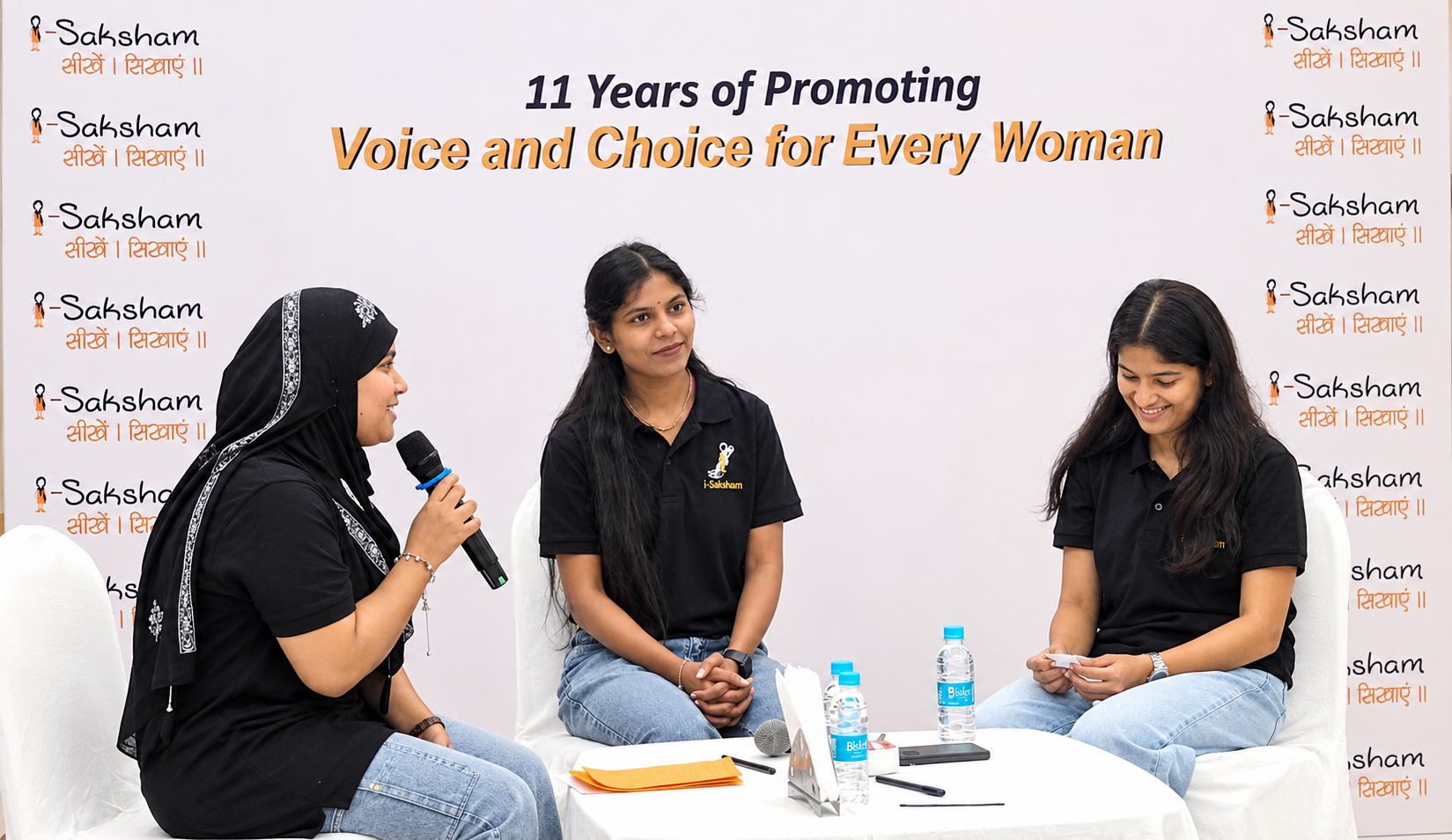
On a Thursday evening in Worli, Mumbai, the conversation was shaped not by presentations or statistics, but by the experiences of two young women from rural Bihar. Shweta and Rashmi, both former Edu-Leaders with i-Saksham’s Edu-Leader Fellowship, spoke about education, marriage, identity and the choices they have made in navigating their lives. Their stories were shared with more than 50 funders, advisers and social-sector leaders, offering a closer look at how young women’s aspirations can evolve when they have access to mentors, peer networks and opportunities to contribute to their communities.
Shweta, from Navdiha village in Bihar’s Jamui district, joined the Fellowship in 2021 after witnessing another Edu-Leader from her village mentor children and openly discuss issues that were not often addressed within families. The experience gave her an opportunity to work with children while developing her own confidence and understanding of what she could pursue. Her journey, however, later took her into circumstances that tested that confidence in a different way. In April 2024, a year after her Fellowship ended, Shweta experienced severe domestic violence from the beginning of her marriage. At a family panchayat in 2025, she was presented with a written agreement and asked to sign it. She chose not to sign the agreement and eventually left the marriage, with support from i-Saksham and the WAYAM Collective, a network of fellow Edu-Leaders.
Since then, Shweta has been working towards rebuilding her life through education and employment. She currently teaches English through the Freedom Employability Academy and is continuing to develop her own educational and career pathway. She is also set to join Azim Premji University for higher education. Reflecting on the choices she made, Shweta said, “No daughter needs to endure injustice at the cost of her life and her self-respect.” Her experience illustrates how agency can sometimes involve making difficult decisions and having the support systems necessary to follow through on them.
Rashmi’s journey has been shaped by a different set of circumstances. From Farda in Bihar, she has lived with vitiligo for six or seven years. For a long time, the condition became closely linked to conversations around marriage and how others viewed her future. Through the Edu-Leader Fellowship, Rashmi found a peer network in which she was able to participate, contribute and be recognised for her abilities rather than being defined primarily by her appearance. Her work as a mentor to adolescents in her community also helped others see her capabilities, while the experience gradually helped her develop greater confidence and self-acceptance.
As Rashmi became more comfortable with herself, she resumed her education. The change was not limited to her own outlook. Over time, her family’s concerns around her vitiligo and marriage gradually gave way to a greater sense of acceptance and pride in what she was doing. Today, Rashmi works as a member of i-Saksham’s communication team, where she shares stories of young women and girls from Munger. Her journey reflects how education, peer relationships and the opportunity to contribute meaningfully within a community can influence how a young woman sees herself and how others around her see her.
The experiences of Shweta and Rashmi also sit within a wider context in Bihar, where questions around early marriage, education and women’s agency remain significant. According to figures cited from the National Family Health Survey, the proportion of women aged 20–24 in Bihar who were married before the age of 18 has declined from around 41% in NFHS-5 to about 35% in NFHS-6. While the decline represents a change over time, the figure indicates that early marriage continues to affect a substantial proportion of young women in the state.
i-Saksham’s own alumni data also points to differences in education and employment trajectories among its Edu-Leaders. According to the organisation’s third-party impact assessment, around 90% of its Edu-Leaders continue their undergraduate education each year, compared with a state-level higher education participation figure of 17.7% cited from AISHE 2022–23. The organisation also reports that approximately half of its alumni move into paid employment with civil society organisations, corporates and government. These figures relate specifically to i-Saksham’s alumni and are not representative of young women across Bihar, but they provide an indication of the pathways followed by participants after the Fellowship.
The Mumbai gathering also offered an opportunity to reflect on what enables such journeys to continue beyond a programme. Opening the evening, i-Saksham CEO and Co-Founder Ravi Dhanuka recalled advice from long-time mentor Ujwal Thakar to “redefine the problem”. The reflection shifted the discussion from simply creating opportunities for young women towards considering whether they also have the agency, confidence and support required to make use of those opportunities. Long-time mentor Paresh Parasnis, founder of Samyak and former COO of HDFC Life, also addressed the gathering.
The conversation was moderated by Taniya, i-Saksham’s first-ever Edu-Leader, while Aanchal, a 2018–20 Edu-Leader who now works with the Foundation for Ecological Security in Gujarat, hosted the evening. Their presence reflected another aspect of the Fellowship’s alumni journey, with former participants continuing to take on roles that connect them to wider social and community work.
For Shweta and Rashmi, the Fellowship has been only one part of much longer journeys. Their experiences differ considerably, but both illustrate how opportunities to mentor others, continue education and participate in a supportive peer network can influence a young woman’s understanding of what is possible. In Shweta’s case, that support became important during a deeply difficult period in her personal life. For Rashmi, it contributed to a gradual shift in how she viewed herself and how her family and community responded to her.
Their stories also suggest that change does not necessarily happen through a single intervention or a single decision. It can develop through repeated experiences of being trusted with responsibility, meeting relatable role models, continuing education and having people around who provide support when circumstances become difficult. When young women are able to contribute within their communities, their families may also begin to see their capabilities differently.
The evening in Mumbai therefore moved beyond two individual stories to a broader question about how programmes, families and communities can create more space for young women to make informed choices about education, work and marriage. Shweta and Rashmi’s journeys do not offer a simple model for addressing the challenges faced by young women in rural India, but they demonstrate how sustained relationships, education and opportunities to lead can become important parts of an individual’s pathway towards greater agency.