
When Communities Become First Responders: How Himalaya Wellness Company and NIMHANS Are Rethinking Suicide Prevention
Suicide prevention is increasingly being recognised as a public health priority that cannot be addressed through clinical care alone. In communities where mental health services remain limited, stigma persists and suicide attempts often go unreported, early identification, community awareness and timely intervention can play a critical role in preventing loss of life. This makes suicide prevention a complex social challenge, requiring coordinated action across healthcare institutions, governments, civil society, communities and the corporate sector.
Project SURAKSHA, a community based suicide prevention initiative supported by Himalaya Wellness Company in partnership with NIMHANS and the Government of Karnataka, offers one such model. Its work in Ramanagara district combines community surveillance, frontline worker training, self harm registries, crisis intervention and referral systems to strengthen the local safety net around vulnerable individuals. The initiative also raises a broader question for India’s CSR ecosystem: how can corporate philanthropy move beyond short term awareness campaigns to support evidence based interventions that strengthen public health systems and remain sustainable over time?
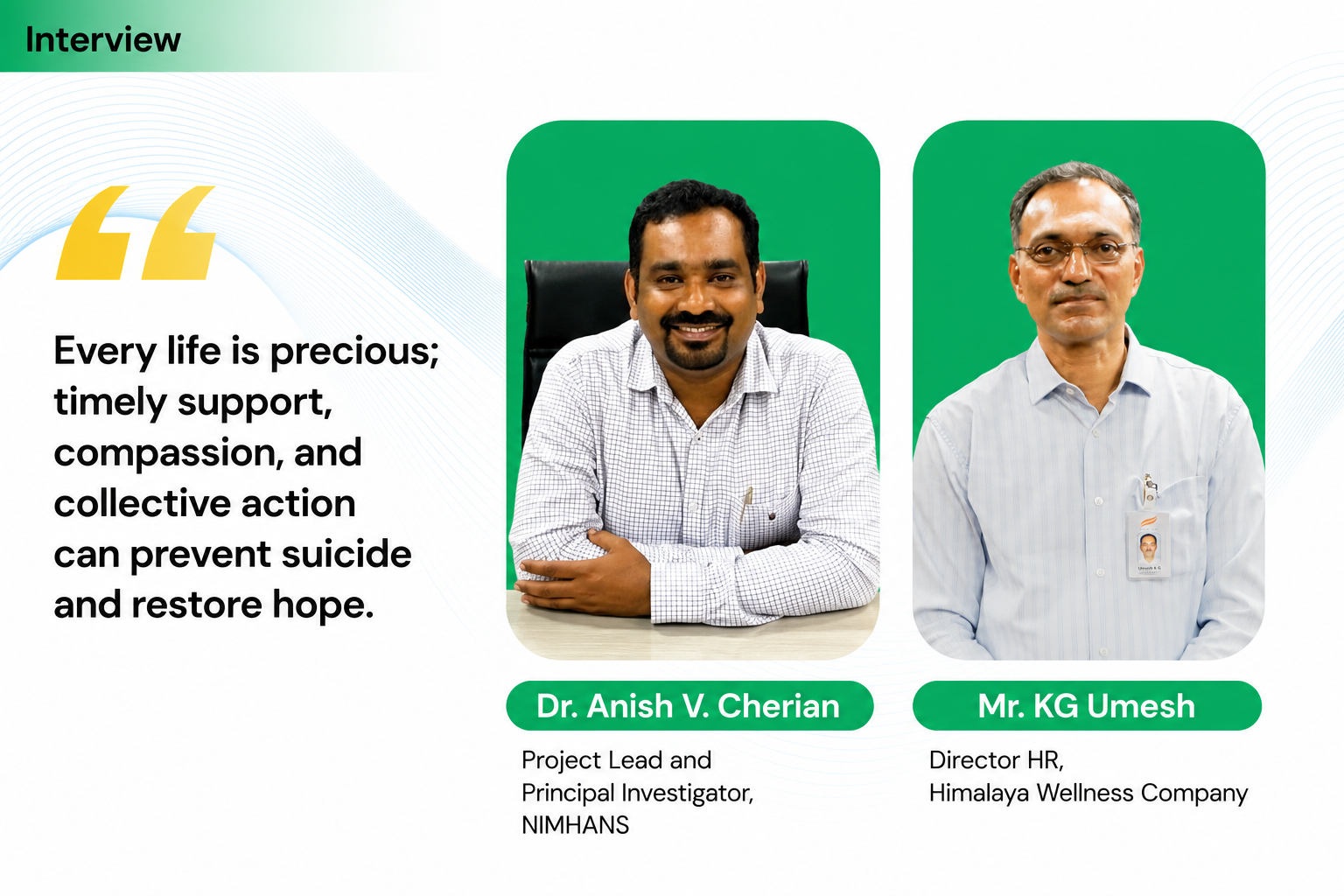
In this interview, Mr. KG Umesh, Director HR, Himalaya Wellness Company, and Dr. Anish V. Cherian, Project Lead and Principal Investigator, NIMHANS, discuss the role of CSR in suicide prevention, the importance of community ownership and cross sector partnerships, the lessons emerging from Project SURAKSHA’s pilot phase, and the need for more responsible media reporting on suicide. Their perspectives also underline the importance of building systems that can identify risk early, connect survivors with mental healthcare and eventually transition ownership to local institutions and communities.
Scroll down to read the full interview:
Q. Mental health and suicide prevention have traditionally been viewed as the responsibility of healthcare systems. How do you see the role of corporate social responsibility evolving in addressing complex public health challenges such as suicide prevention, particularly in underserved communities?
A. KG Umesh: Corporate Social Responsibility is evolving from a traditional funding role into a strategic enabler of systemic change in public health. At Himalaya Wellness Company, we believe that well-being extends beyond physical health. Mental health remains one of the most under-addressed public health challenges in India, particularly in rural and underserved communities, making it an important area for sustained intervention.
With Project SURAKSHA, Himalaya Wellness Company has exemplified this shift by supporting a comprehensive, community-led suicide prevention model in Channapatna Taluk of Ramanagara District, Karnataka, in partnership with NIMHANS and the Government of Karnataka. Rather than isolated awareness events, Himalaya Wellness Company, through their CSR, has funded multi-level interventions including a Community-Based Surveillance System across 32 panchayats, gatekeeper training for hundreds of frontline workers, and self-harm registries that reach underserved agrarian communities where stigma and limited services amplify risks. This approach strengthens public systems, builds local ownership, and delivers measurable impact, demonstrating how CSR can address complex challenges like suicide prevention with agility, sustained investment, and a focus on scalability in rural India. Having successfully completed the three-year pilot phase, we are now supporting the expansion of the model across all five taluks of Ramanagara district. This demonstrates how evidence-based CSR interventions can evolve from pilot projects into scalable public health solutions with district-wide impact.
Q. From your experience, what distinguishes impactful philanthropy in the mental health sector from conventional CSR initiatives, and what principles should organizations adopt when investing in sensitive social issues like suicide prevention?
A. KU: Impactful philanthropy in mental health stands apart through its emphasis on depth, evidence, and long-term ownership rather than short-term visibility. For us, success is not measured by the number of activities conducted, but by tangible improvements in awareness, help-seeking behavior, stigma reduction, and access to support services.
In SURAKSHA’s 2023-2026 pilot, this meant investing in rigorous case-control evaluations showing significant gains in suicide literacy, gatekeeper efficacy, and stigma reduction, alongside practical tools like the self-harm registry and Implementation Toolkit. Organizationsshould adopt principles of long-term partnerships with technical experts, co-design with communities, ethical sensitivity to cultural contexts, and a commitment to mixed-methods evaluation. By prioritizing sustainability from the outset through train-the-trainer models and system integration philanthropy transforms sensitive issues like suicide prevention into credible, replicable solutions that go beyond conventional CSR activitieswhich primarily focused on short term events or infrastructural supports alone. While these are important, it is high time that CSR move beyond this arena and touch the human life directly through a public health partnership. One of our biggest learnings has been that mental health programs cannot be approached as short-duration campaigns. They require patient capital, scientific partnerships, and long-term engagement with communities to create meaningful and sustainable change.
Q. India’s National Suicide Prevention Strategy calls for a whole-of-society approach. How important are cross-sector collaborations between healthcare institutions, governments, corporates, civil society organizations, and local communities in translating national policy into measurable grassroots outcomes?
A. KU: Cross-sector collaborations are indispensable for translating India’s National Suicide Prevention Strategy into tangible grassroots outcomes. As a wellness-focused organization, we recognize that no single institution can address complex challenges such as suicide prevention alone, making collaborative partnerships essential for achieving lasting impact. SURAKSHA illustrates this through seamless partnerships among NIMHANS (technical leadership), the Government of Karnataka (administrative integration), Himalaya Wellness Company (sustained CSR support), and local communities (CBSTs and panchayats). This whole-of-society model enabled training of 795 community gatekeepers, engagement of over 36,000 people, and establishment of surveillance and intervention systems that produced statistically significant improvements in help-seeking and stigma reduction. Such alliances combine policy reach, scientific rigor, flexible funding, and community trust delivering the coordinated action necessary for meaningful, measurable impact at scale.
Q. As Project SURAKSHA moves towards specialized support services and a train-and-transfer model involving local NGOs, what does long-term sustainability look like for such initiatives, and how can corporate philanthropy help institutionalize community mental health systems beyond the lifespan of individual CSR programs?
A. KU: Long-term sustainability for SURAKSHA lies in a train-and-transfer model that empowers local NGOs and embeds proven interventions into existing government systems, ensuring the program continues independently. As the project advances specialized services like postvention support and district-wide expansion, corporate philanthropy can catalyze this by funding NGO capacity building, refresher trainings, and policy advocacy to institutionalize elements such as Zero Suicide frameworks and Community Based Surveillance System (CBSS) within District Mental Health Programme (DMHP) and panchayat structures. By investing in people, evidence, and ecosystem building rather than project-specific deliverables, forward-looking CSR helps create resilient community mental health systems that endure beyond any single program cycle and strengthen India’s broader suicide prevention efforts.Ultimately, the success of Project SURAKSHA will bedefined by whether the systems, skills, and community networks created through the program continue to identify vulnerable individuals, provide support, and save lives long after the project has transitioned to local ownership.
Q. Project SURAKSHA is often cited as a pioneering community-based suicide prevention model. What were some of the key insights or lessons that emerged from the pilot phase that gave stakeholders the confidence to expand the program district-wide?
A. Anish V. Cherian: The foundation of SURAKSHA is the Community-Based Surveillance System (CBSS), a first-responder network of community members and frontline workers who are trained for the early identification and referral of persons at risk of suicide. Our study evaluating the effectiveness of CBSS has shown that the trainings have been highly effective in improving suicide literacy, reducing the stigma against suicide, and more importantly, strengthening the ability of community members and frontline workers to identify and respond to at-risk individuals. Community members have started reporting attempted suicides that otherwise go unrecorded, which allows the SURAKSHA team to provide interventions to the survivors. Similarly, the BISS (Brief Intervention of Self-harm and Suicidality) component of SURAKSHA has equipped the public healthcare system in Channapatna to systematically record suicide attempts and provide mental health referral to survivors. A total of 1,261 suicide attempts have been reported at the registries established under SURAKSHA in public healthcare institutions here. SURAKSHA team has provided crisis interventions and a rigorous 24-month follow-up for these survivors with the goal of reducing re-attempts. No re-attempts have been reported among this group so far, whereas several global studies show that 15-25% of those who attempt suicide are likely to re-attempt it.
IEC materials distributed to the larger community have also been effective. The 24X7 SURAKSHA helpline, popularized through print, online and social media, has received 193 calls until February, of which 33 were crisis calls requiring immediate interventions that the SURAKSHA team provided.
Overall, the pilot has provided evidence that a community-based program like SURAKSHA can be a model for suicide prevention in other Indian states and in other low- and middle-income countries. Most LMICs, including India, currently don’t have a reporting system for suicide/self-harm attempts, due to which suicide attempt survivors often don’t receive mental healthcare.
Q. One of the most significant aspects of Project SURAKSHA is its emphasis on empowering communities rather than relying solely on clinical interventions. How does community ownership strengthen suicide prevention efforts, and why is this approach particularly relevant for India?
A. AVC: Studies globally have shown that community-based multi-level interventions are far more effective in suicide prevention than any single intervention. Community-based interventions through their early identification of vulnerable individuals and strengthening of protective factors against suicide are particularly useful for prevention before a crisis occurs. In contrast, conventionally, the healthcare system intervenes only after a person makes a suicide attempt. Community-based interventions also make use of existing resources without requiring extensive funding, making them even more relevant for countries like India with limited resources including limited number of mental health professionals.
Q. The project has trained over 4,000 frontline workers and reached thousands of students and community members. From a public health perspective, what do these numbers tell us about the scale of awareness and capacity-building required to create an effective safety net for vulnerable populations?
A. AVC: Community members, frontline workers, students and teachers have largely welcomed the SURAKSHA training. Community-level workers such as ASHAs and ANMs, in particular, can be an important resource for suicide prevention given the general shortage of mental health professionals in India. They can be trained to detect mental distress and suicidal ideation among the populations they serve (expectant or new mothers, for example) and provide psychological first aid. From our pilot in Channapatna, we found that our trainingsincreased the suicide literacy and gatekeeper behavior of healthcare workers, including frontline workers; however, evaluations also revealed their complex attitudes towards suicide such as glorification that require more targeted components within the training.
Q. The program currently maintains self-harm registries across 69 hospitals and health centers and has reported no repeat suicide attempts among individuals who received intervention support. How should policymakers, CSR leaders, and public health practitioners interpret these outcomes, and what do they reveal about the value of early intervention models?
A. AVC: As mentioned earlier, 15-25% of those who attempt suicide make a re-attempt. A previous suicide attempt is the biggest predictor of a person’s death by suicide in future. This means, suicide attempt survivors are a high-risk population who should compulsorily receive mental health, to reduce re-attempts. The Mental Healthcare Act, 2017, also mandates the government to provide care, treatment and rehabilitation to those who attempt suicide. However, across India, the rate of survivors who receive mental healthcare after an attempt is low. The BISS component of SURAKSHA demonstrates that re-attempts can be brought down to negligible levels if hospitals systematically record the details of suicide attempt survivors and facilitate appropriate psychiatric referrals for them. It also demonstrates the effectiveness of the specific intervention SURAKSHA team provides to the survivors through brief intervention and telephonic follow-up).
Q. Ethical media reporting is increasingly being recognizedas a critical pillar of suicide prevention. In your view, where does Indian media stand today in balancing public interest with responsible reporting, and what improvements would have the greatest preventive impact?
A. AVC: As part of the pilot project, SURAKSHA team reviewed a total of 38,850 suicide-related local news reports in Kannada and English across 78 publications in Ramanagara district. A content analysis of 4,058 of these articles revealed widespread prevalence of harmful reporting practices such as descriptions of suicide methods, and absence of protective elements (such as linking the incident to mental health). The review revealed that the issue is systemic rather than localized, requiring urgent media-level intervention.
Q. For journalists and media organizations seeking to contribute positively to suicide prevention, what practical reporting frameworks, editorial safeguards, or storytelling approaches would you recommend ensuringcoverage informs the public without inadvertently increasing risk?
A. AVC: The WHO guidelines for responsible suicide reporting is a good resource for editors and reporters who seek to contribute positively to suicide prevention. There are resources for filmmakers by WHO too. The resources will help the editors and reporters to reduce the risk of glorification and sensationalizing suicide, both of which increases the risk of mass copycat suicides (suicide contagion) in the community.





.png)