Jindal Stainless’ Sustainability Journey: Balancing Industrial Growth with Environmental Responsibility
As India’s manufacturing sector expands, the steel industry faces the challenge of meeting growing demand while reducing its environmental footprint. Energy-intensive production, rising resource requirements and evolving global carbon standards are making sustainability an increasingly important part of business strategy. For steel manufacturers, the transition involves not just adopting cleaner energy but also rethinking production processes, resource use and long-term investments.
Jindal Stainless is addressing these challenges through investments in renewable energy, green hydrogen, energy efficiency and resource recovery. The company is also working to increase the use of recycled materials and reduce emissions across its operations.
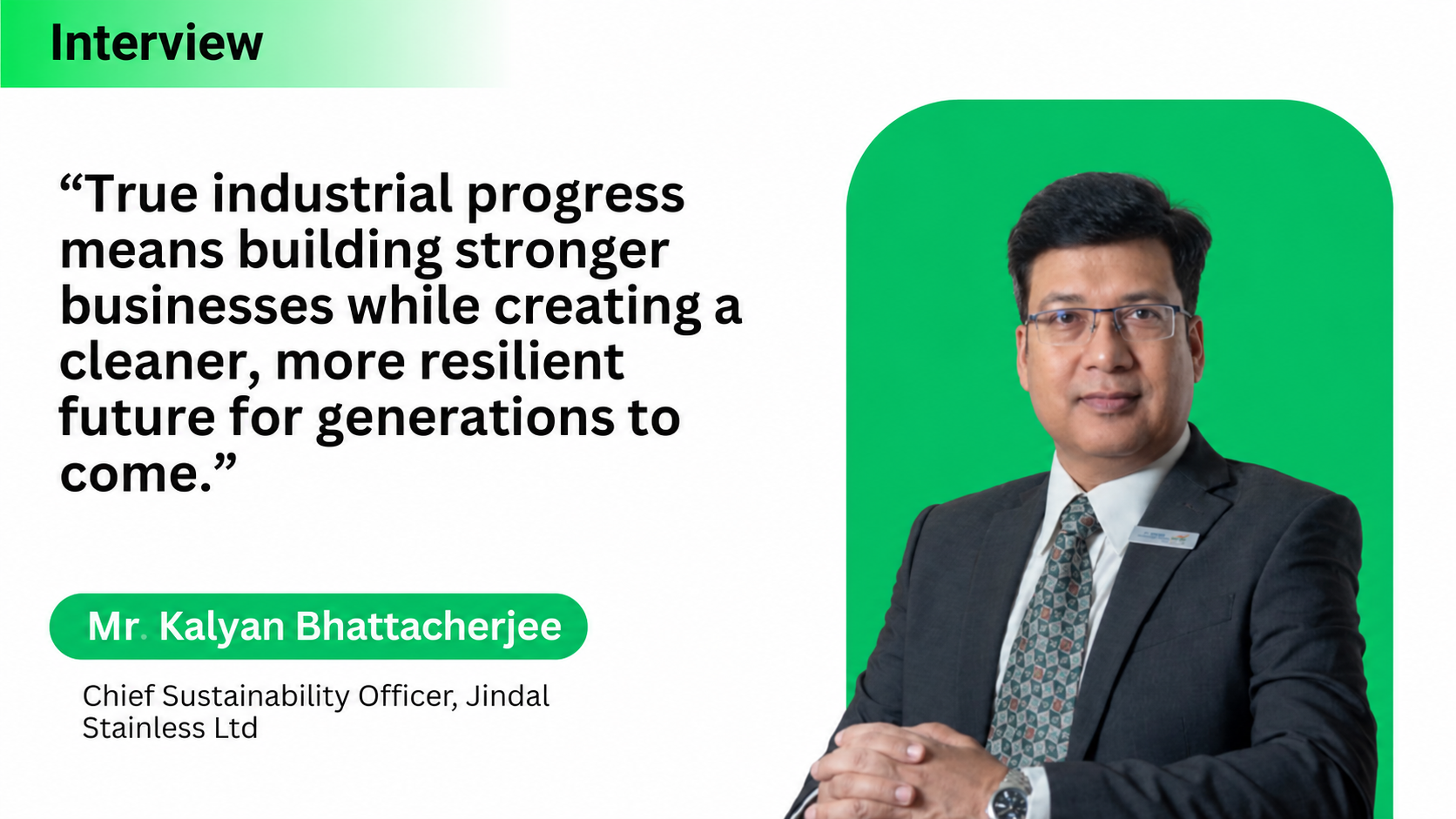
In this interview, Kalyan Bhattacherjee, Chief Sustainability Officer, Jindal Stainless Ltd, discusses the company's decarbonisation efforts, progress towards its sustainability targets and the practical challenges of making steel manufacturing more sustainable. He also shares his perspective on the role of industry-wide collaboration in India's transition to low-carbon manufacturing.
Read the full interview below.
Q. Sustainability in steel is increasingly becoming a question of competitiveness, not just environmental responsibility. How is Jindal Stainless integrating sustainability into its core business strategy and decisions around growth and investment?
A. Sustainability and competitiveness are not two separate conversations for us. How we produce stainless steel, use resources and manage our operations determines how resilient and competitive the business remains over the long term. Our growth strategy is also anchored in employee safety, capability building, community development and responsible engagement with stakeholders. Investments in people, workplace safety and surrounding communities help build a resilient workforce and strengthen our social licence to operate.
Sustainability considerations are supported by Board-level oversight, defined ESG responsibilities, robust risk management and transparent disclosures, helping integrate sustainability into business planning, capital allocation and operational decision-making.
This is reflected in how we are allocating capital. In FY26, we committed more than ₹700 crore towards decarbonisation projects across our operations. We also part-commissioned our 315.6 MW solar-wind hybrid project with Oyster Renewable Energy, our largest renewable investment to date. Once fully operational, it is expected to decrease roughly 6.5 lakh tonnes of CO2 ea year.
Sustainability is also being built into the manufacturing model itself. Our electric arc furnace-based production route uses approximately 70% scrap. Investments in renewable energy, green hydrogen, energy efficiency and resource recovery are helping reduce dependence on conventional energy.
As carbon performance increasingly becomes a factor in procurement and market access, the investments we make today will help us remain competitive in the future.
The larger objective is to ensure that sustainability is not a parallel agenda but a core business consideration – guiding where we invest, how we operate and how we pursue growth, while preparing Jindal Stainless for evolving customer expectations, regulations and market-access requirements.
Q. Jindal Stainless has set a Net Zero target for 2050, with a 50% reduction in Scope 1 and 2 emissions by 2035. What are the key levers that will help the company accelerate this transition, and where do you see the biggest challenges?
A. Our decarbonisation strategy is based on a combination of carbon avoidance measures and, over time, deeper decarbonisation solutions. The honest framing is that this isn't primarily an energy problem, it's a capital cycle problem. A furnace or melt shop is built to run for decades, so a retrofit decision made today locks in an emissions trajectory well past 2035.
Where we've made real progress is on the levers that don't require waiting for that capital window – renewable energy, energy efficiency, waste heat recovery, fuel substitution, green hydrogen, process optimisation and greater scrap utilisation. We have already seen measurable improvement in emissions and energy performance. GHG emission intensity declined by 18.14% between FY23 and FY26, while energy intensity improved by 14.29% over the same period.
The tougher trade-off is pace versus stability: deploying new technology on a live plant is genuinely difficult, you don't get to shut down for a refresh. And green hydrogen specifically is a deliberate economic bet – costs are still higher than conventional alternatives today, and every scale-up is a bet that they'll converge. We're absorbing that gap now because we'd rather be the one with the operating experience when the ecosystem matures than the one starting cold.
Q. What role do renewable energy, green hydrogen and energy efficiency play in Jindal Stainless’ decarbonisation strategy, and how is the company scaling these solutions?
A. Renewable energy, green hydrogen and energy efficiency each address a different part of our decarbonisation challenge.
Renewable energy is helping us reduce dependence on conventional power and improve the resilience of our energy mix.
Renewable electricity consumption has increased nearly 18-fold between FY23 and FY26. We have also advanced our 315.6 MW solar-wind hybrid project, which is expected to abate roughly 6.5 lakh tonnes of CO₂e annually once fully operational.
Green hydrogen is not a futuristic concept for us. Hydrogen has already been part of our stainless steel manufacturing processes, particularly in downstream applications where cracked ammonia was traditionally used. At Hisar, we have a 290 Nm³ per hour green hydrogen plant powered by renewable energy, replacing conventionally produced hydrogen. We have also expanded our green hydrogen infrastructure with a 600 Nm³/hour plant at Jajpur.
Energy efficiency is the least visible of the three but probably the steadiest. Our waste heat recovery boilers alone generate over 1.6 lakh tonnes of steam annually, saving about 26,700 tonnes of coal and cutting close to 44,500 tonnes of CO2 ea year, and we're adding another unit at Hisar.
Q. How is Jindal Stainless strengthening circularity across its operations and value chain, from the use of recycled materials to waste reduction and end-of-life recovery?
A. There's a distinction I keep coming back to, between stainless steel as a sustainable material and stainless steel as a sustainably made product. The first part is settled: over 85% of it is recovered and recycled at end of life without any loss in quality. The second part is where the real gaps sit. Production itself is still energy-intensive. Scrap quality and traceability constrain how far circular manufacturing can scale as high-grade stainless needs clean, well-segregated scrap, and collection infrastructure hasn't fully caught up. Scope 3 emissions and its impact across the value chain is something the whole industry under-tracks.
What we're doing about our own piece: scrap utilisation past 70% in our inputs and close to 1.94 million tonnes recycled or reused last financial year. We are also treating waste as a resource. Metals recovered from slag, grinding dust and ETP sludge are reused in production. Mill scale and bag-filter dust are also reused, while fly ash is utilised by cement and brick manufacturers and in infrastructure applications. At Jajpur, we are doubling our slag-processing capacity through our partnership with Harsco Environmental. This will improve metal recovery from industrial by-products and reintegrate the recovered material into production.
But closing the loop fully isn't a factory-level decision. It's an ecosystem shift, and it only happens if suppliers, recyclers and customers move together.
Q. With carbon regulations such as the EU’s CBAM changing the global manufacturing landscape, how is Jindal Stainless preparing for a future where carbon intensity increasingly influences market access and competitiveness?
A. Carbon intensity is not just a compliance requirement but is increasingly turning into a commercial variable and CBAM is one of the more visible signals of that. ESG-linked procurement is already how our European customers operate, and that tells you where this is headed regardless of which specific regulation is in force in a given year.
Our approach runs on two tracks: continue reducing actual intensity through renewables, hydrogen and efficiency, while building the reporting rigour CBAM and mechanisms like it will demand.
The objective isn't to get compliant for one regulation. The reality is that carbon performance is becoming a standard input to how customers and markets evaluate a supplier, and that shift outlasts any single policy.
Q. Looking back at its sustainability journey, what does Jindal Stainless consider its most significant achievements, what have been the biggest challenges, and what measurable impact have these efforts created for the environment, business and stakeholders?
A. It's been a portfolio, not a single bet – energy recovery, renewables, circularity, cleaner fuels and efficiency, all moving together rather than any one of them carrying the story.
FY24-25 alone saw over 3.18 lakh tonnes of CO₂e abated. Greenhouse gas emissions intensity is down 18.14% and energy intensity down 14.29% across FY23-26. We have also made progress beyond emissions. Water intensity declined by around 10% over the last three years, while renewable electricity consumption increased nearly 18-fold between FY23 and FY26.
The number I'd point to as the real external check is DJSI Corporate Sustainability Assessment score of 78 in FY26, above the global stainless steel industry average.
We have constantly also strengthened our workforce capabilities, instituted and evolved best people practices – whether at the workplace or with surrounding communities.
By bolstering our governance systems, to keep pace with evolving ESG expectations, regulations and disclosure requirements, we were successful in integrating ESG into decision-making and provided greater transparency and accountability to stakeholders.
Q. Beyond decarbonisation, how is the company addressing water, waste, biodiversity and resource efficiency to build more resilient and responsible manufacturing operations?
A. These initiatives are supported by a broader climate and sustainability risk-management approach, including disclosures aligned with the Climate Action Report (TCFD framework), which helps us assess and manage climate-related risks and opportunities alongside our resource and environmental priorities.
Water, waste and biodiversity don't get the airtime emissions does, but they're just as real a part of resilience. Both our Hisar and Jajpur plants run zero liquid discharge. Our water intensity declined from 7.26 m³/tcs in FY24 to 6.53 m³/tcs in FY26. Internal water recycling is undertaken across all our plants, and 5,09,640 cubic metres of rainwater was harvested during FY26. Our longer-term target is to achieve water neutrality by 2033.
Our predominantly scrap-based EAF production route, using approximately 70% scrap, further strengthens resource circularity and efficiency. On waste, we follow the principles of reduce, reuse, recycle and recover. In FY26, our Hisar plant even achieved a Zero Waste to Landfill platinum+ certification during the reporting period from FY 2024-25, for an exceptional waste diversion rate of 99.99%
We were also the first in the Indian iron & steel sector to publish a Task Force on Nature-Related Financial Disclosure (TNFD) report, with biodiversity plans specific to Jajpur, Hisar and Vishakhapatnam. As part of our nature-related initiatives, we planted close to 80,000 saplings in and around the plant areas in FY26.
Q. Looking towards 2035 and 2050, what does Jindal Stainless’ vision of a truly sustainable stainless steel business look like, and what role does the company hope to play in India’s transition to low-carbon manufacturing?
A. Our objective is to continue reducing the carbon intensity of our operations while making the transition economically and technically viable. The targets are clear: a 50% reduction in Scope 1 and Scope 2 GHG emissions by 2035, Net Zero by 2050, water neutrality by 2033 and no net loss of biodiversity.
But achieving this transition will require more than individual companies acting alone. Reliable clean baseload power will be important for energy-intensive industries. Greater availability of quality scrap will be important for increasing recycled content. Technologies such as carbon capture will need to become more commercially viable, and the right policy, infrastructure, financing and skills ecosystem will be necessary to support deeper decarbonisation.
The infrastructure opportunity in front of India is enormous – 500 GW of non-fossil capacity by 2030, infrastructure development for the 11000km coastline, 100 smart cities, a National Infrastructure Pipeline of 9,000-plus projects – and each of those are likely to contribute towards the increasing demand for stainless steel.
Stainless steel needs to move from a niche specification to a standard one, and that's mostly a demand-side problem. It accelerates sharply the moment government procurement starts asking for it, and that’s the direction India has been taking now. Sustainable manufacturing, at this point, is simply an intelligent choice for industrial growth and this will require both the ability to produce lower-carbon steel and the demand to support its scale.


.png)