Linking Sustainability with Livelihoods: V-Trans’ Approach to Responsible Logistics
India’s logistics sector is being called upon to balance the demands of economic growth with the environmental and social costs of moving goods at scale. As companies look beyond emissions and operational efficiency, the conversation is also expanding to include resource use, worker wellbeing, rural livelihoods and the resilience of communities connected to business operations. This is making sustainability less of a standalone CSR exercise and more closely linked to how businesses plan, operate and measure long-term value.
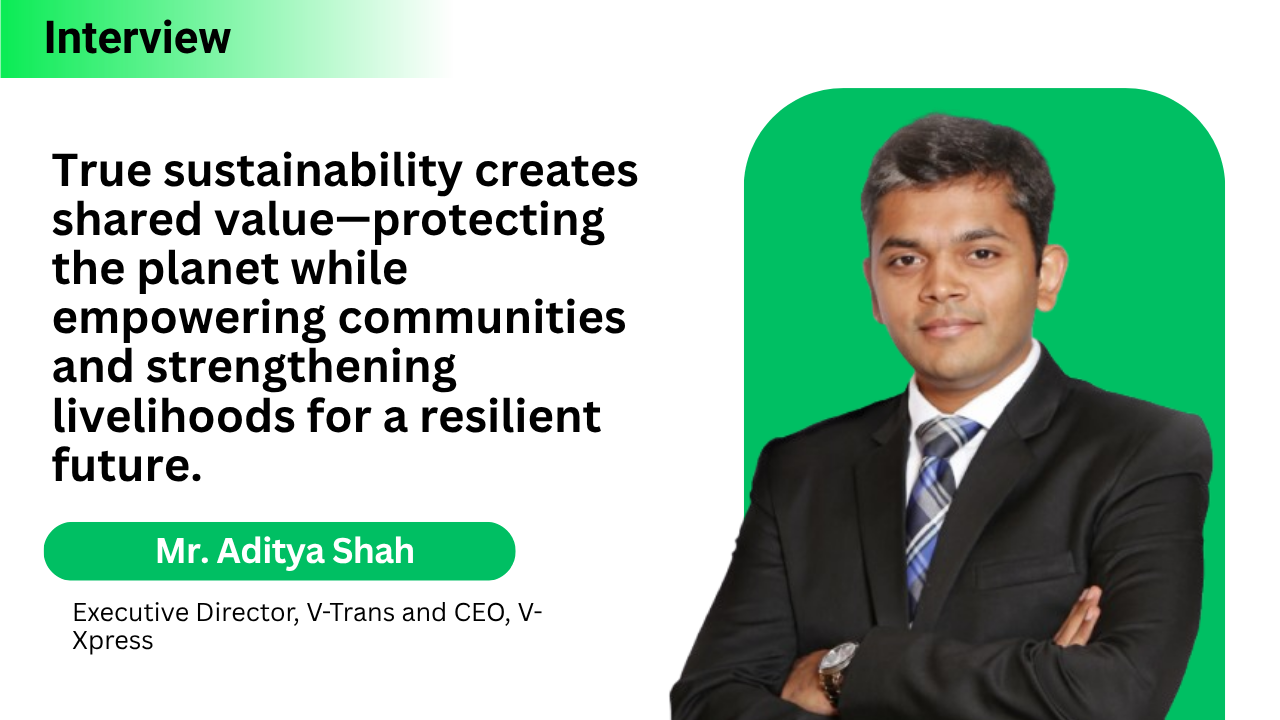
For V-Trans India Ltd, this approach is reflected in its work with farming communities through a fruit-bearing tree plantation programme across Rajasthan, Maharashtra and Gujarat. Rather than treating plantation as a one-time environmental activity, the company has linked it with recurring livelihood opportunities for farmers. In this interview, Aditya Shah, Executive Director, V-Trans and CEO, V-Xpress, talks about this livelihood-first approach, the challenges of scaling it across diverse geographies, and how V-Trans is integrating sustainability across operations. He also discusses digitalisation, cleaner mobility, sustainable infrastructure, impact measurement and the role of collaboration in advancing responsible growth in logistics.
Read the full interview below for insights into V-Trans’ sustainability and livelihood-focused approach:
Q. V-Trans has been integrating sustainability into its operations while also investing in community development. How do you see sustainability evolving from a CSR initiative to a broader business priority for the logistics sector?
A. A few years ago, sustainability at most logistics’ companies meant a CSR line item and not much else. That has changed. Customers now expect their logistics partners to actually showcase ESG commitments, not just mention them in a brochure. It also makes clear business sense: cutting emissions, digitising processes, and moving to renewable energy all bring down costs and make operations more resilient when disruptions hit. With a network our size, nearly 7 decades in the business and over a 1500+ branches, even small efficiency gains compound quickly across the system. Sustainability is no longer treated as a separate function here. It shapes how business decisions get made, how operations are run day to day, and how we approach community development.
Q. Your tree plantation programme takes a livelihood-first approach by working with farming communities. What led V-Trans to adopt this model, and how does it differ from conventional tree-plantation initiatives?
A. Most plantation drives follow the same pattern: plant a few thousand trees, take some photos, and move on to the next site. That model rarely leaves anyone better off, since the trees are seldom looked after once the cameras leave. We chose fruit-bearing species instead of ornamental or purely forest varieties because they keep paying farmers back year after year rather than just adding to a green cover count. The programme runs in partnership with farming communities across Rajasthan, Maharashtra and Gujarat. Land restoration is part of it, but the real objective is the recurring income it puts into farmers' hands. That is what sets it apart from a typical plantation event. It isn't a one-day activity; it is a relationship that has to be maintained over years. It also has a high potential to make farmers self-sustaining within 5–7 years, with benefits continuing throughout the lifespan of the trees.
Q. What impact has the plantation programme had on the livelihoods and incomes of participating farmers, as well as on the local environment?
A. The numbers so far: 21861 trees planted across 60.78 acres, with 42 farmers directly involved. That has translated into roughly 728 tonnes of produce, worth close to Rs 2.23 crore in economic value for these communities. On the environmental front, there is the expected list: carbon sequestration, oxygen generation, groundwater recharge, and improved biodiversity in the area. What matters more, though, is how these benefits compound over time. A tree planted this year is still producing fruit five years from now, still recharging groundwater, still generating income for a farmer. It is not a one-time gain; it keeps growing.
Q. What have been the key challenges in implementing and scaling this programme across three states?
A. There have been a fair number of challenges, honestly. Just getting trees to survive their first couple of years takes consistent maintenance, and that is not guaranteed anywhere. Rajasthan's soil and climate look nothing like Gujarat's or Maharashtra's, so an approach that works well in one state needs reworking in the next. Keeping farmers engaged past the initial planting day, rather than treating it as a one-time visit, takes ongoing relationship-building. Coordinating and monitoring sites that are hundreds of kilometres apart across three states adds another layer of complexity. And since the real payoff only becomes visible after 2nd year, proving the model works takes patience that cannot be rushed.
Q. How is V-Trans using technology and operational efficiencies, alongside initiatives such as fleet optimisation and sustainable warehousing, to reduce the logistics sector's wider environmental footprint?
A. A few things are running in parallel here. On the paperwork side, we have moved to e-Bills, e-PODs, e-Invoices, and digital payments, which does not sound like much until you see how much paper a logistics operation our size generates without it. Most of that runs through Vijayant, our own ERP system, which gives us real-time visibility into every shipment and helps us plan routes and loads efficiently instead of sending out half-empty trucks. On the fleet side, we are gradually adopting cleaner mobility solutions, including CNG and electric vehicles, while also focusing on efficient fleet maintenance and lifecycle management. These efforts, combined with digitalisation and sustainable warehousing, help us reduce emissions and improve operational efficiency. Separately, solar power, rainwater harvesting, and energy-efficient buildings have been part of the investment as well; our corporate office is LEED-certified. No single initiative here is a breakthrough on its own, but stacked together, they bring the overall footprint down meaningfully.
Q. How does V-Trans integrate sustainability and community impact into its broader business strategy, beyond individual CSR initiatives?
A. We have tried to avoid treating sustainability like a separate department that reports back once a year. It runs through operations, our people, infrastructure, and governance – the whole structure. Our ESG principles inform how we grow and how we work with communities, and that stretches across green logistics, employee wellbeing, road safety, education, and rural development. Take Dignity to Drivers, our driver welfare programme, as an example. It has been running for years and covers health camps, training and counselling, and clean rest facilities at our major locations. Drivers are the backbone of this business, so their wellbeing is not a side issue; it directly shapes service quality. Between that, our governance work, and the environmental side of things, sustainability does not sit in its own corner here. It is built into how the business actually runs. The goal is creating value that reaches customers, employees, communities, and the environment together, not picking one over the rest.
Q. How do you assess whether sustainability initiatives are creating lasting impact rather than becoming one-time interventions? Are there specific targets or metrics that guide V-Trans's approach?
A. We track two sets of numbers side by side. On the environmental side, there are trees planted, areas restored, carbon sequestered, oxygen generated, and water infiltration levels. On the human side, there is farmer participation, how much they are producing, and whether their income is actually going up over time. We also track things like how much renewable energy we have adopted and how far the green fleet has expanded. What we are watching out for is the trap of doing something that looks impressive for one quarter and then fades from view. A metric only means something if we are still checking it three or four years later, so that is the discipline we try to hold ourselves to. For example, we track metrics such as tree survival rates, the area restored, carbon sequestered, the growth of our CNG and electric vehicle fleet, and the increasing adoption and generation of renewable energy, particularly solar power.
Q. What is V-Trans's larger sustainability vision, and what will it take to make responsible and inclusive growth a more integral part of India's logistics sector?
A. We want to keep moving toward lower-emission logistics, cleaner fleets, and better green infrastructure and get there faster than we have so far. That means more renewable energy, tighter resource use, and taking our livelihood programmes to communities beyond the three states we are currently in. Digitisation is going to keep mattering too: less paper, less waste, tighter operations. But none of this becomes the industry norm just because one company does it well. It takes customers, partners and policymakers all pulling in the same direction at the same time. That is really the ecosystem we are trying to help build, one where growth does not have to come at the cost of responsibility, and vice versa. Also, we believe that the ultimate beneficiaries of our ESG efforts should be the environment and society. We see ESG as a shared responsibility and a result of genuine collaboration, where small efforts, when brought together, can create a meaningful and lasting impact.


.png)