
IMI Kolkata: Taking Management Education to Rural Enterprise
Rural entrepreneurship is increasingly emerging as a critical pathway to inclusive economic growth, particularly as women-led Self-Help Groups move beyond livelihood support towards enterprise creation and market participation. With millions of rural women already organised through the Self-Help Group ecosystem, the next challenge lies in building the managerial capabilities, digital readiness, market access and local support systems required to help these enterprises become sustainable and scalable.
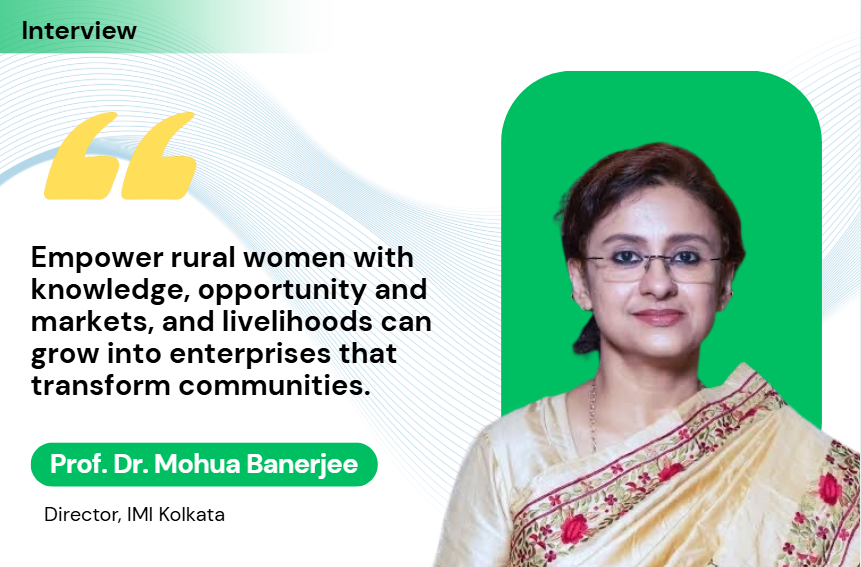
In this context, business schools have an opportunity to extend their role beyond preparing corporate leaders and contribute directly to grassroots economic transformation. IMI Kolkata’s partnership with the West Bengal State Rural Livelihood Mission reflects this evolving approach, using management expertise to strengthen the ecosystem of rural enterprise facilitators and women entrepreneurs. Prof. Dr. Mohua Banerjee, Director, IMI Kolkata, discusses how the institution’s Rural Incubation Model seeks to build local capacity through Business Development Service Providers and grassroots mentors, integrate technology and business management into rural enterprise development, and create pathways from livelihood activities to scalable businesses. She also outlines the larger potential of public, private and academic partnerships in advancing rural innovation, strengthening women’s entrepreneurship and reimagining CSR as a long-term investment in enterprise growth and sustainable livelihoods.
Scroll down to read the full interview:
Q. Management education has traditionally been associated with corporate leadership. How do you see business schools evolving into institutions that also address pressing social and developmental challenges, particularly in rural livelihoods and inclusive economic growth?
A. The purpose of management education is being redefined globally. Accreditation bodies now measure business schools not only by the corporate leaders they produce, but by their societal impact. For India, pursuing the vision of Viksit Bharat 2047, this shift is not optional – it is imperative. The country’s biggest developmental challenge is transforming the rural economy into one that is resilient, innovation-driven, and inclusive; and that requires moving from creating beneficiaries to creating entrepreneurs.
The Deendayal Antyodaya Yojana – National Rural Livelihoods Mission (DAY-NRLM) has mobilised over 10 crore rural women into Self-Help Groups. The next frontier is helping them graduate from subsistence-level activity to enterprises that are sustainable, profitable, and scalable – and this is precisely where business schools can add distinctive value.
Our core expertise – entrepreneurship, strategy, finance, marketing, and operations – can be contextualised for rural enterprise. Through practice-oriented capacity-building programmes, Management Institutes can equip rural women entrepreneurs with essential skills: customer segmentation, financial management, pricing, digital marketing, business planning, and technology adoption. Equally critical is strengthening the last-mile mentoring ecosystem – Business Development Service Providers (BDSPs) and Community Resource Persons for Enterprise Promotion (CRP-EPs) – who support thousands of enterprises on the ground.
At IMI Kolkata, we believe management education must extend beyond the classroom to become an instrument of inclusive development. By combining academic rigour with field-based incubation, mentoring, and innovation, business schools can nurture rural entrepreneurs who generate employment, strengthen local value chains, and drive inclusive growth – making Management Institutions catalysts for both economic competitiveness and social transformation.
Q. IMI Kolkata has consciously positioned management education as a catalyst for grassroots development through its partnership with the West Bengal State Rural Livelihood Mission. What inspired this strategic shift, and how does it align with the institution’s broader philosophy of creating social impact?
A. Entrepreneurship development has long been a core area of IMI Kolkata’s thought leadership. While our primary mission is to nurture future business leaders, we made a conscious strategic choice to extend that mission – recognising that management education must also address India’s developmental challenges and help build an inclusive economy. It was a deliberate decision to look beyond the corporate boardroom and direct our expertise towards the grassroots.
That conviction led to our partnership with the West Bengal State Rural Livelihood Mission (WBSRLM), under the Department of Panchayat and Rural Development, Government of West Bengal. IMI Kolkata has been entrusted as the Technical Support Agency (TSA) to build the capacities of Business Development Service Providers (BDSPs), Community-Based Organisation (CBO) representatives, and mentors across 9 One Stop Facilitation (OSF) Blocks spanning 8 districts, through a comprehensive curriculum on Enterprise Promotion, Business Development, and Rural Entrepreneurship.
For us, this is far more than a training programme – it is management education applied to create measurable social impact. By equipping grassroots facilitators with modern management practices, business diagnostics, digital technologies, and mentoring skills, we are strengthening the ecosystem that supports thousands of women-led nano and micro enterprises.
Our broader vision is to cultivate a culture of innovation and entrepreneurship not only among our students but across the youth and aspiring entrepreneurs of Eastern India. Sustainable rural transformation will happen only when women entrepreneurs can build enterprises that are innovative, profitable, and scalable. Through this partnership, IMI Kolkata is demonstrating how a business school can move beyond the conventional classroom to become a catalyst for grassroots entrepreneurship, rural innovation, and inclusive growth.
Q. Rather than working directly with entrepreneurs, the programme focuses on strengthening Business Development Service Providers (BDSPs) and grassroots enterprise mentors. Why is investing in local capacity builders a more sustainable approach to rural entrepreneurship development?
A. Lasting rural transformation cannot be achieved through short-term interventions alone. India’s rural enterprise ecosystem is vast – over 10 crore women are associated with Self-Help Groups under DAY-NRLM – and no institution can reach them directly. What the ecosystem needs is a strong cadre of trained grassroots professionals who provide continuous handholding, mentoring, and business advisory support. Investing in these local capacity builders is how impact multiplies.
IMI Kolkata has therefore developed structured Entrepreneurship Development Programmes for both women entrepreneurs and grassroots facilitators – Business Development Service Providers (BDSPs) and Community Resource Persons for Enterprise Promotion (CRP-EPs) – that is anchored in our Rural Incubation Model, which operates across three interconnected stages – Pre-Incubation, Incubation, and Acceleration.
In the Pre-Incubation stage, trained BDSPs and CRP-EPs work with entrepreneurs in their own villages – identifying business opportunities, conducting enterprise diagnostics, preparing business plans, facilitating access to finance, enabling digital adoption, and strengthening market linkages. A single trained facilitator can mentor 100-150 women entrepreneurs, making the model highly scalable and cost-effective. Promising enterprises then move into the Incubation stage, receiving structured mentoring, technology support, business formalisation, and growth planning. High-potential enterprises enter the Acceleration stage, where they gain investment readiness support, market expansion assistance, and connections with investors and accelerators.
Our objective goes beyond helping women become ‘Lakhpati Didis’ – we aim to build a pipeline of ‘Millionaire Didis’ and ‘Crorepati Didis’through sustainable, innovation-driven, scalable enterprises. By investing in local capacity builders, we are embedding knowledge and entrepreneurial support within rural communities themselves – creating a self-sustaining ecosystem that continues to drive enterprise growth long after the programme concludes.
Q. The curriculum combines conventional business management concepts with digital commerce platforms, AI-enabled business planning, financial literacy, and regulatory compliance. How important is this blend of technology and management education in preparing rural enterprises for long-term competitiveness?
A. Innovation is the key to building sustainable and scalable rural enterprises. At IMI Kolkata, our mentoring philosophy centres on introducing innovation at every stage of an enterprise’s value chain – from product design and sourcing to production, branding, marketing, sales, and customer engagement. The objective is not merely to improve existing businesses, but to make them competitive, resilient, and future-ready.
For today’s rural entrepreneur, technology is no longer a luxury – it is a necessity. The rapid expansion of internet connectivity, smartphone penetration, digital payments, and banking services has opened unprecedented opportunities for rural businesses to access larger markets, improve operational efficiency, and make data-driven decisions. When traditional entrepreneurial skills are combined with modern management practices and digital tools, the results are tangible: higher productivity, lower costs, wider customer outreach, and stronger profitability.
This is precisely why our curriculum integrates core management concepts – financial literacy, unit economics, business planning, marketing, and regulatory compliance – with emerging technologies such as digital commerce platforms, artificial intelligence, social media marketing, and digital bookkeeping tools. We want entrepreneurs to know not just how to run a business, but how to leverage technology to solve local problems, strengthen their value chains, and identify new market opportunities.
Ultimately, bridging the digital divide is about far more than technology adoption – it is about creating equal economic opportunity. By equipping rural entrepreneurs with both managerial capability and digital competency, we help them build innovative, sustainable, and investment-ready enterprises that contribute meaningfully to rural prosperity and India’s journey towards Viksit Bharat 2047.
Q. Women-led Self-Help Groups have demonstrated immense entrepreneurial potential but often face systemic barriers to scaling their enterprises. From your perspective, what are the biggest structural challenges they encounter, and how does this initiative seek to bridge those gaps?
A. Women-led Self-Help Groups have played a transformative role in financial inclusion and social empowerment across rural India. Yet the transition from collective savings and livelihood activities to commercially successful enterprises remains difficult – and the barriers are structural, not attitudinal.
The first is how SHG enterprises are formed – based on social cohesion rather than complementary business capabilities. Members bring varying levels of entrepreneurial aptitude, technical skill, and commitment, which makes collective decision-making slow and often ineffective. The second is leadership discontinuity – leaders of SHGs, Village Organisations, and Cluster Level Federations are elected for fixed tenures, and each transition can disrupt business continuity and long-term planning. The third is limited exposure to fundamental business concepts – customer segmentation, pricing, financial management, branding, market development, digital commerce, regulatory compliance, and technology adoption. Without structured, market-oriented mentoring, many enterprises remain at subsistence level.
Our Rural Incubation Model addresses each of these gaps. While we continue to support group enterprises, we also work closely with high-potential individual women entrepreneurs, who often emerge as local business champions and job creators within their communities. The programme delivers structured capacity building, enterprise diagnostics, customised mentoring, business planning, market and credit linkages, digital transformation support, and innovation-led interventions. Critically, we are also developing a cadre of Business Development Service Providers (BDSPs) and grassroots enterprise mentors who provide continuous handholding at the village level – ensuring women receive ongoing guidance, not one-time training.
Our objective is to help women-led enterprises evolve from livelihood activities into competitive, profitable, scalable businesses – a pathway from ‘Lakhpati Didi’ to ‘Millionaire Didi’ and eventually ‘Crorepati Didi’. By strengthening both the entrepreneurs and the ecosystem around them, rural women can become powerful drivers of inclusive growth and innovation.
Q. The programme is designed to create an ecosystem rather than deliver a standalone training intervention. What are the essential components of a thriving rural entrepreneurship ecosystem, and how does this partnership aim to strengthen each of them?
A. Training alone cannot create successful entrepreneurs. Sustainable rural entrepreneurship requires an ecosystem that supports enterprises continuously – from the idea stage through growth to investment readiness. This philosophy is embodied in our vision of ‘One Village One Startup’: every village nurturing at least one innovation-driven enterprise that creates employment and solves local challenges.
A thriving rural entrepreneurship ecosystem rests on five interconnected components. First, right selection – identifying promising sectors and high-potential entrepreneurs with the ambition and capability to grow. Second, structured incubation – continuous, customised mentoring rather than one-time training, because every business is different and needs its own enterprise diagnostics, business planning, technology adoption, financial guidance, and growth strategy. Third, access to markets – rural enterprises often produce quality products but struggle to reach profitable buyers, so we connect them with institutional purchasers, digital commerce platforms, B2B opportunities, and value chain partners. Fourth, access to finance – enabling working capital and growth investment at each stage of the journey. And fifth, a strong mentor network – subject matter experts, industry practitioners, academic and financial institutions, government agencies, and startup ecosystem partners, with the right mentor matched to the right enterprise through consistent, milestone-based engagement.
Through this partnership, we are strengthening all five components in an integrated manner – combining capacity building, incubation, technology adoption, market and finance linkages, business formalisation, and acceleration support into one continuous growth pathway. Our objective is not to create isolated entrepreneurs but innovation ecosystems within rural communities, where enterprises collaborate, scale sustainably, attract investment, and inspire the next generation. That is how ‘One Village One Startup’ will move from vision to reality – and how rural India will drive inclusive economic growth.
Q. Could you share the expected scale of the initiative in terms of the number of BDSPs being trained, the Self-Help Groups and women entrepreneurs they are expected to mentor, and the districts or communities projected to benefit over the next few years?
A. IMI Kolkata has been entrusted by the West Bengal State Rural Livelihood Mission (WBSRLM) to build the capacities of Business Development Service Providers (BDSPs), Community-Based Organisation representatives, and enterprise mentors across 9 One Stop Facilitation (OSF) Blocks covering 8 districts of West Bengal. This is the beginning of what we envision as a scalable, replicable model for rural enterprise promotion.
Each OSF is supported by a team of 5–7 trained BDSPs under the guidance of an OSF Management Committee. These BDSPs are the last-mile business facilitators, working directly with rural women entrepreneurs in their blocks. Over the next 18 months, each OSF is expected to identify, mentor, and provide structured business development support to approximately 450–500 women-led nano and micro enterprises – which means the current engagement alone has the potential to directly strengthen nearly 4,000-4,500 rural enterprises.
But our vision extends well beyond this project. We see it as the foundation for a statewide – and eventually national – network of trained grassroots business facilitators who continuously support rural entrepreneurs through enterprise diagnostics, mentoring, market linkages, digital transformation, business formalisation, and access to finance.
By embedding entrepreneurial support within communities themselves, this model can be scaled across many more districts and states, expanding opportunities for women entrepreneurs and driving sustainable rural economic development. Our goal is building an ecosystem where every village has access to quality business advisory services – and where innovative rural enterprises can grow into sustainable businesses and, eventually, startups.
Q. Beyond participation numbers, what key performance indicators will IMI Kolkata and WBSRLM use to evaluate the programme’s long-term success? Will you be tracking metrics such as enterprise growth, income enhancement, market linkages, digital adoption, or employment generation?
A. Measuring long-term impact is integral to the programme’s design, and importantly, this evaluation will be Independent. WBSRLM will engage a third-party agency to monitor and evaluate the performance of each OSF Block – an arrangement we welcome, because independent assessment lends credibility and objectivity that self-reported outcomes cannot.
The indicators mentioned – enterprise growth, income enhancement, market linkages, digital adoption, and employment generation – are precisely the dimensions on which a programme of this nature should ultimately be judged, and they align with the outcomes our capacity-building and mentoring framework is designed to drive. Within our own engagement, our mentoring model is milestone-based: enterprises progress through defined stages of diagnostics, business planning, formalisation, and growth, which creates a natural record of enterprise-level advancement.
While formal impact evaluation sits with WBSRLM and its independent evaluators rather than within IMI Kolkata’s current mandate, our conviction is simple: the true measure of success will not be the number of people trained, but the number of enterprises that grow, formalise, create employment, and endure – long after the programme itself concludes.
Q. The programme has been envisioned as a scalable and replicable model. What lessons from this collaboration could inform similar capacity-building initiatives in other states, and what role can academic institutions play in shaping India’s rural entrepreneurship ecosystem at the national level?
A. The most important lesson from this collaboration is that the model is inherently replicable. The OSF programme can be implemented by all eligible states under DAY-NRLM, with each State Rural Livelihood Mission identifying and onboarding a local academic institution that has the experience and expertise to design and deliver such capacity-building programmes. The framework already exists; what is needed is the will to activate it state by state.
The choice of local institutions matters deeply. Rural entrepreneurship is highly contextual – languages, value chains, market structures, and community dynamics differ from state to state. An institution rooted in its region brings not just academic expertise but contextual understanding, local networks, and the ability to remain engaged well beyond a project cycle. This is what makes the SRLM–academia partnership model both scalable and sustainable.
More broadly, I believe academic institutions must see themselves as nation-builders in India’s rural transformation. Business schools hold precisely the knowledge – entrepreneurship, strategy, finance, marketing, technology – that rural enterprises need, and platforms like DAY-NRLM offer the delivery architecture to take that knowledge to the last mile. If every state pairs its livelihood mission with capable academic partners, India can build a truly national rural entrepreneurship ecosystem – one in which management education serves not only the boardroom but the village; and contributes meaningfully to the vision of Viksit Bharat 2047.
Q. Looking ahead, how do you envision IMI Kolkata’s role in advancing CSR, social innovation, and public-private-academic partnerships that contribute meaningfully to inclusive development, sustainable livelihoods, and grassroots economic transformation?
A. The journey towards Viksit Bharat 2047 cannot be completed without transforming India’s rural economy into one that is innovative, resilient, and entrepreneur-driven. Government programmes have laid a strong foundation for financial inclusion and livelihood generation; the next phase must focus on enterprise creation, innovation, and business growth – and that demands a collaborative ecosystem where government, academia, industry, and the startup community work together.
CSR, too, must evolve. Traditional CSR has focused on livelihood promotion and skill development – important, but no longer sufficient. The next generation of CSR should invest in rural business incubation, acceleration, innovation and entrepreneurship development, because rural entrepreneurs need long-term mentoring, technology adoption, market access, investment readiness, and ecosystem support – not one-time training or financial assistance.
IMI Kolkata envisions itself as a knowledge institution, ecosystem builder, and implementation partner – bringing together public institutions, corporates, investors, incubators, and development agencies. Through partnerships such as those with the West Bengal State Rural Livelihood Mission, and L&T Finance (CSR), we are developing a replicable Rural Incubation Model integrating capacity building, incubation, acceleration, digital transformation, and innovation. Our aspiration goes beyond successful enterprises: we want to nurture innovation-led rural startups that solve local challenges, create sustainable employment, and enable women entrepreneurs to evolve from ‘Lakhpati Didis’ to ‘Millionaire Didis’ and, eventually, ‘Crorepati Didis’ – building businesses that compete nationally and globally.
The Government of India's ₹1 lakh crore Research, Development and Innovation (RDI) Fund presents a tremendous opportunity – and rural innovators and women entrepreneurs must be able to access such funding alongside private investment and venture capital. Through strong public-private-academic partnerships, we can ensure innovation is not confined to urban centres but reaches every village – making ‘One Village One Startup’ a reality and driving inclusive development, sustainable livelihoods, and grassroots economic transformation.



.png)