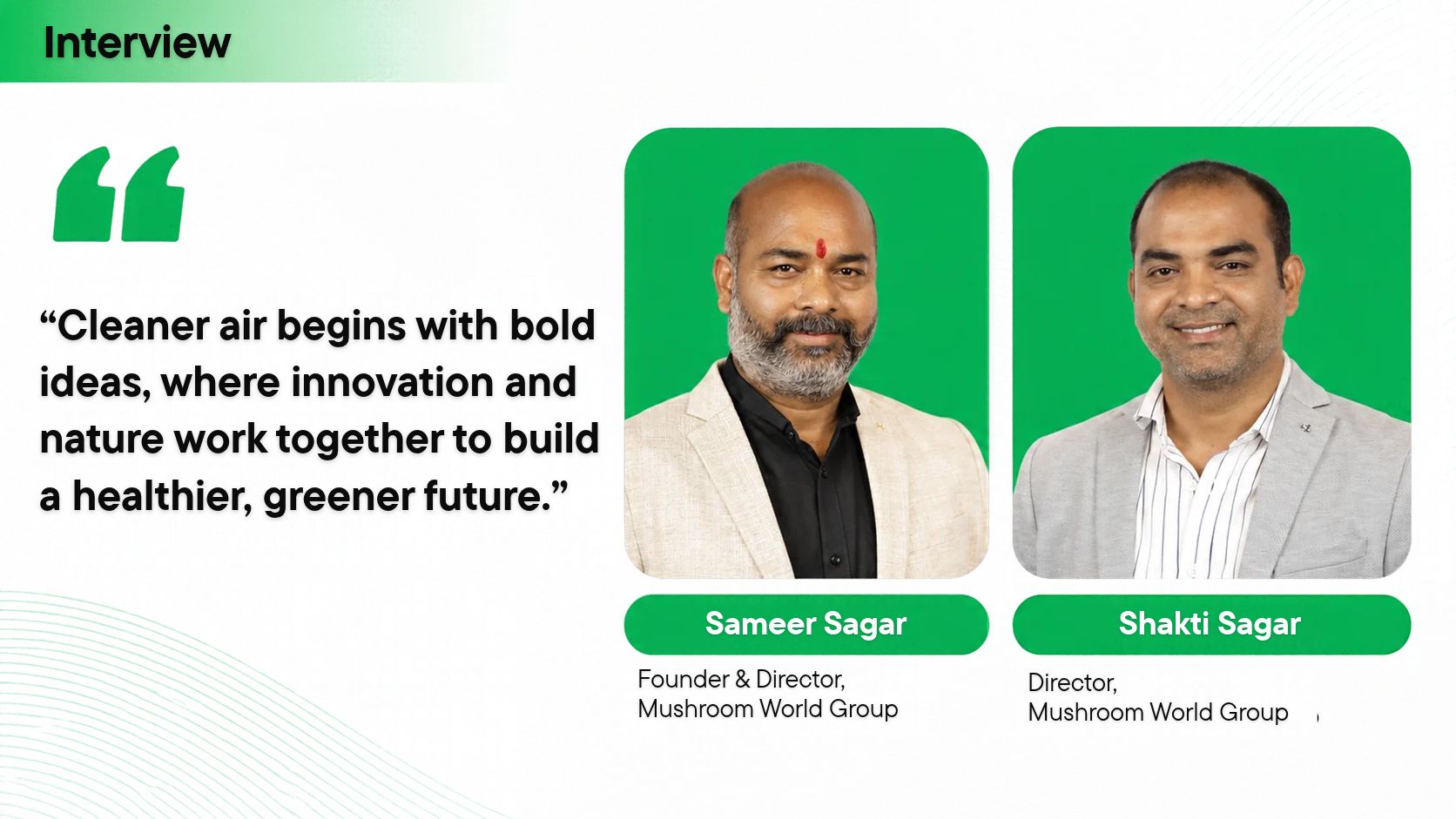
How Bolt.Earth Is Expanding EV Charging Infrastructure to Accelerate India’s Clean Mobility Transition

India’s transition to electric mobility is gaining momentum, but the pace of adoption depends heavily on the availability of reliable, accessible, and scalable charging infrastructure. As the EV ecosystem evolves, companies building the backbone of this infrastructure are playing a critical role in enabling the country’s clean mobility ambitions.
In this context, Bolt.Earth has emerged as a key player in India’s EV charging landscape, focusing on technology-driven solutions, interoperability, and ecosystem partnerships to accelerate adoption across urban and emerging markets. The company recently achieved ISO 9001:2015 certification, marking a significant milestone in strengthening its quality management systems and operational processes.
In an exclusive email interaction with TheCSRUniverse, S. Raghav Bharadwaj, Founder and CEO of Bolt.Earth, shares insights on what this certification means for the company at its current stage of growth, how it reinforces governance and operational discipline, and the role of collaborations with OEMs, industry partners, and policymakers in building a more integrated EV ecosystem. He also discusses Bolt.Earth’s expansion priorities, technology innovations aimed at improving charger reliability and user experience, and how the company is embedding sustainability into its operations while contributing to India’s broader clean mobility and climate goals.
Full interview below:
Q. What does the ISO 9001:2015 certification mean for Bolt.Earth at this stage of its growth, and why was it important for the organization to pursue this standard now?
A. ISO 9001:2015 is an international standard focused on the quality management system. For Bolt.Earth, it builds trust and confidence with the customers, OEMs, and partners by ensuring consistency in product quality and processes. The certification increases the organization’s reputation, indicates maturity and consistent growth, and demonstrates long-term commitment to operational excellence.
Q. How does this certification strengthen your operational and governance framework, and what tangible improvements can stakeholders expect as a result?
A. The certification introduces a structured and standardized approach to operations and governance. It improves transparency and accountability by clearly defining processes, roles, and responsibilities across the organization. In addition, it strengthens risk management through systematic identification, evaluation, and control of operational and governance risks. As a result, stakeholders can expect more reliable and predictable business operations, along with better quality products and services.
Q. Beyond regulatory compliance, how has the process of implementing ISO 9001:2015 strengthened internal decision-making, accountability, and operational discipline across teams?
A. Implementing the standard reflects a shift from traditional approaches to structured, data‑driven decision‑making. It ensures clear ownership, stronger cross‑functional alignment, and robust review, audit, and continuous improvement mechanisms. These practices enable leadership to scale operations effectively without compromising quality.
Q. Bolt.Earth works closely with OEMs and ecosystem partners. Could you elaborate on how these collaborations contribute to innovation, technology integration, and faster EV adoption in India?
A. Innovation has always been the lifeline for Bolt.Earth, and the standard further accelerates and strengthens it through joint development initiatives. Collaboration with OEMs and partners improves customer experience and charger reliability, which eventually promotes faster EV adoption in India by delivering end-to-end solutions in an effective manner.
Q. Are there any recent or upcoming collaborations—across industry, government, or communities—that you believe will be game-changing for the EV charging ecosystem?
A. One of the most significant collaborations is the ongoing OCPI Integration, which began last year and continues to evolve. This directly addresses range anxiety and reduces dependence on multiple apps, making Bolt.Earth a truly universal application that caters to all categories of EVs, including two-, three-, and four-wheelers and public transport.
Another major initiative is the UBeC Protocol, a standard set by the Ministry of Heavy Industries (MHI) and implemented by the National Payments Corporation of India (NPCI). This protocol connects all charge point operators (CPOs) and ensures that any user, regardless of the app they use, can access chargers seamlessly.
In addition, collaborations with OEMs such as Ather, Simple, and Ultraviolette are focused on building two-wheeler fast-charging infrastructure. This ensures that existing two-wheelers with fast charging capability can access Bolt.Earth's network. Given that two-wheeler adoption in India is growing rapidly month by month and that India is defining global standards for two-wheelers rather than those set by other countries for four-wheelers, this collaboration is particularly impactful. It supports daily commuters and strengthens India’s leadership in shaping the future of EV adoption globally.
Q. Can you share any success stories or case studies where Bolt.Earth’s solutions significantly improved EV accessibility, user experience, or operational efficiency for partners or communities?
A. EV accessibility is one of the biggest barriers to adoption in India. For Bank of America’s GCC offices across multiple cities, we deployed dedicated workplace charging aligned with their ESG goals, and within just six months of deployment, EV adoption among employees grew by 600%. Reliable workplace charging reduced range anxiety and became a key driver for employees to switch to EVs, demonstrating how Bolt.Earth’s solutions can directly accelerate adoption while enhancing user confidence and convenience.
Q. What are some of the major challenges Bolt.Earth has encountered, and how has the organization addressed them? How does Bolt.Earth incorporate customer feedback and performance data into its continuous improvement processes?
A. In the early phases of network expansion, inconsistent charger uptime emerged as a primary technical hurdle that Bolt.Earth had to navigate to uphold its commitment to a seamless user experience.
To address this, Bolt.Earth has taken a technology-led approach to significantly enhance reliability and transparency. We introduced internet-connected smart chargers for real-time monitoring, enabled live charger status visibility within the app, displayed key insights such as last used status, previous customer feedback, and ratings, and implemented auto-flagging mechanisms to proactively identify potentially inactive or non-performing chargers.
These measures empower users with real-time information, helping them make informed decisions before heading to a charging location. As a result, reliability has improved substantially, and customer confidence in the network has strengthened.
At Bolt.Earth, customer feedback is central to our continuous improvement framework. All feedback is systematically captured, monitored, audited, categorized, and analyzed.
Negative feedback is carefully classified into five key buckets: agent-related, process-related, product-related, technology-related, and customer-related.
Each category is assigned clear ownership. Agent and process feedback is managed by the Customer Delight (CD) team, which audits cases, provides individual feedback to agents, initiates coaching interventions where required, and incorporates learnings into process improvement pipelines.
Product feedback is shared with the Product team for detailed review and prioritization within the product roadmap. Technology feedback is escalated to the relevant internal IT teams or external tool vendors to drive system enhancements. Customer-related feedback is analyzed to identify behavioral patterns, communication gaps, or awareness issues, followed by targeted interventions to reduce recurrence.
This structured feedback loop ensures that insights translate into measurable improvements across operations, technology, and customer experience. Continuous improvement is therefore embedded into Bolt.Earth’s organizational practice, rather than treated as a reactive process.
Q. How does Bolt.Earth integrate sustainability and environmental responsibility into its operational strategy beyond enabling EV adoption?
A. At Bolt.Earth, we believe that true sustainability isn't just about what we enable, it’s about how we operate. We view the transition to electric mobility as a holistic mission, ensuring that every charger we deploy and every process we manage leaves a positive, lasting impact on the planet.
Here is how we are weaving environmental responsibility into the very fabric of our operational DNA:
1. Powering the Future with Clean Energy
We aren’t just building chargers; we are building a green energy ecosystem. Bolt.Earth is actively exploring and forming strategic partnerships with solar and renewable energy providers. Our goal is to ensure that the "green" kilometers driven by our users are powered by truly clean energy, integrating solar-powered charging hubs to reduce dependency on the traditional grid.
2. Circularity by Design: The Modular Advantage
Waste is a design flaw, which is why our hardware is built on a modular architecture.
-
Extend and Reuse: Instead of replacing entire units, our modular parts allow easy upgrades and reuse of functional components.
-
Responsible Lifecycle: When a part finally reaches its end-of-life, we ensure it enters a responsible recycling stream, minimizing the e-waste footprint of our global network.
3. Strengthening Local Roots & Reducing Miles
Sustainability and local empowerment go hand-in-hand. By prioritizing local manufacturing and assembly, we significantly slash transport-related carbon emissions in our supply chain. This "Made for the World, Built Locally" approach not only reduces our carbon footprint but also bolsters local economies and ensures a more resilient, responsive supply chain.
4. Conscious Packaging & Waste Reduction
We’ve rethought how our products reach customers. Our strategy focuses on stripping away unnecessary layers of packaging, pivoting to recycled and biodegradable materials, and designing packaging for secondary use. In doing so we ensure that "disposable" becomes a word of the past.
5. Accountability Through Carbon Accounting
We believe in "what gets measured, gets managed". Bolt.Earth is committed to setting science-based emission reduction targets and documenting progress in annual sustainability/ESG reports. This commitment to radical transparency holds us accountable to both our community and the planet.
6. Transparency & Global Standards
Our commitment to quality is backed by our ISO 9001 certification, and we are actively pursuing ISO 14001 for environmental management, ENERGY STAR certifications for our facilities, and local Green Building Ratings. These efforts ensure that our physical footprint remains as light as our carbon one.
Q. With increasing demand for EV charging across urban, semi-urban, and highway networks, what are Bolt.Earth’s expansion priorities in terms of geography and infrastructure deployment?
A. Bolt.Earth’s expansion strategy is fundamentally driven by a commitment to democratizing EV accessibility, moving beyond the current saturation in major urban centers. As the Indian EV market evolves (with total uptake having hit 7.8% in FY25), the company is prioritizing geographic diversification and specialized infrastructure deployment to address critical gaps in the ecosystem.
Geographic Expansion: Eliminating "Charging Deserts"
Currently, India’s approximately 29,000 public chargers are concentrated largely in a few urban hubs. Bolt.Earth is shifting this focus toward:
-
Smaller Towns and Rural Regions: Expanding coverage beyond metros to ensure inclusivity for all demographics.
-
Secondary Highways: Enabling robust charging points on these routes to eliminate "charging deserts" and support confident travel between Tier 2 and Tier 3 cities.
-
Regional Connectivity: Building a network designed for long-distance transit rather than just local urban commuting.
Infrastructure Deployment: Focusing on 2-Wheeler Fast Charging
With nearly 60% of Indian households owning two-wheelers and this segment accounting for over 56% of total EV sales, Bolt.Earth recognizes that a dedicated fast-charging public network for 2-wheelers is the "need of the hour".
To support this, the company is prioritizing:
-
Fast-Charging Public Networks: Deploying specialized DC fast chargers, such as the Blaze DC and Lightning DC, designed for rapid turnaround for two-, three-, and four-wheelers in high-traffic zones.
-
Interoperability and Connectivity: Using LTE-enabled smart modules and roaming agreements to ensure seamless charging across different operators.
-
Universal Standards: Adopting unified connector types, such as the LECCS Type 7 and LEVDC Type 6, to remain the primary choice for millions of new riders.
Through this dual focus on deep rural penetration and segment-specific fast charging, Bolt.Earth is working toward a future where EV charging is as routine and accessible as mobile phone charging.
Q. How does Bolt.Earth contribute to strengthening India’s broader clean mobility and climate goals, particularly in alignment with national sustainability targets?
A. Bolt.Earth supports India’s clean mobility transition by expanding accessible and affordable EV charging infrastructure across workplaces, commercial hubs, fleets, and public spaces. By accelerating EV adoption, we contribute directly to India’s Net Zero 2070 commitment and national e-mobility goals under initiatives such as FAME and various state EV policies. Enabling reliable charging at scale reduces transport emissions, lowers dependence on fossil fuel, and strengthens the country’s overall shift toward sustainable mobility.









.png)