

From Classroom Ideas to Real-World Impact: How vivo Ignite Is Building India’s Next Generation of Young Innovators
India’s demographic dividend will translate into long-term social and economic value only when young people have the opportunity to turn knowledge into solutions. With more than 1.5 million schools and over 300 million students, the scale of India’s education ecosystem is immense, but so is the challenge of ensuring that innovation is not limited by geography, access or exposure.
Against this backdrop, vivo Ignite: Technology & Innovation Initiative is seeking to bridge the gap between classroom learning and real-world problem-solving by giving school students access to mentorship, technology and industry expertise. Now in its fourth edition, the initiative has expanded its focus to Aspirational Districts and introduced a Teacher Innovation Grant, while its partnerships with NCERT, IITM Pravartak, SOF and UN Global Compact Network India bring together complementary strengths.
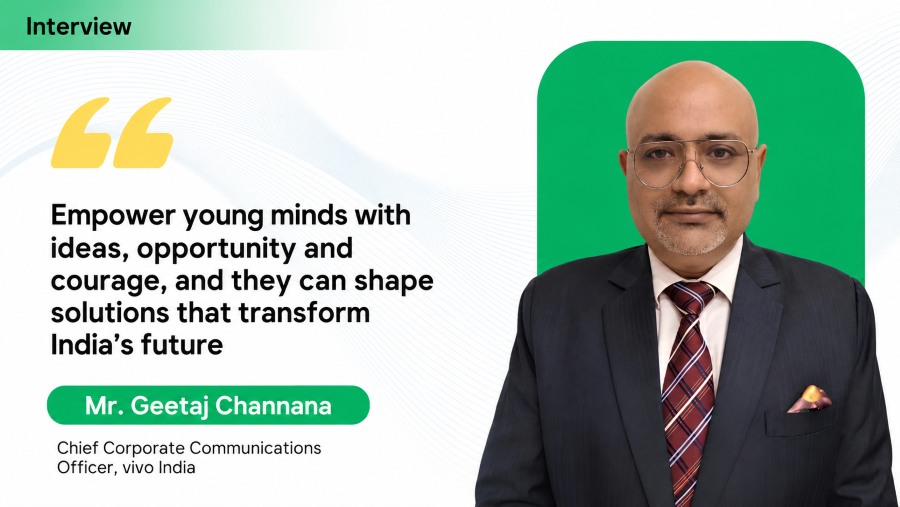
In this insightful conversation, Mr. Geetaj Channana, Chief Corporate Communications Officer, vivo India, discusses building inclusive pathways to innovation, empowering teachers and strengthening collaboration across industry, academia and institutions to create lasting social impact.
Scroll down to read the full interview.
Q&A
Q. India has one of the world's largest school-going populations. From your perspective, what are the biggest gaps that still prevent students from translating classroom learning into real-world innovation?
A. India's education ecosystem is undergoing an important shift. While it is encouraging to see that students today have greater access to quality education than ever before, there is scope to create more opportunities for young students for the practical application of classroom learning.
The National Education Policy (NEP) 2020 rightly recognises this need by placing greater emphasis on experiential learning, critical thinking and innovation. As its implementation gathers pace, we believe it can do wonders to empower our next generation.
At vivo India, we see vivo Ignite as a complementary platform that helps bring these principles to life. Over the past four editions, we've observed that when students are encouraged to identify challenges around them, ask questions and experiment with solutions, their perspective changes. We have also seen that students from smaller towns, government schools and underserved communities often have remarkable ideas but limited access to mentorship, exposure and structured innovation platforms. Our endeavour is to help bridge that gap by giving young innovators the opportunity to transform curiosity into meaningful solutions.
Q. vivo Ignite has now entered its fourth edition with a growing number of participants. Beyond the participation numbers, what outcomes or success stories best demonstrate the programme's impact on young innovators?
A. The true measure of impact is what students do after the programme. Shreeja Mahadik and Harshita Taral's Fab-Brick (3rd edition) evolved from a classroom idea to transform textile waste into a practical sustainable construction material with guidance from vivo Ignite. They have since gone on to mentor younger students, inspiring more girls to pursue STEM. That ripple effect is what matters most. While over 38,000 registrations from more than 12,000 schools across more than 700 districts, with participation from government schools increasing from 5% to 14%, reflect growing reach, seeing young innovators become changemakers is our biggest achievement.
Q. This year's edition places a special focus on Aspirational Districts. Why was this an important addition, and how do you plan to ensure that talented students from underserved regions have equal opportunities to innovate?
A. Some of the most innovative ideas also come from students who experience local challenges firsthand. Yet, these are often the very students who have the least access to innovation platforms, mentorship and exposure. That is why we consciously expanded our outreach to Aspirational Districts this year.
Working closely with our outreach and knowledge partners, we focused on ensuring that geography does not become a barrier to innovation. The response has been extremely encouraging. Students from 83 Aspirational Districts submitted ideas this year, contributing to more than 6,100 innovative ideas from across the country. It reaffirmed a belief we've held from the beginning that talent is universal, but opportunity is not.
Our objective goes beyond increasing participation. We want every promising student, irrespective of where they come from, to receive the guidance, exposure and confidence needed to develop ideas that can create meaningful impact within their communities and beyond.
Q. Many promising student ideas do not progress beyond the concept stage. How does vivo Ignite help students develop these ideas into practical and scalable solutions?
A. Great ideas need the right ecosystem to grow. Shubhashree Sahu's Multi-Functional Eco-friendly Agro Machine (a solar-powered, portable, multi-functional agro machine that streamlines key farming processes to improve productivity while reducing energy consumption) from the 2nd edition is one such example, whose project addressed challenges faced by rural farmers. Through design thinking sessions, expert mentoring and technical guidance, her idea evolved into a practical innovation addressing challenges faced by rural farmers. That's the approach we follow across vivo Ignite, helping students strengthen their ideas through structured mentoring, so they build solutions that are technically feasible, scalable and socially relevant.
Q. The programme has introduced the Teacher Innovation Grant this year. Why is it important to recognise and empower teachers as drivers of innovation, and what impact do you hope this initiative will create in schools?
A. Innovation often begins with a teacher who encourages a student to question, experiment and think differently. While students are at the centre of vivo Ignite, teachers are the enablers who nurture that curiosity every day. The Teacher Innovation Fellowship recognises educators who integrate innovation and STEM into classroom learning. Our goal is to strengthen a culture where teachers inspire generations of young problem-solvers, creating impact that extends far beyond a single classroom.
Q. vivo Ignite brings together partners such as IITM Pravartak, Science Olympiad Foundation, UN Global Compact Network India and Grant Thornton. What role do such collaborations play in strengthening the programme and expanding its impact?
A. Meaningful innovation cannot be built in isolation. It requires academia, industry and institutions to come together, each contributing a unique perspective to help young innovators succeed.
That is the role our partners play in vivo Ignite. IITM Pravartak Technologies Foundation - Technology Innovation Hub (TIH) of IIT Madras serves as our knowledge partner, providing technical mentorship and evaluating ideas from the Top 200 to the Achiever 30, while also being part of the expert jury for the National Finale. Our Outreach partner, Science Olympiad Foundation (SOF), reaches out to children across the country and encourages wider student participation, while the UN Global Compact Network India (UNGC NI) strengthens the programme's focus on solutions aligned with the Sustainable Development Goals (SDGs). Overall, our partner Grant Thornton (GT) serves as the process validator, ensuring a transparent, robust and credible evaluation framework is in place for the entire programme.
These collaborations have helped vivo Ignite grow into a credible national innovation platform, reaching over 38,000 students this year. More importantly, they ensure that every participating student benefits from the collective expertise of leading institutions, giving them the guidance and confidence to transform promising ideas into solutions with real-world impact.
Q. Alongside vivo Ignite, vivo India also runs the vivo KanyaGyaan initiative to support young women pursuing STEM education. How do these two programmes complement each other in advancing vivo India's larger vision for education and social impact?
A. Both programmes are driven by a shared belief that talent should never be limited by opportunity. vivo Ignite encourages school students to think innovatively and solve real-world problems, while vivo KanyaGyaan helps young women continue that journey through higher education, job-oriented vocational skills, and STEM careers. Together, they support different stages of the same pathway, nurturing curiosity early and enabling aspirations to translate into meaningful careers and long-term social impact.
Q. As India places greater emphasis on innovation and STEM education, how do you see corporate-led initiatives such as vivo Ignite complementing the efforts of schools and public institutions in building an innovation-driven future?
A. Preparing young people for an innovation-led future is a shared responsibility. Schools provide the foundation, public institutions create the enabling ecosystem, and industry brings technology, mentorship and real-world exposure. Corporate initiatives like vivo Ignite complement classroom learning by giving students opportunities to apply ideas, collaborate with experts and solve practical challenges. When education, government and industry work together, we can nurture a generation equipped to drive India's innovation-led growth.





.png)