Empowering Social Entrepreneurs: IIM Calcutta Innovation Park’s Blueprint for Impact at Scale
India’s social impact startup ecosystem is evolving rapidly, but turning innovative ideas into sustainable enterprises requires more than capital. It demands mentorship, market access, strategic guidance and an enabling ecosystem that can help entrepreneurs navigate the complexities of growth.
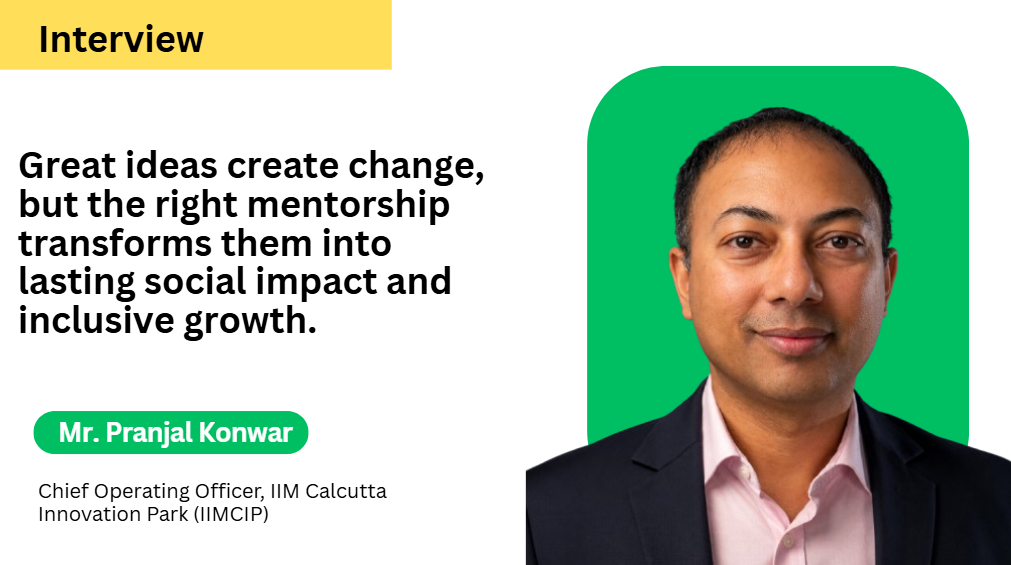
In this interview with Mr. Pranjal Konwar, Chief Operating Officer, IIM Calcutta Innovation Park (IIMCIP), TheCSRUniverse explores how incubation can play a critical role in strengthening India’s social entrepreneurship landscape. Mr. Konwar discusses the vision behind the DICV–IIMCIP Social Impact Incubation Programme, which seeks to support technology-driven ventures working across sustainability, green mobility, community development and women’s empowerment.
He also shares insights from IIMCIP’s experience of working with early-stage founders, highlighting why structured mentorship, business training and market connections are as important as funding. Drawing from examples such as Eri Weave, DeHaat and 5C Network, he illustrates how incubation can translate innovative solutions into commercially viable ventures with measurable social impact.
The conversation further examines the challenges confronting social impact startups, particularly access to suitable capital and markets, while highlighting IIMCIP’s efforts to bridge these gaps. Looking ahead, Mr. Konwar outlines the organisation’s plans to expand its national footprint, deepen support in underserved regions and build stronger innovation ecosystems that can drive inclusive economic growth.
Scroll down to read the full interview:
Q. What was the main idea behind launching the DICV–IIMCIP Social Impact Incubation Programme?
A. The DICV–IIMCIP Social Impact Incubation Programme is a result of a shared vision to help catalyse the next generation of social entrepreneurship innovation that creates lasting societal impact.
The idea is to promote technology-driven social entrepreneurship in India, focusing on sustainability, green mobility, community development and women empowerment. This is in keeping with IIMCIP’s commitment towards building socially responsible entrepreneurs, aligned with the Viksit Bharat objectives and the UN Sustainable Development Goals (SDGs).
Q. Why is it important to provide mentorship and business training to early-stage startups along with funding support?
A. One of the biggest misconceptions in the startup ecosystem is that funding alone determines the success of a startup. Today's founders are often technically qualified, professionally experienced and deeply passionate about solving real-world problems. The challenge is rarely capability; it is execution. This is where experienced mentors create tangible value, helping founders navigate product-market fit, customer discovery, go-to-market strategy, governance, scaling and critical decision-making.
At IIMCIP, we have more than 150 mentors and, where required, we also bring in experts beyond our network to ensure every founder is matched with guidance aligned to their business needs and stage of growth. This enables founders to avoid common pitfalls, make informed strategic choices and deploy capital more effectively.
A good example is Eri Weave, a Meghalaya-based handloom enterprise. When the founder joined us, the business had limited brand visibility and was operating as a proprietorship. Through mentorship, we helped strengthen its branding, financial planning, legal structuring and market connect, enabling the founder to build a stronger foundation for scaling the business. Today, the startup has achieved over 236% revenue growth and secured investment from two Sharks on Shark Tank India. For us, it reinforces a simple belief: funding can accelerate a business, but the right mentorship helps founders build one that lasts.
Q. What were some of the key learnings or observations from the second bootcamp and the participating startups? What are the biggest challenges social impact startups in India face today?
A. One of the key observations from the second bootcamp was the strong commitment shown by the participating startups towards building resilient and growth-oriented ventures. The programme highlighted the importance of strengthening entrepreneurial capabilities across finance, leadership, negotiation, branding and business strategy. It also reinforced how structured mentorship, practical industry insights and ecosystem support help founders navigate challenges and translate innovative ideas into sustainable businesses.
One of the biggest challenges social impact startups face today is access to the right kind of capital. Most traditional investors are not structured to invest in businesses where social impact and financial returns evolve together over a longer horizon. As a result, these startups often depend on dedicated impact investors, and India still has a relatively small pool of such investors.
Market access is another equally important challenge. Building the right partnerships, accessing customers and creating opportunities for scale are often as important as raising capital for social impact startups.
This is precisely where IIM Calcutta Innovation Park seeks to make a difference. Beyond incubation, we actively work with founders by connecting them with mentors, corporates, government agencies and impact investors, helping bridge both the funding and market-access gaps so they can build commercially sustainable enterprises with lasting social impact.
Q. Can you share any success stories or positive outcomes from startups supported by IIM Calcutta Innovation Park?
A. Since its inception in 2014, IIMCIP has incubated 150 startups and supported over 2,000 startups, and has contributed to the startups generating more than 30,000 direct and indirect employment opportunities, impacting 10.5 Mn lives. We have invested ₹32 crores and built a cumulative portfolio valuation of over ₹7,000 crore.
At IIM Calcutta Innovation Park, we measure success by the real-world impact our startups create, whether through technology, livelihoods or inclusive economic growth. One example is DeHaat, one of our earliest incubated startups, which has built an integrated digital platform providing farmers with access to agricultural inputs, crop advisory, financial services and market linkages. By addressing challenges across the agricultural value chain, the company has helped improve farm productivity and farmer incomes while growing into one of India's leading agritech startups and a soonicorn.
Another example is 5C Network, a health-tech startup that tackled India's shortage of radiologists through a cloud-based teleradiology platform. By reducing the turnaround time for radiology reports from 2–3 days to as little as 45 minutes, the platform has enabled hospitals to begin treatment much faster, particularly in underserved regions. Today, it supports hundreds of hospitals and diagnostic centres across the country through a nationwide network of radiologists.
Beyond technology startups, our impact is equally visible at the grassroots. Through our livelihood and women entrepreneurship programmes, we have helped create 59 Crorepati Didis, demonstrating how incubation, mentorship and market access can empower rural women to build sustainable enterprises and create lasting community impact.
Today, we work with governments and corporates, enabling grants, schemes and CSR funds to reach deserving social impact-led entrepreneurs, in a manner that is gender inclusive and with a special focus on bridging the gaps in the startup ecosystem, especially in underserved regions.
Q. What are your future plans for expanding incubation and startup support initiatives at IIMCIP?
A. We will continue our mission of building a world-class, impact-first social incubator by delivering greater value to founders by broadening access to quality mentorship, strengthening market and investor connect, and enabling more startups to become investment-ready and commercially sustainable, particularly from the grassroots, who represent a significant opportunity to drive inclusive economic growth in India.
We also intend to expand our national footprint and deepen our presence across underserved regions by working closely with governments, corporates and ecosystem partners to build stronger regional innovation ecosystems and support entrepreneurs from diverse socio-economic backgrounds, to generate a lasting impact for families and communities.



.png)