Ageing India Needs More Than Care. It Needs a Development Response
India is getting older, and the shift is happening faster than many development conversations acknowledge. According to the Government of India, the country’s population aged 60 and above is projected to reach around 230 million by 2036, making ageing not merely a social welfare concern, but a defining development challenge.
Behind the numbers are complex realities: chronic health conditions, financial insecurity, shrinking family support, caregiving gaps and social isolation, particularly in rural and underserved communities. As migration and changing family structures reshape traditional support systems, the question is no longer simply who will care for India’s elderly, but how India can build systems that enable people to age with dignity, independence and continued participation in society.
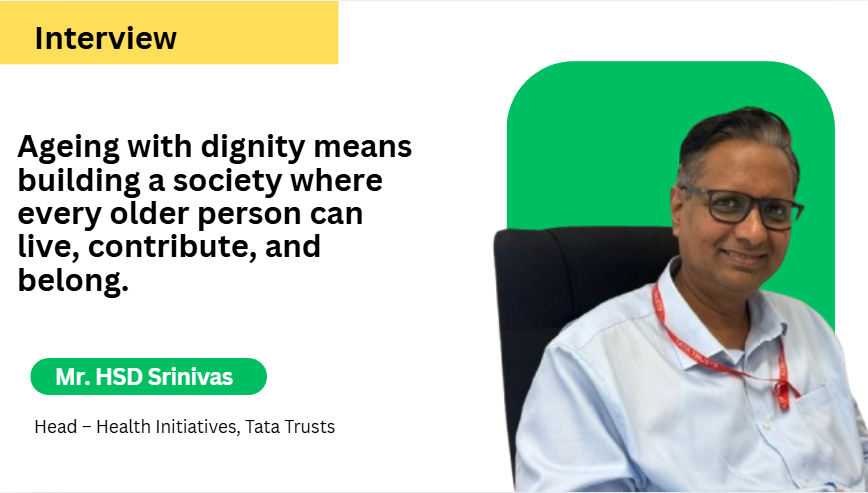
In this interview with TheCSRUniverse, HSD Srinivas, Head – Health Initiatives, Tata Trusts, explores why ageing must move beyond a welfare lens and become a development priority, and examines how philanthropy, CSR, civil society and government can work together to build a more inclusive ecosystem for India’s older citizens.
Scroll down for more insights.
Q&A
Q. India's development efforts have traditionally focused on children, youth, and livelihoods. In your view, does the country's growing ageing population warrant greater attention from the development, CSR, and social impact ecosystem? Why?
A. Today, 138 million Indians are over the age of 60, and that number will approach 230. Yet a large proportion of older adults face chronic illness, financial insecurity and dependence on family members for care. In the absence of formal support systems, caregiving responsibilities often fall on women, affecting their economic participation and reinforcing existing inequalities.
The key challenge is that ageing is still viewed largely through a welfare lens. But ageing is a development issue. It intersects healthcare, livelihoods, financial inclusion, housing, social protection and gender equality. How India responds will shape not only the quality of life of older adults, but also the resilience of families and communities.
The next decade offers a critical opportunity to act. The development ecosystem can help by piloting models, generating evidence and building scalable solutions that ensure ageing is not associated with vulnerability, but with dignity, security and continued participation in society.
Q. What do you consider to be the most pressing health, financial, and caregiving challenges faced by elderly populations today, particularly in rural and underserved communities?
A. The challenges facing elderly populations, particularly in rural India, are deeply interconnected. Health remains the most immediate concern: with over 71% of India's elderly living in rural areas, access to quality healthcare, geriatric specialists and age-friendly services remains limited. As a result, chronic conditions often go undiagnosed or unmanaged.
Financial vulnerability compounds these challenges. A large proportion of older adults lack pensions or reliable income, meaning a health crisis can quickly become a financial one. While social protection schemes exist, navigating and accessing entitlements remains difficult, especially for those living alone or without family support.
The caregiving gap is perhaps the most pressing challenge. India lacks a trained elder-care workforce, particularly in rural areas. At the Tata Trusts, we are working to address this by helping build an ecosystem that enables caregiving to emerge as a viable and respected profession.
For caregiving to scale, it must be recognised and compensated as a skilled profession.
Equally important, though often overlooked, are nutrition and social isolation. Our support to Manav Lok in rural Maharashtra demonstrates how community-led solutions can address both.
Through village-based community kitchens- ‘annapurna tais’ provide elderly residents hot, nutritious meals twice a day. In cases where someone cannot pay, the community absorbs the shortfall. In addition to the meals, the elderly find an avenue of social engagement and community support. The model has sustained itself without interruption and offers a powerful example of dignity-centred elder care.
Ultimately, ageing well requires more than healthcare alone. It demands integrated solutions that combine health, financial security, caregiving, nutrition and social connection, because none of these challenges exist in isolation.
Q. From Tata Trusts' perspective, how are demographic shifts, migration, and changing family structures impacting the well-being and social support systems available to older adults in rural India?
A. Migration is one of several social and economic shifts reshaping how care and support are organised for older adults in rural India. As younger family members move to towns and cities for education and employment, traditional multi-generational households are evolving into more compact nuclear ones. While these transitions often improve household incomes, they can also leave older adults with less day-to-day care and companionship.
The challenge extends beyond legal and financial support. What surfaces in the field is often quiet but profound: no one to accompany an elder to a health centre or notice a missed meal. This isolation can contribute to depression, cognitive decline, missed medications and delayed treatment for otherwise manageable conditions. Changing family structures also place a disproportionate caregiving burden on women who remain in the household, often at the expense of their own economic participation.
In response, we are investing in community-based support systems that can complement family care. Through our partnership with Kalike in Karnataka, sessions are being conducted across government libraries, offering older adults opportunities for physical activity, cognitive stimulation, legal awareness and simply spending time together. The model is designed to be sustained by librarians beyond the grant period. Similarly, our partner Jan Seva runs 75 multi-activity centres, known as Mayechi Saveli, in community spaces such as temples and gram sabha buildings, creating accessible spaces for social engagement and connection.
Technology-enabled elder-care solutions also hold promise, but most remain inaccessible to rural and low-income populations. Bridging this affordability and access gap will be critical as India builds more resilient support systems for an ageing population.
Q. Do you believe ageing and elderly well-being are adequately reflected in current development and philanthropic priorities? What gaps and opportunities do you see for greater engagement from foundations working in rural India?
A. India's development and philanthropic ecosystem has made important strides in addressing different aspects of ageing. As the country's elderly population grows, there is an opportunity to build on these efforts and create more integrated systems of care that respond to the evolving realities of ageing.
Older adults experience health, caregiving, financial security, social connection and personal safety as interconnected needs. This understanding shapes our approach at the Tata Trusts. We work across the continuum of elder care. From geriatric healthcare and caregiving to nutrition and social connectedness. More importantly, we do so alongside government and civil society partners, with the aim of strengthening existing systems and community institutions rather than building parallel ones.
Perhaps the greatest opportunity lies in supporting community-owned solutions. Through collaborations with government agencies, CSOs and local institutions, philanthropy can help demonstrate scalable models that communities can sustain over time. Our experience has shown that when health, caregiving, social engagement and access to services are brought together, older adults are better able to age with dignity, security and a sense of belonging.
Q. As India undergoes a demographic transition, what role should philanthropic trusts, corporate CSR programs, civil society organisations, and policymakers play in ensuring that older adults can age with dignity, security, and access to essential medical services?
A. As India undergoes a demographic transition, the response to ageing will require coordinated action across philanthropy, CSR, civil society and policymakers, each playing a distinct but complementary role.
Philanthropies are well placed to take on early-stage risk funding and testing new innovations and pilots, learning what works and what does not, and generating evidence for scale. Beyond funding, philanthropy can also act as a neutral convener, bringing together actors from health, skilling, social care, legal and financial systems on a common platform.
CSR programs can help scale and institutionalise proven models, particularly in building workforce capacity and supporting service delivery innovations. Civil society organisations remain critical in grounding these interventions in community realities and last-mile delivery.
For policymakers, the opportunity lies in deepening and integrating existing efforts. While policy intent on elder care is increasingly visible, there is scope to allocate greater resources beyond financial transfers to healthcare infrastructure, mental health services, caregiving systems and social participation. There is also scope to improve geriatric-specific implementation within existing schemes.
Ultimately, the goal is a shift from viewing ageing as a welfare challenge to designing systems where older adults can age with dignity, security and inclusion. Achieving this will require all ecosystem actors to move in alignment, with the older person at the centre of design and delivery.


.png)