The Cockroach Janta Party and the Politics of Digital Dissent
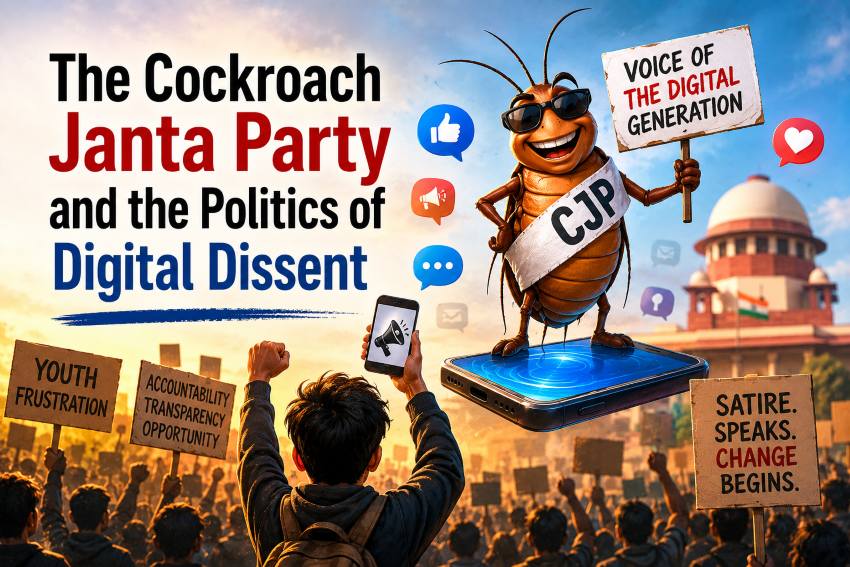
At TheCSRUniverse, our editorial focus is usually on long-term systemic issues such as sustainable development, corporate accountability, and the evolving role of institutions in shaping social outcomes. Yet over the past few days, one unusual phenomenon has dominated digital conversations among young Indians: the rapid rise of the so-called Cockroach Janta Party (CJP).
What began as an online joke has quickly turned into a wider commentary on youth frustration, public institutions, and political communication in India.
The trigger was a remark made during a Supreme Court hearing on May 15, 2026, when Chief Justice Surya Kant reportedly compared certain forms of online activism and citizen-led criticism to “cockroaches” and “parasites.” The statement immediately sparked backlash across social media. Soon after, Abhijeet Dipke, a public relations student, responded by launching a satirical digital “party” that embraced the insult rather than rejecting it.
The language of the movement was intentionally absurd. Its self-description revolved around being “chronically online,” unemployed, and skilled at “ranting professionally.” Its slogan, “Secular, Socialist, Democratic, Lazy,” openly parodied political language and constitutional rhetoric. The party symbol was a mobile phone.
Ordinarily, internet satire fades within a news cycle. But this did not.
Within days, the movement reportedly drew millions of followers across social media platforms and large numbers of sign-ups through online forms. Politicians, commentators, and meme pages amplified it further, pushing it well beyond niche internet culture.
What makes this moment worth examining is not the humour itself, but what the humour is revealing.
When Satire Becomes a Social Signal
The popularity of the CJP reflects a growing disconnect between young Indians and the institutions meant to represent or support them. Beneath the memes lies a generation dealing with persistent unemployment, rising competition for limited opportunities, recurring exam-related controversies, and a broader perception that accountability mechanisms often fail to deliver meaningful outcomes.
In that context, satire becomes more than entertainment. It becomes a language of participation.
The movement’s appeal also comes from the fact that it mixes parody with recognisable public concerns. Alongside jokes and exaggerated branding, the CJP circulated demands related to judicial accountability, political defections, transparency in public institutions, greater representation for women in politics, and examination-related grievances affecting students. Whether symbolic or serious, the language resonated with a section of young Indians already frustrated with existing systems.
That transition is important.
India’s youth are increasingly political, but not always through traditional political structures. Many no longer engage through party offices, student unions, or ideological platforms in the conventional sense. Instead, they mobilise through digital communities, humour, creators, satire pages, and viral narratives. The CJP appears to be part of that larger shift.
This trend is not unique to India. Across several countries, younger generations are increasingly expressing political frustration through internet culture, satire, and unconventional digital communities rather than formal civic spaces. The growing trust deficit between institutions and young citizens is becoming a global pattern, particularly in societies where economic uncertainty and political fatigue intersect.
At the same time, it would be premature to frame this as a political revolution or a transformational movement. Viral attention does not automatically translate into sustained civic engagement or institutional change. Social media momentum is often temporary, and internet-led campaigns frequently struggle to move from visibility to organisation.
Still, dismissing the phenomenon entirely would also be a mistake.
For institutions, policymakers, and even the CSR ecosystem, there is a lesson here about communication and public trust. Young people are clearly responding to spaces that acknowledge frustration openly rather than through carefully managed narratives. The speed with which this satire resonated suggests that many feel unheard in formal discussions around employment, governance, education, and opportunity.
Humour, in this case, worked because it lowered the barrier to participation. It allowed disillusionment to become shareable.
At TheCSRUniverse, we see the rise of the Cockroach Janta Party less as a conventional political story and more as a signal of changing civic behaviour in digital India. Whether the movement disappears in a few weeks or evolves into something more structured is ultimately secondary. What matters is the mood it has tapped into.
The episode highlights a generation that is politically aware, digitally fluent, sceptical of institutions, and increasingly comfortable using irony as a form of dissent.
That alone deserves attention.