Beyond EVs: Why India’s Sustainable Mobility Future Needs More Than Electric Cars
As tensions in West Asia continue to influence global oil markets and renew concerns around fuel security, Prime Minister Narendra Modi recently reiterated the need for India to reduce its dependence on fossil fuels and accelerate the shift towards electric mobility. His remarks come at a time when crude oil volatility, urban pollution and climate concerns are converging into one of India’s biggest development challenges: sustainable mobility.
For India, the push towards electric vehicles is not only about reducing emissions. It is also about economic resilience. The country imports more than 85 percent of its crude oil requirements, making fuel dependency a major financial and strategic vulnerability.
The transition is already visible on Indian roads. Electric scooters are becoming increasingly common in cities. Delivery fleets are gradually electrifying. Ride-hailing platforms are experimenting with EV integration, while automakers and startups continue to invest heavily in batteries, charging networks and electric mobility ecosystems.
But even as India’s EV revolution gathers pace, urban planners and sustainability experts are increasingly raising a more difficult question: can replacing every petrol and diesel vehicle with an electric one truly solve India’s urban mobility crisis?
For many, the answer is no.
India’s EV Revolution Is Accelerating
India is now among the world’s fastest-growing EV markets, particularly in the electric two-wheeler and three-wheeler segments.
According to the International Energy Agency’s Global EV Outlook 2025, nearly 10 percent of two-wheeler sales in India in 2024 were already electric, and adoption is expected to rise significantly by the end of the decade under current policy support (IEA, Global EV Outlook 2025).
Industry estimates and vehicle registration data suggest India crossed more than 2.4 million EV sales in FY2026, with electric scooters and e-rickshaws accounting for the largest share of growth (FADA industry data, 2026).
Companies such as Ather Energy, Ola Electric, TVS Motor Company, Tata Motors and Mahindra & Mahindra are aggressively expanding their EV portfolios, while startups focused on charging infrastructure, battery swapping and fleet electrification continue to attract investor interest.
Government schemes such as FAME and PM E-DRIVE have played a critical role in this expansion through subsidies, charging infrastructure support and incentives for electric buses and commercial mobility systems.
The policy direction itself is evolving. Increasingly, India’s EV strategy is moving beyond private passenger cars and focusing more heavily on public and shared mobility systems.
Industry stakeholders say the Prime Minister’s appeal could also accelerate larger conversations around fuel-efficient public mobility systems, particularly at a time when global energy security concerns are growing.
“Hon’ble Prime Minister Shri Narendra Modi's appeal to shift to public transport comes at a critical inflection point for India's urban mobility sector, one shaped as much by geopolitical pressure as by long-term climate commitments.
At Cityflo, shared urban transport has been our operating thesis since inception. Our commuters collectively avoided nearly 75 lakh litres of fuel in the last year by shifting from private vehicles to shared mobility.
India has immense ridership density and is making rapid progress on urban infrastructure. If the Prime Minister's appeal signals a broader shift in that direction, the sector is positioned to respond,” said Jerin Venad, CEO & Co-founder, Cityflo.
The Bigger Problem Is Not Just Fuel
While EVs reduce tailpipe emissions, they do not automatically solve India’s deeper urban transport problems.
An electric car still occupies the same road space as a petrol car. It still contributes to congestion, parking shortages and overcrowded infrastructure.
In cities such as Delhi, Bengaluru and Mumbai, roads are already operating beyond capacity. Merely replacing fuel-powered vehicles with electric ones may reduce pollution levels over time, but it does little to improve mobility efficiency or reduce traffic stress.
This is where global examples become important.
In Amsterdam, cycling is integrated into everyday urban life. Copenhagen has built extensive protected cycling infrastructure that makes bicycles safer and often faster than cars. In Paris, authorities expanded pedestrian-friendly streets and cycling lanes dramatically after the pandemic while discouraging excessive car dependency.
These cities still support EV adoption, but they do not rely on electrification alone. Their success comes from integrating public transport, cycling, walkability and shared mobility into a unified system.
India’s Urban Realities Are More Complex
India cannot simply replicate European transport models.
Cycling infrastructure remains inadequate across most Indian cities. Mixed traffic movement, unsafe roads and poor lane segregation make cycling risky for many commuters. Extreme summer temperatures and long travel distances further complicate adoption.
Social perceptions also matter. For decades, moving from a bicycle to a scooter or car has symbolised economic aspiration and upward mobility.
At the same time, public transport systems remain inconsistent across urban India. Metro networks have expanded significantly in cities such as Delhi, Bengaluru and Hyderabad, but overcrowding, poor last-mile connectivity and fragmented planning continue to limit accessibility for millions.
This creates a difficult challenge for policymakers. India needs cleaner transport systems, but it also needs practical, affordable and scalable mobility solutions.
What Policymakers Need To Do Next
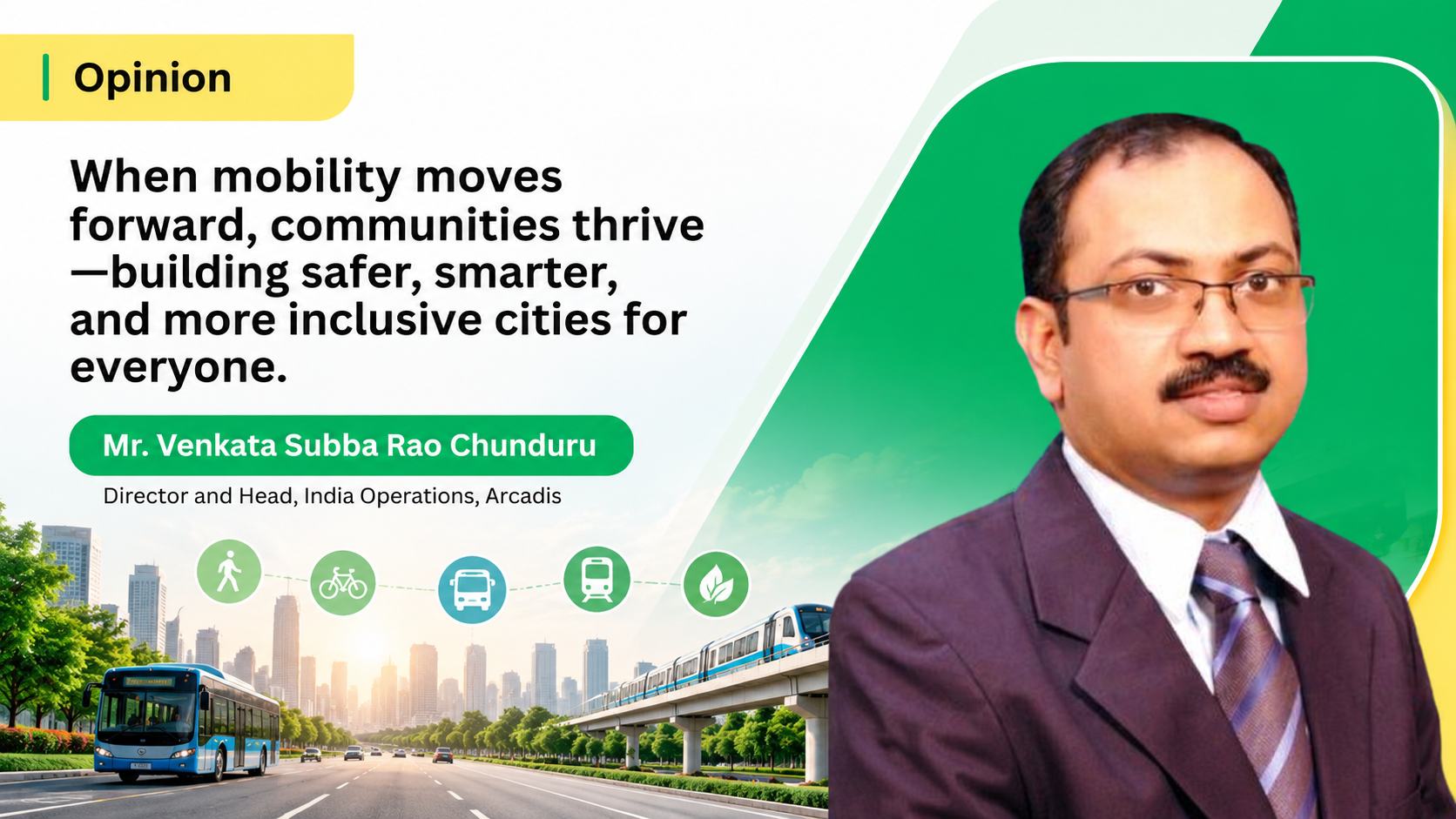
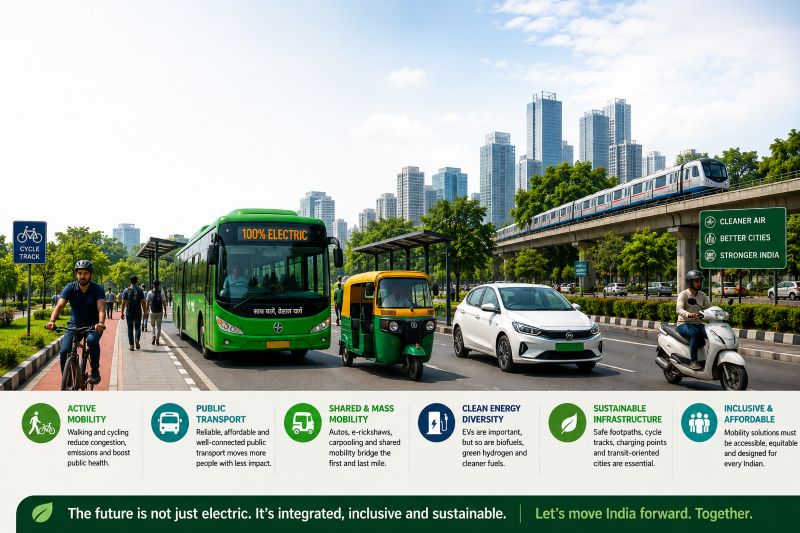
Experts increasingly believe India’s long-term mobility future depends not only on electrifying vehicles but on reducing excessive dependence on private vehicles altogether.
That requires a far broader policy approach than EV subsidies alone.
Prioritise Public Transport
One of the biggest gaps in Indian urban mobility remains reliable public transport. Experts argue that large-scale investment in electric buses, metro integration and last-mile connectivity could reduce both congestion and emissions far more effectively than focusing only on private EV ownership.
Electric buses, in particular, could become one of India’s most impactful sustainability interventions because they move far more people while reducing fuel consumption and pollution simultaneously.
Several state governments have already begun expanding electric bus fleets, but experts say adoption needs to accelerate much faster across Tier 1 and Tier 2 cities.
Build Safer Cycling and Walking Infrastructure
Urban planners also stress the urgent need for protected cycling lanes, pedestrian-friendly roads and shaded footpaths.
In India, a large percentage of trips are still short-distance journeys that could potentially shift toward walking or cycling if safer infrastructure existed. Yet most Indian cities remain heavily vehicle-centric in design.
Experts believe that integrating cycling infrastructure into Smart City projects, industrial zones and urban redevelopment plans could significantly reduce traffic pressure while improving public health.
Encourage Shared Mobility
Policies encouraging shared mobility systems such as electric public transport, bike-sharing, ride pooling and feeder mobility could help reduce the overall number of vehicles on roads.
Countries that successfully reduced urban congestion did not merely replace vehicles with cleaner versions. They reduced unnecessary vehicle ownership itself.
Integrate Urban Planning With Mobility
Experts also believe Indian cities need better integration between transport systems and urban planning.
The “15-minute city” model, where workplaces, schools, healthcare and daily essentials remain accessible within shorter distances, is increasingly being discussed globally as a way to reduce dependence on long daily commutes.
For India, transit-oriented development around metro corridors and mixed-use neighbourhoods could become essential to future urban sustainability.
Expand Renewable Energy Alongside EVs
Another critical challenge is ensuring that EV adoption is powered by cleaner electricity.
Experts caution that if India’s electricity grid continues relying heavily on coal, the long-term environmental gains from EV adoption may remain partially limited. Expanding renewable energy capacity alongside electrification is therefore essential.
What India Is Already Doing Right
Despite the challenges, India has already begun taking important steps.
The PM E-DRIVE scheme is supporting charging infrastructure expansion and incentivising electric buses, trucks and commercial vehicles. Delhi has emerged as one of the country’s largest adopters of electric buses, while cities such as Pune and Bengaluru have experimented with cycling corridors and pedestrian-focused planning.
The Smart Cities Mission has also encouraged investments in walkability and non-motorised transport infrastructure, though implementation remains uneven across regions.
Meanwhile, electric two-wheelers and e-rickshaws continue to be India’s strongest EV success stories because they directly solve economic problems for users.
According to the International Energy Agency, India remains one of the world’s largest markets for electric three-wheelers due to strong commercial demand and lower operating costs (IEA, Global EV Outlook 2025).
For delivery workers, auto drivers and small businesses, sustainable mobility succeeds when it becomes affordable and practical rather than aspirational.
The Role CSR Can Play
The corporate and CSR ecosystem also has an important role in shaping India’s mobility transition.
Mobility remains an under-addressed area within CSR despite its direct connection to public health, urban wellbeing and environmental sustainability.
Companies can support cycling infrastructure around industrial zones, fund electric school buses, create employee mobility programmes and invest in community charging infrastructure.
Corporate campuses can encourage EV pooling, cycle-sharing systems and pedestrian-friendly commuting practices. CSR partnerships with city administrations could also help create safer public mobility spaces in underserved urban areas.
As ESG priorities evolve, sustainable mobility is likely to emerge as a far more important area for corporate intervention.
The Mobility Transition India Really Needs
Electric vehicles are undoubtedly an important part of India’s climate and energy transition. They reduce oil dependence, improve urban air quality and create new industrial opportunities for the country.
But EVs alone cannot fix overcrowded roads, fragmented transport systems or unsustainable urban planning.
The larger challenge is redesigning Indian cities around mobility systems that are cleaner, safer, healthier and more accessible for everyone.
Because sustainable transport is ultimately not only about changing the engine beneath the vehicle.
It is about changing the way cities move altogether.