Why India’s CSR Healthcare Strategy Must Integrate Climate and Occupational Health Risks
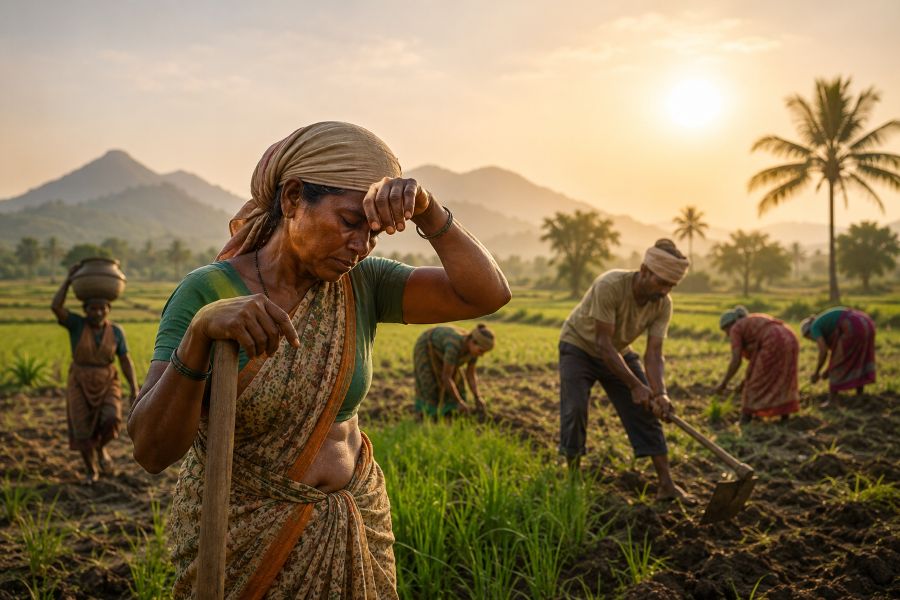
Rising heat is becoming a public health and livelihood challenge
India’s Corporate Social Responsibility (CSR) ecosystem has evolved into one of the world’s largest structured corporate giving frameworks since the implementation of mandatory CSR provisions under the Companies Act, 2013. According to analyses of Ministry of Corporate Affairs filings and sectoral CSR reports, Indian companies collectively spend over ₹30,000 crore annually on CSR activities, with healthcare consistently remaining among the top-funded sectors alongside education.
Healthcare alone accounts for roughly one-fourth of total CSR expenditure in several recent reporting cycles. However, while CSR healthcare spending continues to expand, climate resilience, occupational health, and rural adaptation remain comparatively underfunded despite rapidly rising exposure risks.
This reveals an increasingly important structural mismatch. CSR healthcare in India is still largely shaped by institutional delivery models such as hospitals, diagnostic camps, mobile medical units, and increasingly, digital health platforms. What remains relatively under-addressed is the growing burden of climate-linked occupational health risks, particularly across rural and agricultural labour systems.
This challenge is becoming more urgent as India experiences more frequent and prolonged periods of extreme heat. The Lancet Countdown on Health and Climate Change 2025 reported that people in India experienced nearly 20 heatwave days on average in 2024, of which approximately 6.5 days were directly attributable to human-induced climate change.
The report also estimated that India lost nearly 247 billion potential labour hours in 2024 due to heat exposure, with agriculture and construction accounting for a significant share of these losses. For low-income households dependent on daily wages, these productivity declines directly translate into income insecurity and livelihood stress.
These figures underline a broader shift in the climate conversation. Heat is no longer only an environmental concern; it is increasingly becoming a workforce health, livelihood, and economic resilience issue. India’s National Disaster Management Authority has previously described heatwaves as a “silent disaster,” while global bodies such as the World Health Organization and International Labour Organization increasingly classify extreme heat as both a public health and occupational safety challenge.
The Intergovernmental Panel on Climate Change has also repeatedly identified South Asia as one of the world’s most heat-vulnerable regions, with rising temperatures expected to significantly affect labour productivity, health systems, and vulnerable communities.
Indian climate scientists, including Dr. Roxy Mathew Koll, have repeatedly warned that rising frequency and intensity of extreme heat events are among the clearest manifestations of climate change in South Asia, with disproportionate impacts on populations dependent on outdoor labour systems.
Heat stress is now a documented occupational health risk
Global health institutions have repeatedly warned about the growing impact of heat exposure on outdoor workers.
The World Health Organization has identified heat stress as a major occupational health hazard linked to dehydration, heat exhaustion, cardiovascular strain, and heat stroke, particularly among workers performing physically demanding labour outdoors.
Similarly, the International Labour Organization (ILO) has warned that rising temperatures are reducing safe working hours globally and increasing health risks for workers in agriculture, construction, and informal sectors. The organisation has also repeatedly emphasised that excessive workplace heat threatens both worker health and decent work conditions.
According to ILO estimates, heat stress could result in the loss of more than 2% of total working hours worldwide by 2030, equivalent to over 80 million full-time jobs, if global warming continues at current trajectories.
India faces heightened vulnerability because a large share of its workforce remains dependent on outdoor and informal labour systems. Agriculture alone continues to employ a substantial rural workforce, including millions of women engaged in seasonal and informal agricultural labour involving sowing, transplanting, and harvesting under direct sun exposure.
Yet access to protective infrastructure such as shaded rest spaces, cooling systems, hydration facilities, and regulated heat-safe work practices remains uneven across many labour-intensive sectors.
Climate-health experts like Dr. Kris Ebi have increasingly warned that rising heat exposure should be viewed as a chronic public health challenge affecting labour productivity, long-term health outcomes, and economic resilience rather than only an episodic weather emergency.
Emerging evidence links repeated heat exposure with long-term health risks
Beyond immediate heat-related illness, researchers are increasingly examining the long-term physiological impacts of repeated occupational heat exposure.
A 2025 study published in Lancet Regional Health – Southeast Asia examining agricultural workers in Tamil Nadu found:
• Chronic kidney disease (CKD) prevalence among agricultural workers at 5.31%
• CKD of unknown origin (CKDu) prevalence at approximately 2.66%
• Repeated reductions in kidney filtration indicators during peak heat periods among outdoor workers
Researchers noted that recurring dehydration and prolonged heat exposure may be contributing factors requiring deeper longitudinal investigation.
Globally, similar concerns have emerged in agricultural regions of Central America and Sri Lanka, where studies have explored associations between chronic dehydration, heat stress, and kidney disease among outdoor workers.
In India, institutions including the Indian Council of Medical Research have increasingly highlighted the need for further research into climate-linked occupational health risks and non-traditional kidney disease patterns not associated with diabetes or hypertension.
Importantly, these are often not acute outbreaks or immediately visible emergencies. They are slow-onset occupational health declines that may remain undetected until advanced stages of illness emerge.
Rural women face layered climate-health vulnerabilities
The health burden associated with rising heat exposure is not evenly distributed.
Women engaged in agricultural and informal labour systems often face compounded vulnerabilities linked to workplace conditions, sanitation access, and unpaid care responsibilities.
Field-based occupational health studies in high-heat environments have documented that some women workers intentionally reduce water intake during work hours because of limited sanitation facilities near fields and labour sites. Some studies among salt pan and agricultural workers in India have also documented extremely low fluid intake during long work shifts in high-heat environments, creating sustained dehydration cycles that may directly affect kidney function over time.
Women in rural households also frequently continue domestic and caregiving responsibilities after physically demanding outdoor labour, increasing cumulative fatigue and heat exposure across the day.
Global organisations including the World Health Organization have warned that climate-related health risks disproportionately affect populations already facing structural inequalities, including women in informal labour systems.
Climate-linked mental health stress is also rising in agrarian communities
Beyond physical health impacts, climate variability is increasingly affecting mental health outcomes across rural populations.
The World Health Organization has identified climate change as a growing risk factor for anxiety, stress, and mental health vulnerability linked to economic insecurity, displacement risks, and environmental uncertainty.
In agrarian communities, erratic rainfall, crop loss, debt pressures, and declining productivity frequently create sustained psychological stress. Women often shoulder dual responsibilities linked to agricultural labour and household food security, intensifying emotional and physical strain.
However, many CSR mental health responses remain heavily dependent on app-based counselling and tele-mental health platforms. While such interventions may work effectively in urban contexts, implementation challenges persist in rural areas because of limited digital access, connectivity gaps, privacy concerns, and cultural barriers around remote counselling systems.
This creates a recurring implementation gap where initial outreach may expand, but long-term engagement and continuity of care remain uneven.
CSR healthcare spending remains structurally tilted toward institutional and digital models
India’s CSR healthcare investments have expanded steadily in recent years, but spending patterns continue to reflect a strong preference for scalable and reportable institutional interventions.
A significant share of healthcare-focused CSR spending currently supports:
• Hospital infrastructure
• Mobile medical units
• Diagnostic camps
• Telemedicine and digital health platforms
• Awareness and outreach campaigns
These interventions have improved healthcare access in many underserved regions and remain important components of healthcare delivery.
However, climate-health experts increasingly argue that healthcare interventions cannot remain limited to downstream treatment models while climate-linked occupational risks continue to rise at the source of exposure itself.
The challenge is particularly visible in the growing reliance on technology-led healthcare delivery.
Digital health and telemedicine initiatives have expanded rapidly after the pandemic, but implementation studies across low-resource settings continue to show uneven adoption due to barriers related to device access, connectivity, digital literacy, and privacy.
India’s public healthcare delivery system still depends heavily on community-based outreach structures including ASHA workers, primary health centres, and frontline health systems under the National Health Mission framework.
This suggests that climate-health resilience in rural India may require stronger integration between healthcare delivery, local governance systems, and workplace-level preventive infrastructure.
Policy systems are beginning to recognise heat as a governance challenge
India has already begun acknowledging heat as a public health and disaster management issue.
The National Disaster Management Authority has issued heatwave management guidelines encouraging state and local authorities to strengthen preparedness, early warning systems, and public awareness mechanisms.
The Ahmedabad Heat Action Plan, developed through collaboration between municipal authorities, public health experts, and research institutions, is widely cited as one of South Asia’s earliest structured heat adaptation frameworks. The model includes:
• Early warning systems
• Public heat advisories
• Hospital preparedness measures
• Awareness campaigns targeting vulnerable populations
Climate-health researchers increasingly view such approaches as examples of integrated adaptation planning that combine public health, governance, and environmental risk management.
What more integrated CSR interventions could look like
Some organisations have already begun experimenting with more grounded climate-health approaches.
The Self Employed Women’s Association has worked on livelihood protection, occupational safety, and resilience-building for informal women workers across multiple states, including initiatives linked to heat awareness, water access, and local adaptation planning.
Similarly, Mahila Housing Trust has implemented interventions focused on cooling infrastructure, heat-resilient housing, and community-level climate adaptation measures in vulnerable urban and peri-urban settlements. The organisation has also supported localised heat-risk mapping and awareness programmes designed specifically for low-income women workers.
The Aga Khan Agency for Habitat has additionally worked on community-based climate resilience and risk reduction programmes that integrate local infrastructure planning, disaster preparedness, and environmental adaptation strategies for vulnerable populations.
In parts of India, non-profit and research collaborations have also experimented with practical heat adaptation measures such as shaded community spaces, passive cooling techniques, reflective roofing materials, decentralised water access points, and locally managed early-warning systems for extreme heat events.
On the policy innovation side, some early-stage experiments globally are also exploring climate-linked insurance mechanisms tied to temperature thresholds, enabling vulnerable workers to reduce exposure during periods of extreme heat stress.
These approaches suggest that future CSR healthcare models may need to move beyond episodic medical interventions and toward continuous exposure reduction strategies.
For CSR stakeholders, this could include:
• Heat-safe worksite infrastructure
• Shaded rest areas near fields and labour sites
• Hydration and cooling access points
• Community-led preventive health screening
• Local heat-alert awareness systems
• Partnerships with panchayats, FPOs, and frontline health workers
• Integration of ASHA-led climate-health monitoring systems
Such interventions align healthcare more directly with the environments where climate-linked health risks are actually produced.
Conclusion
The evidence emerging from climate science, occupational health research, and field-level studies increasingly points toward the same conclusion: rising heat is becoming a structural determinant of health, labour productivity, and livelihood security for millions of outdoor workers in India.
The Lancet Countdown 2025 estimates of labour-hour losses, WHO guidance on heat stress, ILO warnings on occupational exposure, IPCC climate assessments, and emerging Indian research on agricultural worker health all reinforce the scale of the challenge.
Health risks are increasingly being produced at the site of work itself.
For India’s CSR ecosystem, this presents an important strategic shift.
Healthcare-focused CSR can no longer remain limited to hospitals, diagnostic camps, digital platforms, or episodic outreach models alone. As climate risks intensify, the next phase of impact may depend equally on preventing exposure, reducing physiological stress, and strengthening resilience within the environments where vulnerability is highest.
That means investing not only in treatment capacity, but also in hydration infrastructure near fields, shaded workspaces, cooling systems, structured rest cycles during heat alerts, community-based health monitoring, and preventive climate-health systems rooted in local realities.
In a warming India, the future of CSR healthcare may ultimately be measured not only by how many people receive treatment, but by how effectively communities are protected from preventable climate-linked health risks before they escalate into long-term illness.
And that shift may begin not in hospitals or apps, but in the fields where exposure begins every morning under an increasingly harsh sun.








.JPG)