The Power of Data: Turning Sustainability Intent into Measurable Action
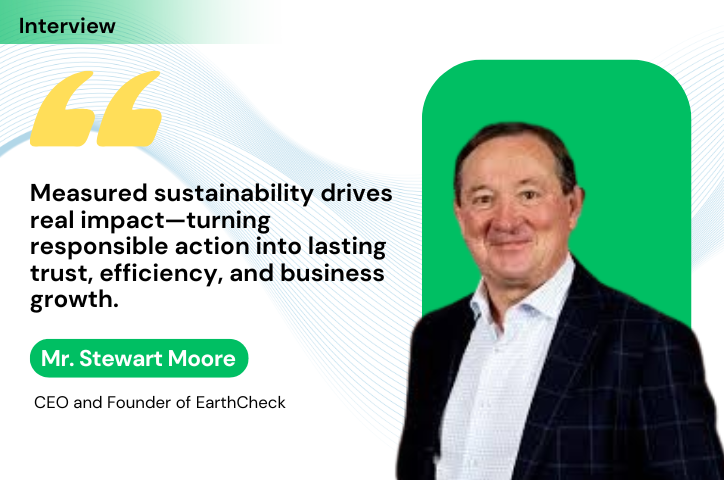
As sustainability moves from intent to expectation, the hospitality sector faces a pressing question: how can commitments translate into measurable impact? Stewart Moore, CEO and Founder of EarthCheck, brings a global, data-driven perspective shaped by decades of working with governments and industry to benchmark and improve sustainability performance. Through EarthCheck’s certification and advisory work, he has consistently advocated for embedding scientific measurement at the heart of business strategy. For a resource-intensive sector like hospitality, this shift is especially critical in markets like India, where rising travel demand intersects with growing pressure on water, energy, and waste systems. Moore underscores that data is not merely a reporting requirement but a strategic tool that drives efficiency, accountability, and long-term value. This article examines how structured measurement and credible verification can help transform sustainability from a stated priority into a measurable business advantage.
There have been substantial changes in terms of sustainability within the hospitality sector during the last couple of years. With ambitions being increasingly incorporated into organizational strategies, there is inevitably an increasing focus on how success can be measured. The next logical step would be for organizations to ensure their commitments materialize by developing sound measures. If such ambitions can be backed by strong operational data, they can also serve as drivers of organizational success.
The reality is that the hospitality is inherently resource-intensive. A full-service hotel can consume between 200–400 litres of water per guest per day, while energy use per occupied room in luxury properties can be 2–3 times higher than in mid-scale formats. Waste generation, particularly food and single-use materials, continues to be a structural challenge.
The HORECA industry has recognised the need to move from sustainability as a narrative to sustainability as a disciplined, measurable strategy embedded in operations, guided by data, and strengthened through independent science.
Why Data changes behaviour
What gets measured gets managed but more importantly, what gets benchmarked gets improved. When organisations begin to track performance across core parameters such as energy intensity, emissions, water usage, and waste, they gain visibility into inefficiencies that are otherwise invisible in day-to-day operations.
Globally, data-backed interventions in hospitality have demonstrated tangible impact:
- Smart energy management systems can reduce consumption by 15–25%
- Water recycling and reuse systems can lower freshwater demand by up to 30%
- Food waste tracking programmes have shown reductions of 20–40% in large hotel kitchens
These are not marginal gains. They directly influence operating margins in an industry where cost pressures are structurally high.
Leading hotel groups understand this. For instance, the IHCL Group - operating the iconic Taj brand has embedded benchmarking and EarthCheck certification across 100 properties. The results demonstrate what rigorous measurement makes possible. Across these measured properties, a significant proportion of properties outperformed the regional benchmark level as well. The parameters included, energy and emissions, which exceeded by 60% and 70% respectively, along with 29% higher performance for potable water, and an inspiring 83% of properties for landfill. This is in part due to IHCL’s commitment to continual improvement and bettering of practices over time.
Across the past decade, the group has shown significant reductions in these four key pillars of sustainability performance. Other stats further show that IHCL has reduced their energy intensity by 18%, their emissions intensity by 35%, potable water intensity by 34%, and waste to landfill intensity by 46%.
These outcomes were driven by targeted interventions including:
- Green energy being utilised at key locations.
- Introduction of EV chargers at key sites.
- Replacement of conventional cooling systems with sustainable cooling technologies.
- Deployment of IoT-based energy management systems and Demand Flow solutions for chiller optimisation.
- Adopting fossil fuel–free laundry utilising energy-efficient alternatives.
- Installation of organic waste composters.
- Establishment of in-house water bottling plants.
- Elimination of single-use plastics.
The result is sustainability transformed from a cost centre into a strategy, reducing operating costs, strengthening investor reporting, and building the kind of verified credibility that increasingly determines access to sustainability-linked capital.
The India Context
It is important to understand that sustainability is a cost conversation, and for India that embodies a complex ecosystem, this is a primary concern. Domestic travel is expected to cross 2 billion visits annually in the coming years, even as nearly 600 million Indians face high to extreme water stress. Energy demand continues to rise, and urban infrastructure remains uneven.
For hospitality operators, this creates a dual pressure of managing rising resource costs and meeting increasing ESG expectations from investors and consumers In this environment, data-led sustainability is no longer about compliance, it is about operational resilience and it is critical.
Powering the future
From hotel visitors to investors, stakeholders from all segments of the hospitality industry are demanding tangible evidence, backed by numbers, of environmental performance.
Certification, benchmarking, and third-party verification are not just nice things to aim for; they are crucial tools for establishing credibility and demonstrating commitment. The industry needs to imbibe a simple principle; Measure what matters. Act on what the data tells you. Report outcomes with transparency.
The parting thought is rooted in the fact that when sustainability, when grounded in data, stops being a moral obligationm and becomes a business advantage.