India Tightens Plastic Waste Rules with Recycled Content Mandate and Stronger EPR Framework
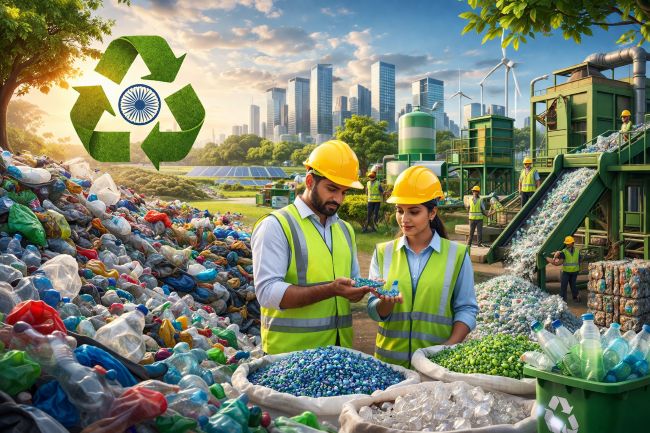
India is entering a more decisive phase in its fight against plastic pollution, with recent regulatory developments signalling a shift from policy intent to measurable action. A series of updates to the Plastic Waste Management framework now place stronger obligations on businesses, particularly around the use of recycled plastic, traceability, and compliance under Extended Producer Responsibility or EPR.
From Waste Collection to Material Circularity
The latest move making headlines is the government’s push to make the use of recycled plastic content in packaging mandatory. Producers, importers and brand owners will now be required not only to meet recycling targets but also to incorporate recycled material into their packaging. Labelling requirements are also being introduced to disclose recycled content, bringing greater transparency to the system.
This marks an important shift in approach. Until now, the focus has largely been on collection and recycling targets under EPR guidelines. With this change, the emphasis moves further along the value chain toward actual utilisation of recycled material. In simple terms, companies will now be expected to close the loop rather than just facilitate it.
The regulatory push comes at a time when India is generating over 3.4 million tonnes of plastic waste annually, according to official estimates, with a significant portion still not fully recycled. At the same time, more than 60,000 producers, importers and brand owners have been brought under the EPR framework, indicating the scale at which compliance mechanisms are now being enforced.
For industry, this has both operational and strategic implications. Sectors such as FMCG, food and beverage, and e-commerce, which rely heavily on plastic packaging, will need to reassess sourcing, packaging design, and supplier partnerships. The availability and quality of recycled plastic will become a key factor, potentially driving investments in recycling infrastructure and material innovation.
Alongside this, the regulatory environment around EPR is also becoming more stringent. Recent updates indicate tighter scrutiny of compliance mechanisms. One significant change is the restriction on the use of end of life disposal certificates as a means to meet EPR targets. This effectively discourages practices that rely on disposal rather than recycling and pushes companies toward more sustainable waste management pathways.
Officials from the Ministry of Environment, Forest and Climate Change have consistently emphasised that the objective is to ensure that plastic waste is scientifically managed and does not end up in the environment, while also promoting a circular economy approach. The Ministry has also highlighted that EPR implementation is being strengthened through a centralised online portal to improve transparency, monitoring and accountability.
The government’s intent is clear. The hierarchy of waste management is being reinforced, with priority given to reduction, reuse and recycling over disposal. This aligns with global best practices and reflects a maturing of India’s regulatory approach to plastic waste.
Another important development is the push for improved traceability within the plastic value chain. Digital tools such as centralised EPR portals and tracking mechanisms are being strengthened to ensure that plastic waste is accounted for more accurately. With thousands of registered entities under the EPR regime, the need for transparent and verifiable data has become critical.
From a compliance perspective, companies are now expected to engage more actively with reporting requirements, audits and documentation. This may increase the short term compliance burden, but it also creates a more level playing field and reduces the scope for non compliant actors.
Challenges Persist Amid Policy Momentum
These changes are also likely to influence the broader sustainability landscape in India. As recycled content becomes a requirement rather than a voluntary commitment, it could accelerate the growth of a domestic recycling market. This, in turn, may create new opportunities for waste management enterprises, social businesses and informal sector integration.
At the same time, challenges remain. The supply of high quality recycled plastic is still evolving, and there are concerns around cost implications for businesses. Small and medium enterprises may find it particularly difficult to adapt without adequate support. There is also a need for stronger infrastructure at the collection and segregation level to ensure a consistent feedstock for recycling units.
However, the direction of policy leaves little room for ambiguity. India is moving toward a more circular model for plastics, where accountability is distributed across the lifecycle of the product. For corporates, this means that sustainability can no longer be treated as a peripheral function. It must be integrated into core business strategy, procurement and product design.
From a CSR and ESG perspective, these regulatory shifts open up new areas of engagement. Companies may increasingly invest in waste management ecosystems, support innovation in materials, and collaborate with local bodies and civil society organisations. The intersection of compliance and impact is becoming more pronounced.
The Missing Link Between Compliance and Consumption
An emerging question that remains largely unaddressed is whether regulatory tightening alone can significantly reduce plastic waste without a corresponding shift in consumption patterns. While the current framework places strong accountability on producers and brand owners, it does not directly address the growing demand for convenience driven packaging, especially in urban and e-commerce driven consumption. As recycled content becomes mandatory, there is a possibility that plastic use may continue at similar or even higher levels, albeit in a more circular form. This raises a critical consideration for policymakers and industry alike. Can India move beyond managing plastic more efficiently to actually reducing its dependence on it?
At the same time, the evolving compliance landscape may also reshape how companies deploy their social investments. With EPR obligations becoming more stringent and measurable, there is a growing likelihood that corporates will begin aligning portions of their CSR initiatives with waste management ecosystems, such as supporting collection infrastructure, material recovery facilities, and integration of informal waste workers. While CSR funds cannot be used to meet statutory EPR obligations directly, they can play a complementary role in strengthening the broader ecosystem that enables compliance. This convergence of compliance and impact could redefine how companies approach sustainability, blurring the lines between regulatory responsibility and voluntary social investment.
The next phase of the conversation may therefore need to bring consumers, retailers and product design more actively into the fold, shifting the focus from end of pipe solutions to systemic reduction strategies.
As India advances its plastic waste management agenda, the conversation is also expanding beyond regulation to include innovation, collaboration and accountability. These themes are expected to take centre stage at platforms such as the Climate Action and Sustainability Conference and Awards 2026, where industry leaders, policymakers and practitioners will come together to discuss scalable solutions and emerging trends.
As regulatory pressure intensifies, the real test for India Inc. will be not just compliance, but the ability to rethink plastic use itself.