She Who Feeds the Nation: Time to Recognise India’s Women Farmers
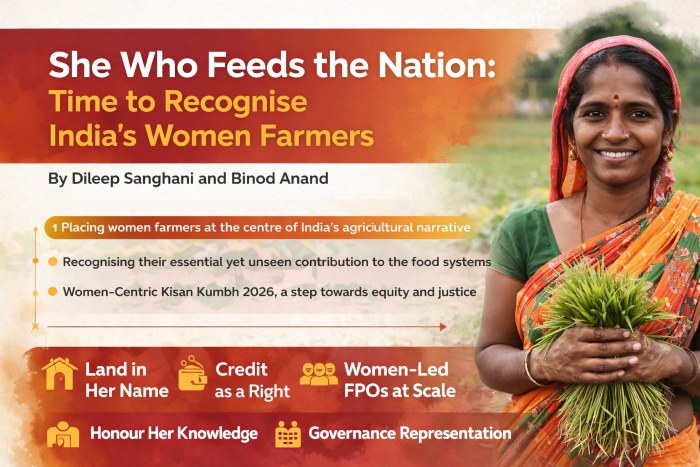
By Dileep Sanghani and Binod Anand
At a time when India is accelerating toward inclusive growth and rural transformation, voices from the cooperative and policy ecosystem are calling for a long-overdue shift—placing women farmers at the centre of the agricultural narrative. Drawing from decades of grassroots engagement and policy experience, Dileep Sanghani, a veteran of India’s cooperative movement, and Binod Anand, a key contributor to agricultural reforms and MSP policy, present a compelling perspective on the invisible backbone of India’s food systems—the woman farmer. Their joint opinion reflects both institutional insight and lived realities from rural India, setting the stage for a deeper national conversation on equity, recognition, and structural reform.
Before the World Wakes, She Is Already at Work
There is a woman in every field of India. She rises in the dark, long before the first call to prayer, before the milk cooperative opens its doors, before the mandi stirs to life. She wraps her sari against the cold, and walks — sometimes barefoot, sometimes miles — to the land she tends but rarely owns. She carries a child on her hip and a hoe in her hand. She has no soil testing kit, no weather app, no government extension officer waiting at her door. What she has is knowledge older than any agricultural university: the colour of leaves, the smell of coming rain, the feel of soil that is alive versus soil that is dying.
And she begins. She sows. She weeds. She irrigates. She harvests. She threshes. She sorts. She stores. When the grain has been sold and the season's accounts tallied, she rarely appears in that ledger. The income registers in her husband's name. The credit goes to the household. The subsidy reaches a Kisan Credit Card that does not bear her photograph. The MSP procurement queue has no space reserved for her. And the next morning, she rises again before the world, and begins once more.
India's 140 crore citizens eat because she does this. Every day. Without fail. Without recognition. Without complaint.
 The Numbers That Shame Us Into Attention
Let us be precise, because the women farmers of India deserve the dignity of accurate accounting rather than vague applause. Women constitute nearly 80 percent of all marginal farmers in India. They perform between 60 and 75 percent of total agricultural labour — from seed selection, sowing, weeding, and transplanting, to harvesting, threshing, post-harvest drying, and livestock management. The International Labour Organization estimates that women contribute over 3.5 billion hours of unpaid agricultural labour every year in South Asia alone — labour that, if compensated at even the minimum wage, would amount to a sum that would dwarf most rural development budgets.
Yet less than 13 percent of agricultural land in India is held by women. Fewer than 12 percent of formal agricultural loans go to women farmers. Representation in cooperative governing boards hovers in the low single digits in most states. And in policy rooms — the rooms where MSP is fixed, where crop insurance is designed, where natural farming roadmaps are drawn — the voice of the woman farmer is, at best, an occasional guest.
“Krishivalo Dharmo Lokasya”
Agriculture is the righteous order of the world. — Arthashastra of Kautilya
The Arthashastra commands us to protect and honour those who uphold this dharma. No one upholds it more faithfully than the women who bend their backs in India's fields every dawn. If dharma is to mean anything in our policy making, it must begin with her.
The White Revolution Was Her Revolution
India today produces more milk than any other nation on earth. Over 230 million metric tonnes annually. A triumph that is discussed in economic reports, celebrated in cooperative movement histories, and attributed to institutions, infrastructure, and the genius of Tribhuvan Das Patel . All of that is deserved. But there is a crucial truth that tends to disappear in the telling: the White Revolution was, at its operational heart, a women's revolution.
It is the woman of the Indian household who manages the cow and the buffalo. She is the one who wakes before dawn to milk the animal, measures the yield with her hands, carries the milk to the collection centre in a steel vessel balanced on her head, and accounts for every litre. She maintains the animal's health through traditional knowledge — knowing when to change fodder, when to call the vet, when the animal is about to calve. The veterinary doctor visits once a month. She is there every hour of every day.
The Amul model — rightly hailed as one of the great cooperative achievements of the twentieth century — functions on the ground because of her. The village dairy cooperative is, in practice, a women's institution even when its governance structure does not reflect that reality. Studies conducted across Gujarat, Rajasthan, and Uttar Pradesh consistently show that in households affiliated with dairy cooperatives, women perform over 70 percent of the dairying labour. The milk that fills the tankers that feed the nation's cities is, overwhelmingly, her milk. The credit, however, flows elsewhere.
“Gavaam Maataa Sarva Bhuutaanaam”
The cow is the mother of all beings — and she who nurtures the cow nurtures the world.
If India stands atop the world in dairy, it is because of this woman — unnamed, uncelebrated, rising before dawn in ten million villages — who has kept the flame alive through drought, through economic distress, through the indifference of policy, and through the silence of history. The globe must do more than notice. The globe must thank her. And then the globe must act.
 A Life the World Has Never Fully Seen
We write these words not from the comfort of abstraction, but from what we have witnessed across the length and breadth of rural India — in the paddy tracts of eastern UP, in the tribal belts of Jharkhand, in the drylands of Bundelkhand, and in the hills of the northeast. The life of the woman farmer is hard in ways that do not make headlines.
She carries water before she carries food. In hundreds of thousands of villages, the nearest reliable water source is still a kilometre or more away, and the daily ritual of water collection falls, almost without exception, to the woman. She walks this distance before the sun rises and before she walks to her field. By the time she sits to eat in the evening, she has walked distances that would exhaust a trained athlete. She does this at eight years old and at eighty.
Her body bears the cost of a lifetime of agricultural labour. Cervical spondylosis from carrying head loads. Knee degeneration from squatting in fields. Skin diseases from unprotected chemical exposure. Vision problems from years of working in open sunlight. Anaemia — almost universal — from inadequate nutrition and the last-to-eat culture of rural households where she serves everyone before she serves herself. The public health data on women agricultural workers makes for grim reading. Yet no occupational health framework in India has ever been seriously applied to her work.
She lives the contradiction of being the most essential and the most expendable figure in the rural economy. When prices fall, it is her labour — unpaid — that absorbs the shock. When a crop fails, it is her gold that is the first collateral. When the male farmer migrates to the city, it is she who becomes the farm manager by default, without training, without credit, without support. And when the rains return and the harvest is good, it is rarely her name in the celebration.
Kisan Kumbh 2026: New Delhi, 30–31 March - A Convergence Long Overdue
It is against this backdrop of both immense contribution and persistent neglect that we welcome, with genuine conviction and institutional commitment, the Women-Centric Kisan Kumbh 2026 — to be held on the 30th and 31st of March at the campus of the Indian Institute of Technology, New Delhi. The Kisan Kumbh is co-organised by the Centre for Rural Development and Technology (CRDT) at IIT Delhi, the Cowtrition Foundation, and a consortium of partner organisations drawn from the cooperative, agricultural research, and rural development ecosystem.
The name Kumbh is not chosen lightly. The Kumbh is India's most ancient metaphor for convergence — of rivers, of wisdom, of the nation's collective will. A Kisan Kumbh, then, is a gathering not of sadhus but of those who till the sacred earth, a mahakumbh of agrarian purpose. And a Women-Centric Kisan Kumbh is a declaration: that the woman who has been at the margin of our agricultural story must now be placed at its centre.
The deliberations at IIT Delhi will span two full days. The agenda encompasses gender-responsive MSP policy design, women-led Farmer Producer Organisations (FPOs) and their institutional strengthening, access to cooperative credit and the Kisan Credit Card for de facto women farm operators, land rights and joint titling reforms, recognition and documentation of indigenous agricultural knowledge held by women, women's representation in cooperative governance, and the role of natural and zero-budget farming — domains where women are already the primary practitioners.
Importantly, the Kisan Kumbh takes place in the inaugural year of the International Year of Women Farmers — a designation that carries both the endorsement of the global community and the weight of urgent obligation. The United Nations, in recognising this year, has called on member states to move from symbolic gestures to structural change. The Kisan Kumbh is India's response to that call — concrete, grounded, and powered by institutional commitment at the highest level.
We call upon every stakeholder — from state governments and central ministries to cooperative federations, agricultural universities, civil society organisations, and the private sector — to engage with the Kisan Kumbh in the spirit it deserves. Not as observers, but as co-architects of a policy transformation that this nation's women farmers have waited too long for.
What Justice Looks Like: A Five-Point Commitment
First, Land in Her Name: The single most transformative act any state government can undertake is to ensure that land rights are registered jointly or solely in the name of women farmers. Without land, she has no collateral, no legal standing, and no institutional voice. Joint titling must become the default, not the exception.
Second, Credit as a Right: The Kisan Credit Card, crop insurance under PM Fasal Bima Yojana, and PM Kisan income support must reach women who are the operational managers of agricultural households, regardless of whose name the land deed carries. Operational control, not title, must determine eligibility.
Third, Women-Led FPOs at Scale: Of the 10,000 Farmer Producer Organisations under the Government of India's initiative, a significant and mandatory proportion must be women-led, with dedicated capacity building, market access, and cooperative credit linkages. An FPO ecosystem that excludes women is an FPO ecosystem built on borrowed time.
Fourth, Honour Her Knowledge: The indigenous agricultural and dairying knowledge held by women — in seed conservation, integrated pest management, fodder management, and animal health — is a national resource. It must be formally documented, compensated, and integrated into India's natural farming mission and ICAR research priorities.
Fifth, Governance Representation: No agricultural cooperative, commodity exchange, or rural financial institution should be eligible for government support without demonstrating meaningful women's representation at its governing board. This is not a quota; it is accountability.
A Closing Word — With Wisdom, and a Little Wit
“Maataa Bhumih Putroham Prithivyaah”
The Earth is the Mother; I am her child. — Atharva Veda 12.1.12
The woman farmer is not a symbol. She is not in the beneficiary category. She is not a poster for a scheme. She is the operational spine of Indian agriculture, the invisible infrastructure of Indian dairy, and the unacknowledged curator of India's food sovereignty. She is, quite literally, the reason the rest of us have the leisure to write columns, attend conferences, and pass policies in air-conditioned rooms.
There is a certain irony — not lost on students of history — that we have built temples to Annapurna, the Goddess of Food, in every corner of this land, while the living Annapurnas in our fields have gone without deeds, without credit, without so much as a paragraph in the district agricultural report. We worship the idea of the woman who feeds us, while quietly underpaying and under-recognising the actual woman who does the feeding. The theology has always been correct. It is the implementation that has been catastrophically behind schedule.
On the occasion of the Kisan Kumbh 2026, we offer this reminder to policy makers, cooperative leaders, agricultural scientists, and fellow citizens: the next time you sit down to a meal — whether it is dal and roti in a village, or a glass of milk in a city — know that somewhere, a woman woke before dawn to make it possible. She asked for nothing. She received less than that. It is time to correct a debt that has compounded over generations.
As the great cooperator and visionary Tribhuan Das patel once observed, the genius of the cooperative movement is that it makes the small powerful and the powerless sovereign. At the Kisan Kumbh, we intend to apply that genius — in full measure — to the most powerful and most overlooked force in Indian agriculture: the woman who farms. She has been patient long enough. India's soil knows her name, even if India's policy does not. Let the Kisan Kumbh be the moment we learn it — and remember it, permanently.