
Poland Turns to Reclaimed Sewage Water as India’s Data Centre Boom Raises Water Questions
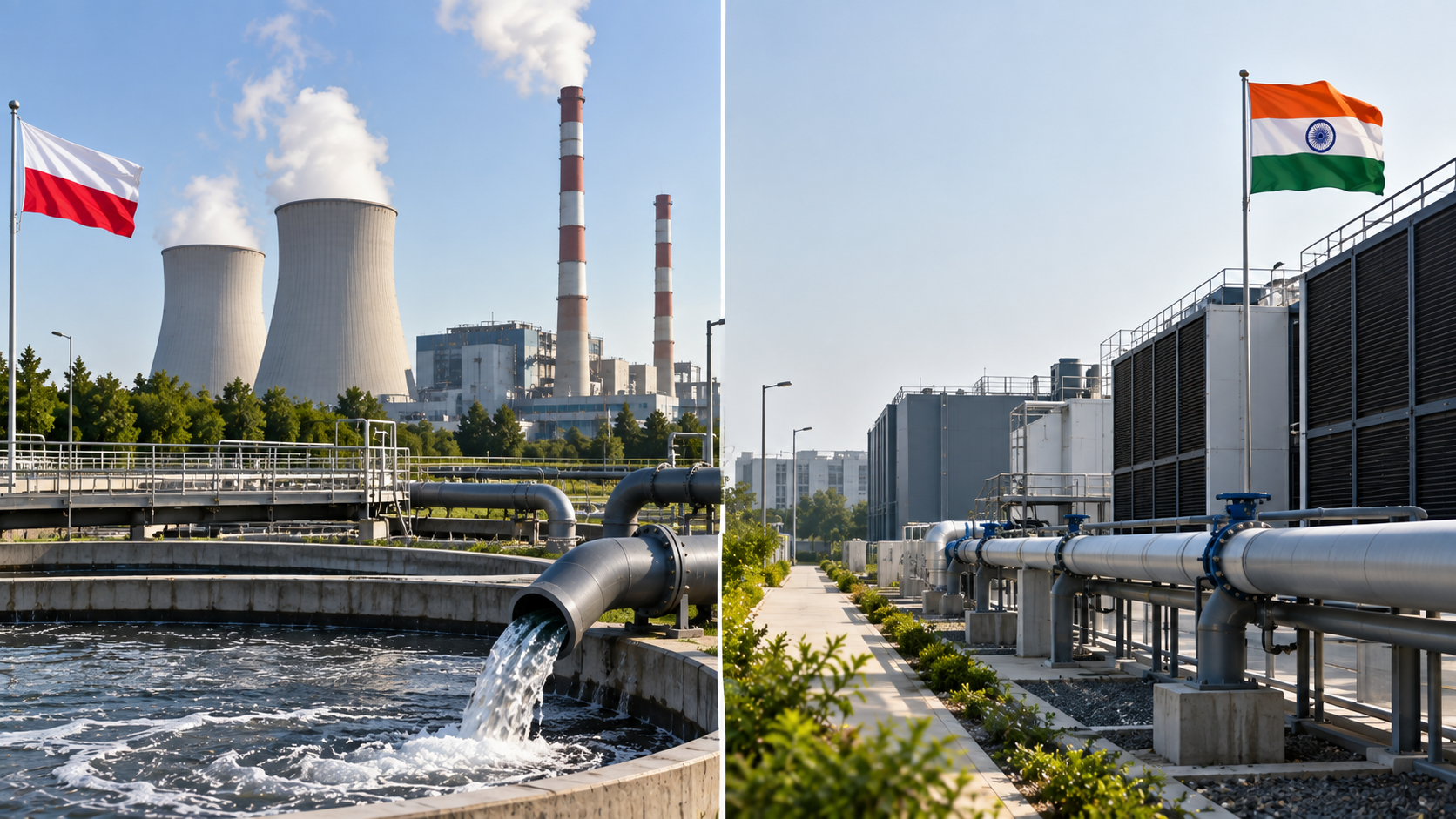
As countries race to expand power and digital infrastructure, water is emerging as an increasingly important sustainability concern. Poland has now taken a step towards reducing freshwater dependence by allowing reclaimed municipal wastewater to be used to cool power plants, an approach that could offer lessons for India as its data centre industry expands rapidly.
From January 2027, Poland will allow treated wastewater from municipal sewage systems to be used in the cooling circuits of power plants and combined heat and power plants. The move follows a summer of heatwaves, low rainfall and record-low river levels, which affected the operation of some power plants.
The idea is simple: instead of using freshwater for industrial cooling and then treating wastewater as a waste stream, water that has already been treated can be used again.
A key part of the initiative is being developed by ORLEN Termika, the energy company’s heating and power generation subsidiary. The company plans to invest more than PLN 1 billion (around €230 million) over four years to develop systems connecting wastewater treatment facilities with three of its energy and heating plants in the Warsaw region.
At the Żerań Combined Heat and Power Plant, which currently uses water from the Vistula River, the project is expected to reduce surface-water withdrawals by up to 80%. At the Siekierki plant, the expected reduction is around 20%.
ORLEN Termika is also working with MPWiK, Warsaw’s municipal water and sewage company, to recover energy from wastewater. The company plans to use heat pumps to extract heat from treated wastewater for district heating before the water is used in the cooling process.
The Żerań heat-recovery project has also received PLN 125.4 million in funding from Poland’s National Fund for Environmental Protection and Water Management, highlighting the wider environmental and infrastructure value attached to wastewater reuse and energy recovery.
The approach is particularly relevant for a country facing increasing water stress. It also reflects a wider circular-economy principle in which resources are recovered and reused rather than consumed once.
India faces a different but growing challenge
India's water challenge is becoming increasingly relevant to its digital infrastructure ambitions.
The country is witnessing rapid growth in data centres, driven by cloud computing, artificial intelligence and rising digital demand. A February 2026 study by the Council on Energy, Environment and Water (CEEW) estimates that India's data centres used approximately 150 billion litres of water in 2025. The study expects water use by the sector to more than double by 2030.
Water consumption varies significantly between facilities, however, depending on their location, climate and cooling technology. This makes the choice of cooling system an important part of the environmental footprint of a data centre.
The issue has already become visible around major projects. Google's proposed data centre development in Andhra Pradesh, estimated at $15 billion, has faced opposition from environmental groups and local residents concerned about its potential impact on water resources and wildlife. Reuters reported that Visakhapatnam already has a daily water supply shortfall of around 70 million litres. State authorities have disputed concerns about the project's impact, while Google has said it plans to use sustainable technologies, including air cooling.
The debate highlights a larger question for India: how should the country balance its need for digital infrastructure with the water needs of communities and ecosystems?
Alternatives are already emerging
There is no single solution to the water challenge. Cooling technology can make a significant difference.
Amazon, for instance, said in June that its Indian data centres do not use water for cooling. The company has also set a global target to become water positive in its data-centre operations by 2030.
Such examples show that the water footprint of data centres is not fixed. Choices around cooling technology, location, water sourcing and reuse can substantially change how much pressure a facility places on local water resources.
This is where Poland's move becomes relevant beyond its own power sector.
Can treated wastewater become part of India's solution?
India already generates large volumes of municipal wastewater, but a significant opportunity remains in treating and reusing it for industrial purposes.
For data centres located in water-stressed areas, the use of properly treated wastewater could potentially reduce dependence on freshwater, provided the necessary treatment, quality standards and infrastructure are in place.
The same principle could apply to other water-intensive industries and energy facilities.
The question, therefore, is no longer only about how much water India's expanding digital economy consumes. It is also about which water it uses, whether that water can be reused, and whether freshwater should be reserved for purposes where it is most essential.
As AI and data infrastructure continue to expand, water efficiency will need to become part of infrastructure planning from the beginning. Poland's decision offers one possible direction: treating wastewater not as the end of the water cycle, but as another resource that can re-enter it.