
LLF and Haryana School Education Department Launch TLPS 2025 Report at NIPUN 2.0 Leadership Conclave
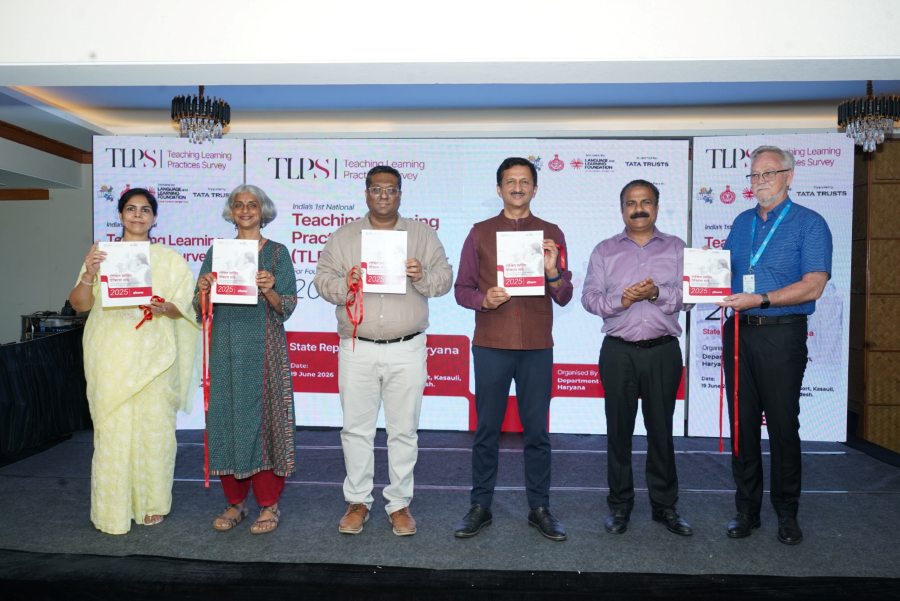
Kasauli, June 29, 2026: Language and Learning Foundation (LLF), in partnership with the Department of School Education, Government of Haryana, and with support from Tata Trusts, has launched the Haryana State-Level Teaching and Learning Practices Survey (TLPS) 2025 Report during the three-day NIPUN 2.0 Leadership Conclave in Kasauli, Himachal Pradesh.
The report examines teaching and learning processes in Classes 1 and 2 across 100 classrooms in Haryana, with a focus on strengthening foundational learning through improved classroom practices.
The findings were released in the presence of senior officials including Sh. Swapnil Ravindra Patil, State Project Director, Samagra Shiksha Haryana; Dr. Parmod Kumar, State Programme Officer, Directorate of School Education, Panchkula; Dr. Shailaja Menon, Consultant, Education Portfolio, Tata Trusts; and Smt. Seema Rajput, Director, State Programme Team, Language and Learning Foundation, among other academic experts and development partners.
The TLPS 2025 is described as one of India's most comprehensive studies of teaching-learning processes in early-grade classrooms, covering nine states. The Haryana sub-report specifically documents findings from 100 schools, 100 classrooms, and 100 teachers across Fatehabad and Rohtak districts. The survey drew on classroom observations, teacher interviews, lesson-sequence analysis, and time-on-task studies to examine classroom learning environments, lesson planning and delivery, language and mathematics teaching practices, and teacher professional development.
Key findings indicate high levels of teacher awareness regarding Foundational Literacy and Numeracy (FLN) goals. Nearly three-fourths of teachers reported attending in-person FLN training in the previous year, a majority reported receiving regular academic mentoring, and almost all expressed the view that the NIPUN and FLN missions are positively influencing classroom learning.
Sh. Swapnil Ravindra Patil, State Project Director, Samagra Shiksha Haryana, said: "The TLPS Haryana findings help us identify gaps between teaching practices and student learning. The real value of the report lies in how we use these insights for evidence-based planning and continuous improvement. If we are able to integrate TLPS findings with the Performance Grading Index (PGI), it can become a powerful tool for shaping future educational priorities and strengthening teaching quality across the state."
Amrita Pathwardhan, Deputy Head of Programmes, Tata Trusts, stated: "TLPS is valuable because it brings classroom practice into the centre of the FLN conversation. Haryana has been working to strengthen foundational learning through the NIPUN Haryana Mission, and these findings offer useful insights into how early-grade instruction can be further supported. The report points us towards the need to help teachers create classrooms where children participate actively, make meaning, and learn with understanding."
Dr. Dhir Jhingran, Founder and Executive Director, Language and Learning Foundation, said: "The Haryana TLPS 2025 Report gives us a valuable view of what is happening inside early-grade FLN classrooms. Haryana has taken some significant initiatives to improve foundational learning, and the TLPS 2025 report can help deepen that work by focusing on classroom practices, student participation, assessment, and differentiated support for struggling learners. Improving FLN in a sustained manner requires teachers, mentors, and systems, so that every child gets the support they need in the early years."
Haryana's foundational learning efforts have expanded considerably in recent years. Through the NIPUN Haryana Mission, the state is working to improve FLN outcomes for more than 8.68 lakh children across 8,663 government primary schools, supported by over 35,700 primary teachers and a structured academic capacity-building and monitoring framework.