
Beverage Cartons Can Be Recycled at Scale, Industry Leaders Say
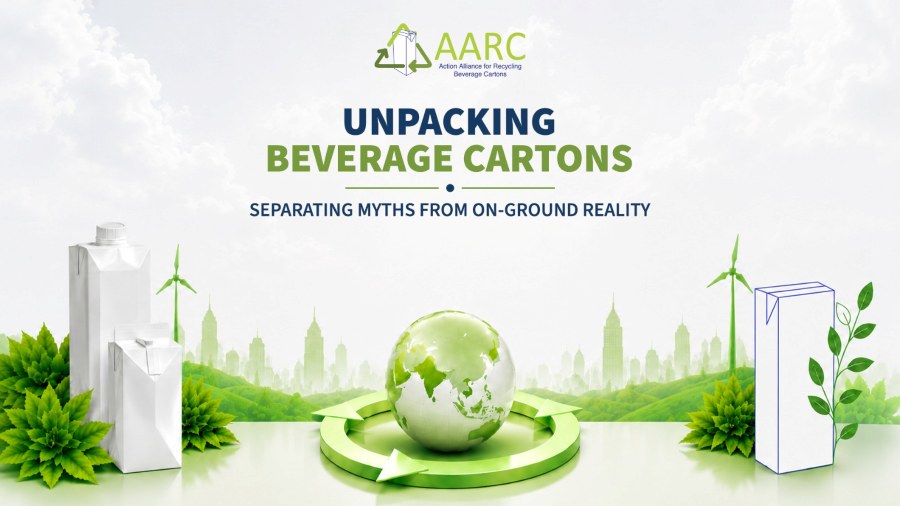
New Delhi, August 14, 2026: Beverage cartons can be collected and recycled at scale in India, but stronger collection, segregation and Extended Producer Responsibility (EPR) systems are needed to improve material recovery, industry stakeholders said at a webinar organised by the Action Alliance for Recycling Beverage Cartons (AARC).
Titled ‘Unpacking Beverage Cartons: Separating Myth from On-ground Reality’, the webinar brought together stakeholders from across the beverage carton value chain to discuss carton composition, collection, recycling, EPR and recycled content. The event also saw the release of the white paper, ‘Beverage Cartons in India: Advancing Food Safety, Sustainability, and Circularity’.
According to data presented during the discussion, India’s beverage carton recycling rate has increased to 48%, from 29% in 2011 and 45% in 2022. The assessment by TERI covered beverage carton flows across 24 cities, where recycling rates were estimated at around 60–66%. The study estimated that only about 5–6% of used beverage cartons in the cities assessed reached landfill.
Cassio Simoes, Chairman, AARC and Managing Director, Tetra Pak India, said, “Beverage cartons are often perceived as difficult to recycle because of their multi-material structure. In reality, they are predominantly paperboard-based, with approximately 70–75% paperboard fibre, alongside polymer and aluminium layers, and established recycling routes already exist for these materials. TERI’s national extrapolation puts India’s beverage carton recycling rate at 48%, up from 29% in 2011 and 45% in 2022. With around 21 billion beverage cartons consumed annually in India, and this volume expected to double by 2030, the priority now must be to strengthen collection, segregation and recycling systems so that more of this material is recovered and put back into productive use.”
The webinar noted that beverage cartons have established recycling pathways through paper mills and dedicated full-carton recycling facilities. Waste collectors, kabadiwalas, aggregators and recyclers also handle cartons through existing collection channels.
The discussion also covered the role of cartons in food safety and preservation. Narayanan Renganathan, Vice President and Head of Procurement, Dabur, said, “A beverage carton is much more than a package. It is designed to protect food, reduce spoilage and keep products safe and fresh for months without refrigeration. By combining paperboard with thin layers of aluminium and polymers, the format can help reduce dependence on refrigeration and the food waste associated with spoilage. Sustainability does not end when the consumer finishes the product — the paper fibres, polymers and aluminium can all be recovered and converted into new products. The opportunity now is to accelerate this transition through collaboration across the value chain.”
On EPR, panellists highlighted the need for better segregation infrastructure, collection systems and mechanisms that recognise actual recycling across different material-recovery pathways.
Shri G. Thirumurthy, Scientist F, Central Pollution Control Board (CPCB), said, “The scale of EPR implementation has increased significantly, but effective plastic waste management ultimately depends on what happens across the entire chain — from collection and segregation to transportation, recycling and end-of-life management. The next priority is to strengthen infrastructure, improve segregation and establish clear technical and operational mechanisms that translate policy objectives into measurable outcomes on the ground.”
The discussion also noted that EPR targets across plastic packaging categories increased from approximately 27.22 lakh tonnes in 2022–23 to around 80 lakh tonnes in 2024–25. Category III targets increased from approximately 3.6 lakh tonnes to 9.04 lakh tonnes during the same period.
Stakeholders also discussed recycled-content infrastructure, including recycled polymers for food-grade applications, certification and mass-balance systems. The webinar concluded with a call for greater coordination among waste collectors, recyclers, brands, policymakers and local bodies to strengthen collection and recycling systems for beverage cartons.