TeamLease Degree Apprenticeship on Reimagining CSR as a Catalyst for Women’s Workforce Integration
India stands at a defining moment in its development journey. As the country advances toward Vision 2047 and the aspiration of a Viksit Bharat, the question is no longer whether growth will occur, but how inclusive and sustainable that growth will be. With women contributing only a fraction of their potential to the national economy despite strong educational participation, bridging the gap between learning and livelihoods has become a national imperative. Structured, work based learning models are increasingly emerging as the missing link between policy intent and economic reality.
In this conversation, Dr Nipun Sharma, CEO of TeamLease Degree Apprenticeship, argues that apprenticeships must evolve from statutory obligations into strategic instruments of ESG, CSR, and nation building. He outlines how India’s policy architecture, from the Apprentices Act and NAPS to NATS, NEP 2020, and the National Credit Framework, provides a robust foundation for corporates to embed gender inclusive, degree linked apprenticeships within their talent pipelines. The discussion moves beyond skilling rhetoric to measurable outcomes, demonstrating how structured apprenticeship ecosystems can improve employability, reduce recruitment costs, strengthen retention, and most importantly, unlock women’s economic participation at scale.
At its core, the interview underscores a decisive shift in thinking. Apprenticeships are not peripheral CSR activities but powerful engines of inclusive growth that can convert education into careers, welfare into workforce participation, and demographic potential into economic power.
Scroll down to read the full interview:
Q. In the evolving landscape of corporate responsibility, how do you see apprenticeships moving beyond compliance to becoming a core pillar of ESG and inclusive growth strategies in India?
A. Apprenticeships are steadily moving from a compliance obligation to a strategic ESG lever that links skilling, inclusion, and sustainable workforce development. India has already engaged over 4.8 million apprentices under NAPS and over 1.1 million under NATS in recent years, showing scale and policy alignment. Currently India has almost 1 million active NAPS and over 0.4 million under NATS. At the same time, this scale is comparatively miniscule against our total active workforce, which signals a large untapped opportunity. When companies embed apprenticeships into their talent strategy, they are not just filling entry-level roles, they are building local supply chains, improving productivity, and creating structured pathways for underrepresented groups. This makes apprenticeship a measurable ESG outcome that supports inclusive hiring, community impact, and long-term workforce resilience rather than a statutory requirement.
Q. Given that women contribute only 18 percent to India’s GDP despite constituting nearly half the population, how can structured apprenticeship ecosystems serve as catalytic CSR interventions rather than peripheral skilling initiatives?
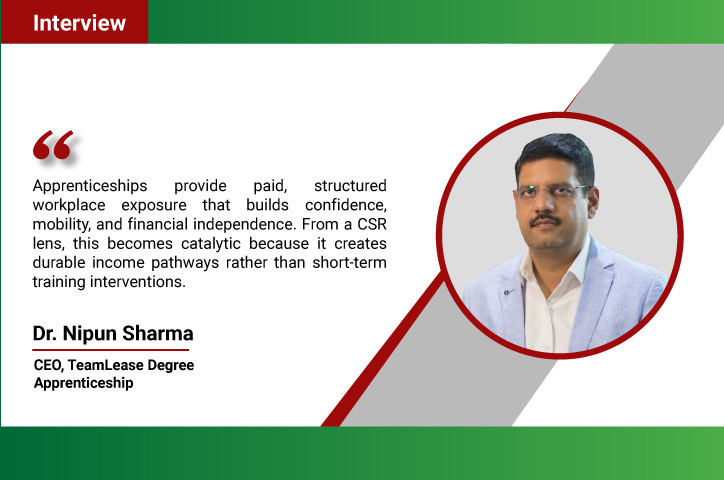
A. Structured apprenticeship ecosystems allow CSR to move from donation-led models to outcome-led workforce participation. Women already account for nearly 42-43% of higher education enrolments, yet only 34-37% of graduating women are considered employable by industry standards. This gap shows that education alone is not translating into careers. Apprenticeships provide paid, structured workplace exposure that builds confidence, mobility, and financial independence. From a CSR lens, this becomes catalytic because it creates durable income pathways rather than short-term training interventions. If scaled effectively, closing gender participation gaps could raise India’s GDP by up to 27%, making women’s workforce integration both a social and economic priority.
Q. From a long-term nation-building perspective, how can apprenticeship-led workforce development align with India’s Vision 2047 and the idea of Viksit Bharat, particularly in unlocking women’s economic participation?
A. India has roughly 380 million women in the working-age group, yet female labour force participation remains around 41%, with even lower participation in urban areas. This gap represents one of the largest untapped growth levers for Vision 2047. Apprenticeship-led workforce development aligns well with this ambition because it creates structured entry points into formal employment while enabling continuous skill progression. It shifts the narrative from women as beneficiaries of welfare to contributors to productivity and growth. Over time, this builds household incomes, strengthens local economies, and supports the long-term goal of creating a large, skilled, and inclusive workforce that can power India’s development journey.
Q. With frameworks such as the Apprentices Act, NAPS, NATS, NEP 2020, and the National Credit Framework enabling work-based learning, how can corporates strategically integrate these policies into their CSR mandates to create scalable gender-inclusive pathways?
A. India already has a strong policy backbone that encourages work-based learning. Larger establishments with more than 40 employees are mandated to engage a minimum 2.5% of their workforce and up to 15% (25% in Maharashtra) as apprentices, and employers receive stipend support of up to 25% under NAPS and 50% under NATS, making participation viable at scale. Corporates can use CSR budgets to create bridge programs for women, sponsor degree-linked apprenticeships, and support mobility solutions such as transport and hostels. Integrating these policies into CSR helps convert compliance into structured, long-term talent pipelines. It also enables women to earn while they learn, accumulate academic credits through the National Credit Framework, and build careers without dropping out of the education system.
Q. The data suggests that only 34 to 37 percent of graduating women are considered employable by industry standards. In your view, where does the disconnect lie between higher education and workplace readiness, and how can degree apprenticeships bridge this gap more effectively?
A. The core disconnect lies in the absence of applied exposure. Women’s employability is around 36% in IT, ~40% in BFSI, ~22% in core engineering, and ~55–60% in healthcare, showing wide variation across sectors. Degree apprenticeships bridge this gap by embedding learning inside real workplaces. They combine academic theory with hands-on experience, communication skills, and digital exposure. This reduces the transition shock from campus to corporate. It also improves confidence, retention, and role readiness. Over time, this model can transform degrees from credentials into career pathways, especially for women who benefit from structured and supported entry into formal employment.
Q. Despite growth in female apprenticeship enrolment from roughly 7–8 percent in 2018 to nearly 18–20 percent by 2023–24, women still constitute less than one-fifth of total apprentices. What structural or institutional barriers continue to limit acceleration, and how can CSR-led corporate leadership address them?
A. Female apprenticeship participation has grown significantly, rising from about 7-8% in 2018 to nearly 18-20% recently, yet women still make up less than one-fifth of total apprentices. The barriers are structural. Safety concerns, mobility limitations, childcare gaps, and social norms still restrict participation. Around 51% of women cite safety during commuting as a barrier to joining the workforce. CSR-led corporate leadership can address these through local hiring, transport support, safe workplace infrastructure, and mentorship networks. When companies create visible, safe, and structured pathways, participation accelerates naturally.
Q. Nearly 38 percent of organisations report having no female apprentices at all. What accountability mechanisms or incentive models would you recommend to ensure that gender inclusion becomes measurable and embedded within talent supply chains?
A. Data shows that 38% of organisations currently have no female apprentices, and only 2% report over 50% female participation. This indicates that intent alone is not enough. Companies can integrate gender targets into leadership KPIs, supplier diversity frameworks, and ESG disclosures. Incentives can include linking apprenticeship inclusion to procurement preferences, tax benefits, and performance-linked funding. Measuring outcomes such as conversion to employment, retention, and wage progression ensures that inclusion becomes part of the talent supply chain, not just a CSR statement.
Q. Sectors such as electric mobility, manufacturing, and telecommunications report skill gaps exceeding 40–50 percent for women in technical roles. How can CSR-backed apprenticeship investments be strategically directed toward these high-demand, high-gap industries to create long-term workforce resilience?
A. In manufacturing, electric mobility, and telecom, skill gaps for women are estimated at 40-50% due to shortages in technical certifications and limited workplace exposure. CSR-backed apprenticeship investments can be directed toward plant-level training, certification support, and degree-linked programs in mechatronics, robotics, and maintenance roles. These sectors are future-facing and labour-intensive. Building women’s participation here strengthens long-term resilience. It also diversifies talent pipelines in industries that will define India’s next growth phase.
Q. Employers integrating women into apprenticeship programs report improved productivity, reduced recruitment costs, and stronger retention outcomes. Could you share measurable insights or case-backed examples that demonstrate how gender-inclusive apprenticeships create tangible business ROI?
A. Evidence from across industries show strong business outcomes when apprenticeship programs are integrated into the talent supply chain. About 98% of apprentices transition into formal jobs, with nearly 40% absorbed by the same employer. Companies report improved productivity, better discipline on shop floors, and lower absenteeism when structured apprenticeship programs are implemented. Employers in sectors such as solar, semiconductors, IT, healthcare, and retail are increasingly integrating women apprentices as part of their long-term talent strategy due to their dexterity, discipline, and lower IR issues. Beyond diversity, this reduces hiring costs by 30-40%, improves retention, and builds job-ready pipelines aligned to real operational needs.
Q. If India aims to build a 400 million-strong women workforce, what role must industry-led degree apprenticeship models play in transforming women from beneficiaries of welfare to architects of economic growth?
A. India’s current trajectory suggests female workforce participation could reach around 255 million by 2047, but this still leaves a gap of nearly 145 million women outside the workforce. Closing this gap requires structured entry pathways into formal employment. Industry-led degree apprenticeship models can play a central role by enabling women to earn, learn, and grow simultaneously. They create continuity between education and employment, reduce dropout risks, and build long-term career mobility. When scaled, this approach can move women from informal participation to formal leadership tracks, making them central contributors to productivity, innovation, and national growth.








.png)