When Women Lead, Communities Rise: Reimagining Inclusive Development
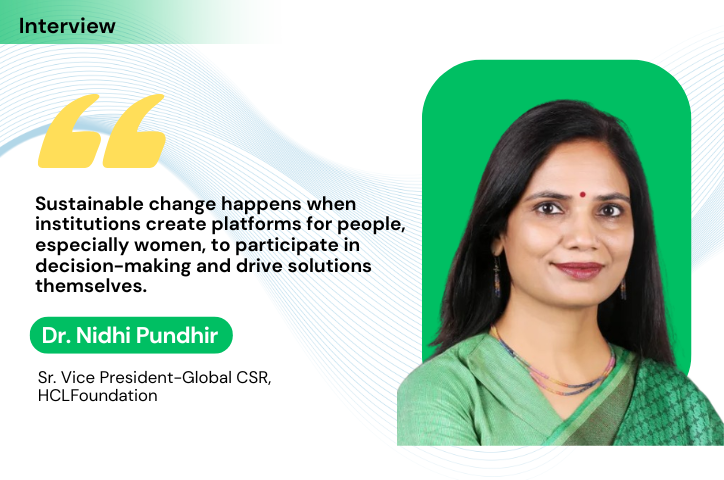
In a development landscape often driven by short term outcomes, Dr. Nidhi Pundhir, Senior Vice President-Global CSR, HCLFoundation, brings a refreshing focus on building systems that last. Her leadership is rooted in a simple yet powerful belief that real change happens when communities are not just supported, but empowered to lead. Backed by the vision of Roshni Nadar Malhotra and the broader commitment of HCLTech, the Foundation has scaled impact across millions of lives, with a strong emphasis on women and grassroots leadership. In this conversation, Dr. Pundhir reflects on her journey, the values shaping HCLFoundation’s work, and the deeper shifts needed to build inclusive and resilient institutions. She also shares her perspective on redefining leadership, where purpose, participation, and long term impact take precedence over titles and metrics.
Scroll down to read the full interview.
Q&A
Q. What gap or challenge in the development landscape shaped your leadership journey and the work you are building today?
A. Early in my journey in the development sector, I realized that lasting change comes not only from addressing immediate needs, but from building systems that communities can truly own and sustain. This insight became central to my leadership approach. At HCL Foundation, our work has focused on creating long-term community-led development models across areas such as livelihood, environment, health, and skill.
Infact our journey is a testament of passion and purpose. A story of scale and depth. It is first and foremost exemplary evidence of the CSR vision of the Board translating into action. Ms Roshni Nadar Malhotra, the Chairperson of HCLTech and the Chair of CSR Committee at HCLTech, has trusted HCLFoundation team with her vision and that’s what has been the force behind success of HCLFoundation, in such short span. Over the years, the Foundation has reached more than 7.9 million lives, with over half being women and girls. The opportunity, for me, has always been to build institutions and partnerships that accelerate inclusive progress and enable communities to shape their own future.
Q. Looking back, what was a defining moment that strengthened your confidence in your leadership approach?
A. I grew up in Rajasthan in a family of educators, yet I saw how girls around me were discouraged from pursuing education, with marriage seen as their only path. A defining turning point was witnessing how community-led initiatives can transform entire ecosystems when people are trusted as partners rather than beneficiaries. Early in my work, I saw women from rural communities step forward to manage resources, lead farmer groups, and build collective enterprises. Their resilience reinforced my belief that leadership is not about authority but about enabling others to lead. Experiences like these strengthened my confidence that sustainable change happens when institutions create platforms for people—especially women—to participate in decision-making and drive solutions themselves.
Q. In a role that demands scale and measurable outcomes, how do you ensure that purpose and long-term impact remain central to the institution you are building?
A. Purpose must be embedded in the architecture of the institution itself We focus on building programmes that combine scale with community ownership and strong partnerships with governments and civil society. The ethos can be summed up in three ways, one the ‘shared value system’ at HCLFoundation. The values of highest possible credibility, accountability and agility, which can be found in each team and its members. Second, systemic investments in partnerships at all levels, with government, not-for-profit organisations and citizens. Third, very integral ethos being identifying people & planet as distinct focal areas in our strategy, with equal impetus not only on socio-economic equitable human development but also acknowledging urgent need to conserve, restore and enhance biodiversity through measurable environmental action.
This allows initiatives to grow organically and sustain themselves over time. When impact is designed around resilience, accountability, and community participation, institutions can deliver measurable outcomes while remaining anchored in purpose.
Q. What systemic shifts are needed to make leadership spaces more accessible, equitable, and sustainable for women?
A. I believe true purpose comes from recognizing the dignity of others and creating spaces where voices that are often unheard can be included. Recognising that I am custodian of the trust that my organisation, my mentors, my family, my team and communities I serve, place in me. That leadership is about ensuring peace, it is about creating a space where ‘creative independence’ celebrated yet a natural disciplne flows, such that we remain focussed on our purpose and drive it with passion!
We must expand access to education, mentorship, and leadership opportunities for women across sectors. Equally important is recognizing the leadership women already demonstrate at the grassroots—whether through self-help groups, farmer collectives, or community institutions. The International Women’s Day theme this year, “Give to Gain,” is a timely reminder that progress cannot remain incremental. Organizations and institutions must actively create pathways for women to move from participation to leadership, ensuring their voices shape policy, strategy, and the future of development.
Q. Beyond metrics and designations, what kind of institutional legacy do you hope your work will leave for the sector and for the next generation of women leaders?
A. For me, legacy is about institutions that continue to create impact long after individual tenures end. I hope the work we do contributes to development models that are collaborative, inclusive, and rooted in community ownership. At HCLFoundation, our efforts across programs like Samuday, Uday, and Harit aim to demonstrate that when communities—especially women—are empowered to lead, change becomes sustainable. Across sectors, HCLFoundation champions women as change-makers—from STEM classrooms to ocean conservation, from artisan and SHG collectives to women farmers leading the use of modern agricultural equipment.Across sectors, HCLFoundation champions women as change-makers—from STEM classrooms to ocean conservation, from artisan and SHG collectives to women farmers leading the use of modern agricultural equipment.
For the next generation of women leaders, I hope the path becomes less about overcoming barriers and more about shaping the agenda itself with confidence, purpose, and a commitment to collective progress.



.png)