Union Budget 2026 – ESG Wishlist

In this guest column, Dr. Mahesh Dalvi, Director – Operations Consulting (ESG & Sustainability Services) at RSM India, presents an ESG-focused wishlist for Budget 2026, outlining how targeted fiscal and regulatory measures can strengthen energy security, accelerate clean technologies, enhance grid resilience and reinforce social sustainability through healthcare and MSME support.
Global geopolitical situations, fluctuating fossil fuel markets & post-COVID era have reinforced a fundamental truth that energy & health securities are critical.
Union Budget 2026 arrives at a decisive juncture, with the compliance carbon market launching in 2026 and 2030 targets. While Budget 2025 laid a strong foundation, Budget 2026 must now focus on execution- addressing energy gaps, derisking the energy & healthcare supply chain and enabling industrial decarbonisation. India has demonstrated that rapid progress is achievable, whether clean energy or an improved collective health of the nation.
With the right fiscal and regulatory signals, Budget 2026 can firmly position the country as a secure, self-reliant and globally competitive leader moving towards the world’s third-largest economy.
Strengthening India’s Energy Security
India as a developing economy stands at a critical moment in its Net Zero transition and climate journey and achieved one of its Panchamrit targets five years ahead of its 2030 timeline. Significant provision is arranged in the Budget to achieve towards these commitments. In the WEF at Davos, more than $300 billion are being projected to global investors for supporting India’s energy transition plan.With this rising power demand, global geopolitical uncertainties and firm climate commitments, the Union Budget 2026–27 is playing a decisive role in shaping India’s path towards energy security, energy independence and long-term sustainability. The renewable energy and clean technology industries now expect the budget to move beyond capacity expansion, and focus on resilience, reliability, domestic manufacturing and system level integration. The social sector is also looking forward to improvement in implementation of programmes and ease in adaptation of new technologies.
India’s Path to becoming a Solar Powerhouse
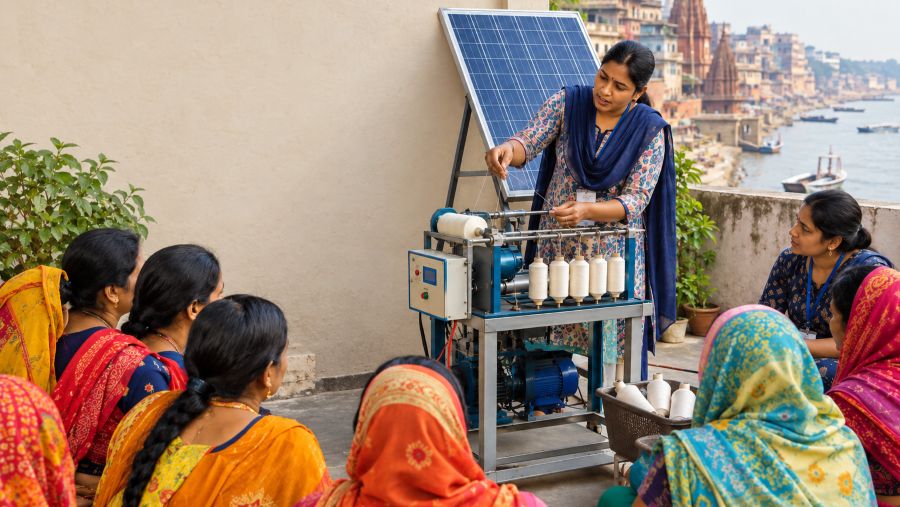
India has planned clean energy options such as solar, wind, green hydrogen, small hydro, & compressed biogas with additional technologies such as battery energy storage systems (BESS) and carbon capture, utilization & storage (CCUS). Among these, solar power is the one of the major drivers to achieving our Panchamrit goals. To improve supply chain resilience, solar manufacturers are expecting fiduciary support, especially in production-linked incentives (PLI) & R&D incentives and extension in closure dates for Financial for PM KUSUM and Surya Ghar Yojana, faster subsidy disbursements & broader capacity-building initiatives.
Avenues for Clean Energy Technologies
Green hydrogen deployment is accelerating under the National Green Hydrogen Mission, targeting 5 million tonnes annually by 2030. Given India’s dependence on imported electrolyzer IP, the current ₹400‑crore R&D allocation may increase. India plans to launch a ₹38,900‑crore CCUS programme with 50% government support. Momentum for nuclear energy is expected, following a ₹20,000‑crore allocation for Small Modular Reactors. Climate-based finance will play a lead role because of Carbon Credit Trading Scheme (CCTS) which is now mandatory for energy-intensive sectors.
Grid Integration and Flexibility
Industry experts are expecting relaxations in Inter-State Transmission System (ISTS) waiver timeline after 2028 for major RE sources and the growing BESS market. A potential relief in the existing 18% GST for BESS-related services will be a boost for Indian RE-based companies. Additional expectations include recognition of viability gap funding for grid-scale storage & pumped hydro, investments in high-voltage direct current (HVDC) corridorsand AI-based forecasting systems.
Social Sustainability
While decarbonisation leads ESG conversations, the social pillar strengthening MSMEs through GST simplification and PLI support & the health insurance sector is equally critical.Continuing GST exemptions in health insurance and expanding Ayushman Bharat to cover OPD and diagnostics would enhance affordability and advance the goal of Insurance for All by 2047. India’s strong position in the global pharmaceutical value chain can be reinforced through an India clinical-validation fund, rationalising duties on life-saving medicines & technology-driven reforms (Global Capacity Centres, digitized health& AI-based health solutions).