
Digital Infrastructure Can Help States Sustain Rural Water Services: Policy Paper
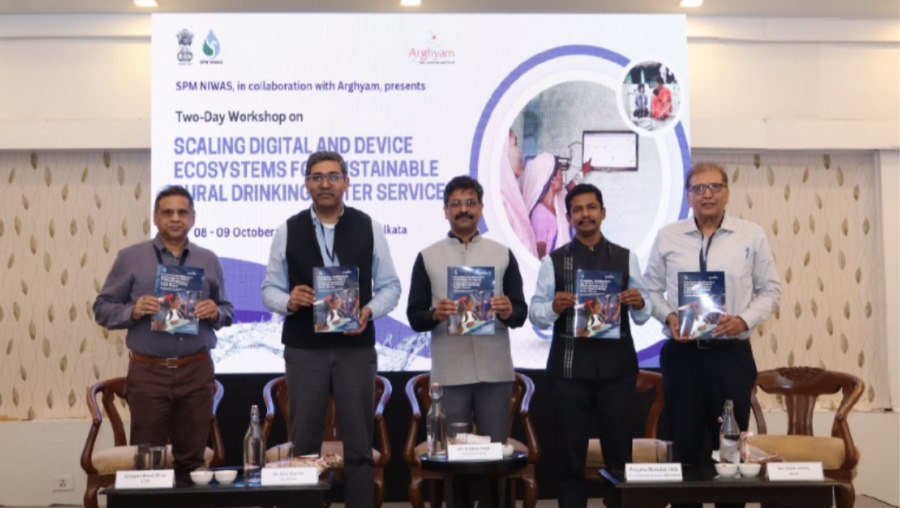
Kolkata, October 21, 2026: An open and interoperable digital infrastructure could help States strengthen the monitoring, maintenance and delivery of rural drinking water services as the Jal Jeevan Mission 2.0 shifts its focus towards sustaining existing connections, according to a policy paper released by the Dr Syama Prasad Mookerjee National Institute of Water and Sanitation (SPM-NIWAS) and Arghyam.
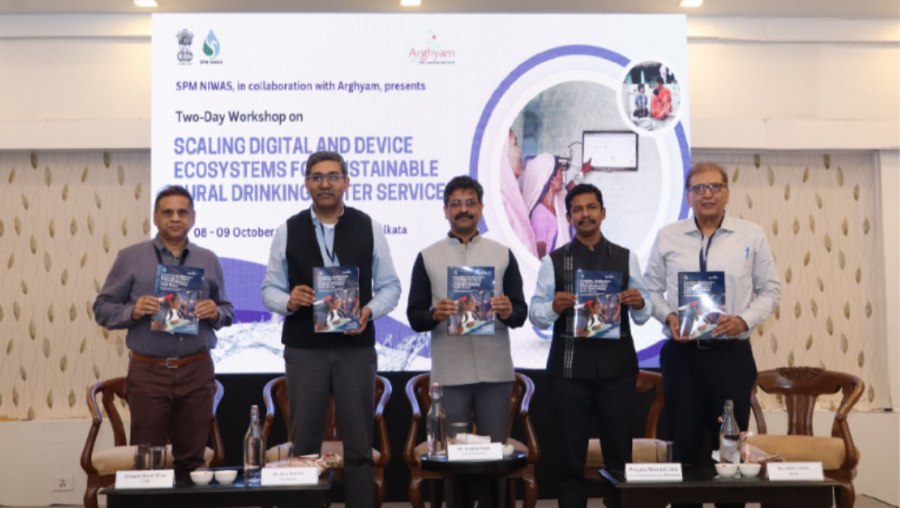
The paper was released at a two-day national workshop in Kolkata on Scaling Digital and Device Ecosystems for Sustainable Rural Drinking Water Services. The workshop brought together representatives from 16 State governments, NITI Aayog, academia and industry.
The paper highlights the need to connect existing digital systems for asset management, water quality monitoring, grievance redressal and service delivery. Fragmented information, it notes, can make it difficult for authorities to identify infrastructure failures, plan maintenance and assess whether water services are functioning reliably.
Citing the 2024 functionality assessment, the paper states that 76% of household tap connections were found to be functional when assessed against criteria covering water quantity, quality and regularity.
Rather than introducing another standalone platform, the paper recommends building on the existing Sujalam Bharat framework through common standards and open application programming interfaces (APIs). This approach would enable national and State-level systems to exchange information while allowing States to retain control over their data and digital systems.
The proposed architecture includes connected registries for water supply schemes, sources, infrastructure assets, laboratories, service providers and household connections. It also envisages reusable digital services for monitoring water supply, quality, grievances and finances, alongside shared data and artificial intelligence (AI) tools.
Connecting these systems could help States identify infrastructure requiring maintenance, track expenditure, monitor water quality and address service disruptions earlier. The framework could also provide Village Water and Sanitation Committees with better information to oversee local drinking water services.
Priyatu Mandal, Director, SPM-NIWAS, said, “It is important for States to cross-pollinate what works rather than each one rediscovering the wheel to enable digital transformation to move faster across the country.”
Anuj Sharma of Arghyam said, “At this scale, digitalisation of rural drinking water can deliver real benefits. The choice that matters is whether it is built open, inclusive and shared with States, rather than closed or imposed on them.”
The paper also highlights JalSoochak, an open-source AI tool developed by Arghyam that reads water meter photographs. According to the paper, the tool achieves more than 92% accuracy under challenging field conditions.
Recognising differences in digital readiness across States, the authors recommend a phased implementation approach. States with limited digital systems could begin with foundational registries and applications, while those with existing but fragmented or advanced platforms could connect them through common standards and APIs.
The paper also proposes a governance structure led by the Department of Drinking Water and Sanitation and the National Jal Jeevan Mission to coordinate digital standards, shared tools and capacity-building efforts for States.
The paper is authored by C.K. Dhar of SPM-NIWAS, and Deepak Gupta and Manu Srivastava of Arghyam. Its recommendations focus on using connected digital systems to strengthen accountability and support the long-term delivery of reliable rural drinking water services.