
CSR Rules Overhaul: Bars CSR Spend on One-Off Events, Govt Schemes and Corpus Funds, Comments Open Till December 11
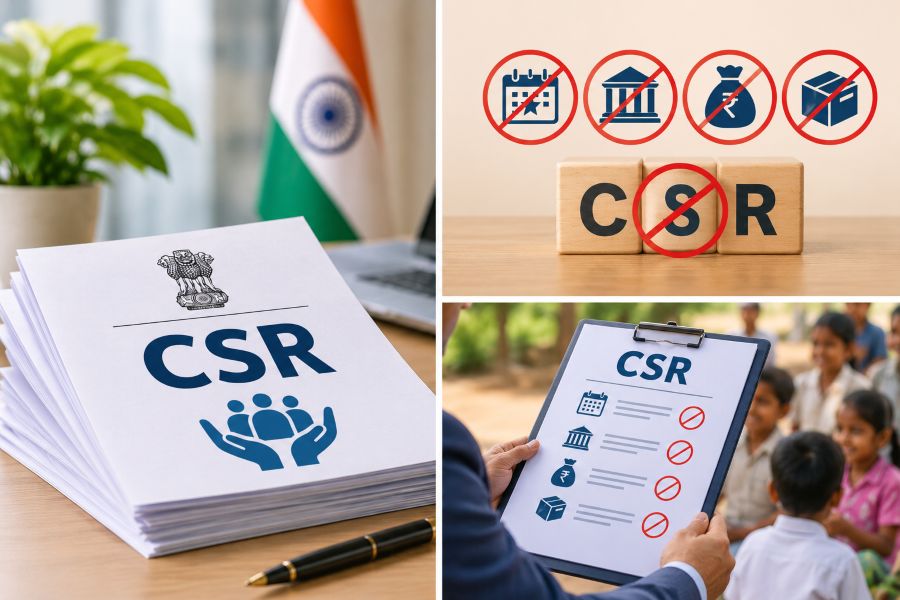
New Delhi, Nov 21, 2026: The Ministry of Corporate Affairs (MCA) has proposed the wide-ranging rewrite of India's corporate social responsibility (CSR) framework. Under the draft, companies could no longer count spending on one-off events, government schemes, corpus funds or free distribution of their own products as CSR.
The draft Companies (CSR Policy) Second Amendment Rules, 2026 and a fully substituted Schedule VII of the Companies Act, 2013 were released through a public notice dated November 11, 2026. Stakeholders can send comments through the MCA's e-consultation module until December 11, 2026.
Four new exclusions from CSR
Rule 2 of the CSR Rules lists what does not count as CSR. It already excludes activities in the normal course of business, political contributions, employee-only benefits, marketing sponsorships and statutory obligations. The draft adds four more:
- One-off events
- Financing government schemes
- Contributions to the corpus fund of any entity
- In-kind contributions of a company's own products or services, except for immediate disaster relief
Where products are given for disaster relief, the draft says they should be valued at arm's length: the open market price, minus taxes, that an independent buyer would pay.
According to an analysis by Vinod Kothari Consultants, most of these exclusions were already in MCA's FAQs and general circulars. Writing them into the rules makes them legally enforceable.
Amit Agarwal, Senior Partner at Nangia & Co LLP, told Business Standard the exclusions separate "genuine impact and freebies, events or idle corpus funds."
What else the draft changes
The draft also:
- makes impact assessment voluntary for every company, ending the current mandatory requirement for companies with an average CSR obligation of ₹10 crore or more;
- lets the government cancel an implementing agency's CSR-1 registration on eight grounds, including fraud and diversion of funds, with a three-year bar on re-registering;
- allows international organisations headquartered in India to act as implementing agencies;
- expands Schedule VII from 13 to 14 items, adding mental health, telemedicine, the PM Internship Scheme, career counselling, climate action and sports infrastructure.
The draft does not change the rules on unspent CSR accounts, the 5% cap on administrative overheads, or CSR committee duties.
Why it matters
Companies spent ₹34,908.75 crore on CSR in FY24, up from ₹24,965.82 crore in FY20, according to government data placed in Parliament. Sattva Consulting estimates FY25 spending at ₹40,794 crore. The official FY25 figure is not yet out.
The ban on financing government schemes sits awkwardly next to the new Schedule VII entry for the PM Internship Scheme, itself a government scheme. Vinod Kothari Consultants has asked for "government scheme" to be clearly defined, and that question is likely to come up in the consultation.
Under Section 135 of the Companies Act, companies with a net worth of ₹500 crore or more, turnover of ₹1,000 crore or more, or net profit of ₹5 crore or more must spend at least 2% of their average net profits from the previous three years on CSR. The requirement took effect in April 2014.