

Trump Initiates US Exit from Key UN Climate Bodies; India-led International Solar Alliance (ISA) Also in List
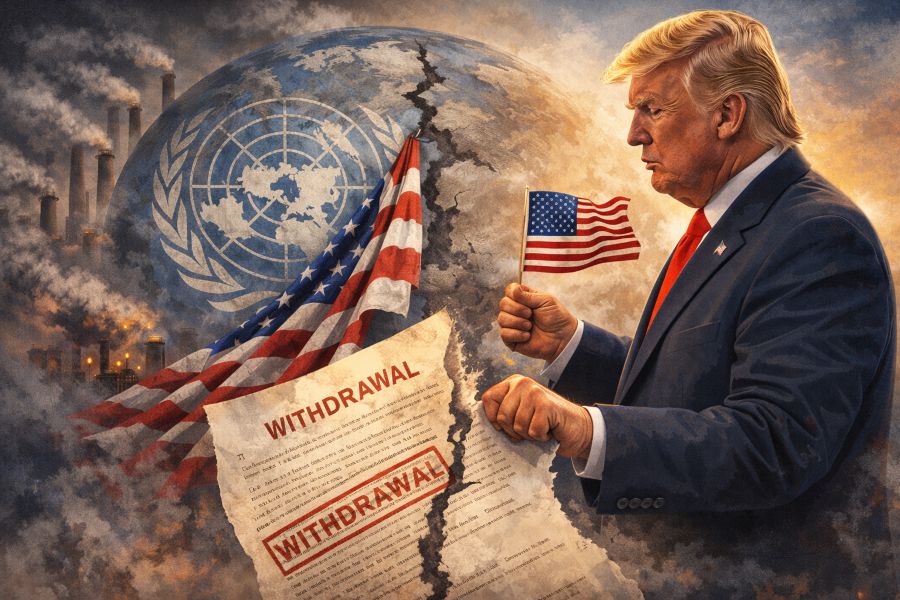
New Delhi, January 9, 2026: In a seismic shift for international climate diplomacy, US President Donald Trump’s administration has announced the country’s withdrawal from 66 international organisations, including the India-led International Solar Alliance (ISA), describing them as “wasteful, ineffective, or harmful” to American interests.
The US withdrawal comes at a time when global efforts to combat climate change are already under strain, raising concerns among allies and environmental groups.
Among the bodies listed for withdrawal are key United Nations entities such as the UN Framework Convention on Climate Change (UNFCCC), the UN Women agency and the UN Human Settlements Programme, alongside several non-UN institutions like the International Renewable Energy Agency, Intergovernmental Panel on Climate Change (IPCC) and the International Union for Conservation of Nature (IUCN).
The list also includes a wide range of organizations and groups, among them 31 UN bodies such as UN Water, UN Oceans, the UN Population Fund, and the UN Entity for Gender Equality and the Empowerment of Women.
The UNFCCC is the foundational 1992 treaty underpinning three decades of global climate cooperation alongside 66 other international organizations deemed misaligned with American interests. This unprecedented action, announced via White House memorandum and social media on January 7, 2026, positions the US as the first nation to exit the nearly universal climate treaty, raising urgent questions for Indian policymakers, corporates advancing ESG commitments, and climate organizations worldwide.
Ratified by the US Senate under George H.W. Bush, the UNFCCC established the goal of stabilizing greenhouse gas concentrations to avert dangerous human interference with the climate system, without mandating specific emission cuts. It birthed the annual COP summits, Kyoto Protocol (1995), and Paris Agreement (2015)—milestones of multilateral progress now at risk.
Trump also took steps to withdraw the United States from the UN Intergovernmental Panel on Climate Change (IPCC), a Nobel Prize–winning organization that issues reports on climate change. While the president is unlikely to be able to block U.S. scientists from taking part in IPCC work, the decision may affect the ability of federal scientists to participate.
Implications for India’s Climate Leadership
For India—positioned as a voice of the Global South and committed to net-zero by 2070—this US retreat amplifies strategic pressures. With the US historically the largest cumulative emitter, its UNFCCC exit could erode Paris Agreement credibility, embolden other majors to weaken NDCs, and complicate India’s $2.5 trillion climate finance needs by 2030. Indian corporates with US supply chains or ESG-linked financing will face heightened scrutiny on Scope 3 emissions, while renewable developers lose a key bilateral funding channel. (see the generated image above)
US Secretary of State Marco Rubio defended the move: “We will not expend resources on institutions irrelevant to or conflicting with our interests. Cooperation serves our people where it delivers.” Critics like former Climate Envoy John Kerry called it “a gift to China,” warning it hands leadership to competitors while absolving polluters globally.
Legal and Diplomatic Uncertainties
The Senate’s 1992 ratification creates a legal grey area: Can Trump unilaterally exit, or does Congress—Republican-controlled—need to assent? Success would bar US participation in future COPs (COP31 looms in 2026), national inventory submissions (already skipped this year), and Paris re-entry pathways, as the Agreement operates under UNFCCC auspices. Allies prioritizing climate action face diplomatic strain, while developing nations question high-income commitments.
The broader purge targets 31 UN bodies (UN Water, UN Oceans, UNFPA, UN Women) plus non-UN forums like the Global Counterterrorism Forum. Stemming from a February 2025 executive order reviewing “non-serving” pacts, this aligns with Trump’s Day One Paris withdrawal redux.