Startup Sakhi: Empowering Rural Women to Become India’s Next Generation of Entrepreneurs
Economic empowerment has increasingly become central to the conversation around sustainable rural development, with women emerging as key drivers of community transformation. Recognising this potential, the Centre For Transforming India (CFTI) has launched Startup Sakhi, a first-of-its-kind initiative aimed at nurturing women-led enterprises through structured funding, mentorship, incubation, and market linkages.
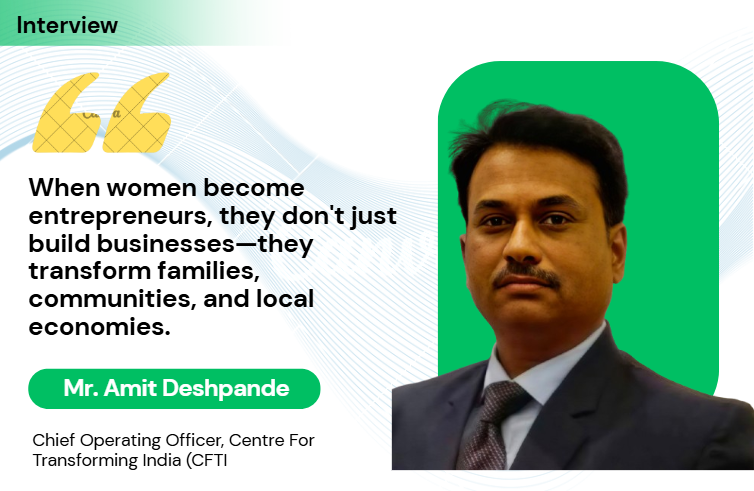
In this exclusive interaction with TheCSRUniverse, Amit Deshpande, Chief Operating Officer, Centre For Transforming India (CFTI), discusses the strategic thinking behind Startup Sakhi, the barriers that continue to limit rural women’s entrepreneurial aspirations, and how the programme seeks to bridge critical gaps in access to capital, business skills, and ecosystem support. He also shares
insights into the pilot rollout in Raigad, the importance of partnerships, and CFTI’s long-term vision of creating a scalable model that can strengthen women-led livelihoods and contribute meaningfully to India’s rural economic growth.
Scroll down to read the full interview:
Q. Startup Sakhi marks CFTI’s entry into the women empowerment and livelihoods domain. What strategic considerations led to this expansion, and how does it align with CFTI’s broader mission?
A. Startup Sakhi marks a very natural and strategic evolution of CFTI’s grassroots work. For years, our interventions across education, health, water, sanitation, and community development have shown us that sustainable rural transformation cannot happen unless women are economically empowered. We have worked closely with communities across aspirational districts and repeatedly observed that women, especially those associated with SHGs, already possess strong entrepreneurial intent, but often lack access to funding, mentorship, exposure, and institutional support. Startup Sakhi was conceptualized to bridge exactly these gaps. It aligns strongly with CFTI’s larger mission of enabling long-term, community-led transformation by helping women become active economic contributors and decision-makers within their families and villages.
Q. From your perspective, what are the most critical barriers rural women face in becoming entrepreneurs, and how does Startup Sakhi address these gaps differently from existing interventions?
A. Rural women entrepreneurs face multiple interconnected barriers. Access to capital remains one of the biggest challenges, but equally important are confidence gaps, limited market exposure, lack of digital literacy, mobility constraints, and absence of structured guidance. Many women have viable ideas and skills but do not know how to formalize or scale them into sustainable enterprises. Startup Sakhi addresses these gaps through a structured support model that combines financial assistance with mentorship, training, and incubation. In the first stage, 100 SHGs will receive ₹10,000 and basic training, while top-performing groups will progress to advanced mentorship and grants of up to ₹5 lakh, along with continued support to scale their businesses. Through this, the initiative aligns with CFTI’s broader mission of driving long-term, community-led transformation through women’s economic empowerment.
Q. What was the rationale behind this structured, competitive approach, and how does it improve outcomes for SHGs?
A. The structured and competitive model was intentionally designed to create both accessibility and progression. Recent reports also show that while India has over 100 million women associated with SHGs, a large number still struggle to transition into scalable enterprises due to lack of structured entrepreneurial ecosystems. We recognized from the outset that it was important to keep this inclusive for first-time entrepreneurs while at the same time providing deeper support to the most committed and scalable ideas in each phase of development. The phased approach is designed to give SHGs an opportunity to progressively build their confidence, develop a stronger understanding of business, and improve their capabilities for the execution of their operating plans, as well as provide accountability, continuing interaction, and measurable progress. The strong response expected for the initiative, with nearly 8,000–10,000 applications anticipated from women-led SHGs in Raigad alone, by helping women gradually strengthen their business capabilities and confidence.
Q. Why was Raigad district chosen as the pilot location, and what key learnings or indicators will determine scalability to other regions?
A. Raigad was chosen as the pilot project site due to its excellent pairing of need, ability for the community to participate, and ability to operate. CFTI’s established grassroots ties/relationships and networks in Maharashtra will aid in establishing deeper connections with community members and monitoring implementation of programs at the ground level. In addition, according to recent National Rural Livelihoods Mission (NRLM) data for Maharashtra, Raigad has nearly 3,700 active Self-Help Groups (SHGs), reflecting a strong foundation for women-led livelihood initiatives. The pilot program will determine important metrics around participation, quality of
business ideas, retention across various phases of business creation, earning potential, and the effectiveness of mentorship support. The lessons learned from Raigad will refine the model before rolling out in other parts of the country.
Q. With an expected 8,000–10,000 applications but only 1,000 women being supported initially, how do you balance inclusivity with meaningful impact?
A. For us, having inclusivity combined with impactful, measurable results is essential. While we expect to receive a high volume of applications, our primary goal for initially selecting 1000 women will be to provide high-quality help with measurable results to those 1000 women. Supporting 1000 women in a more unified fashion will allow for more frequent mentoring, closer follow-up, and stronger implementation assistance than if we were to divide our resources among other applicants. Also, through the application process, thousands of additional women will have gained exposure to entrepreneurship via motivation/awareness. etc. Once partnerships and resources are built to a greater extent, the objective of this initiative is to expand and significantly reach out to as many women as possible.
Q. Could you elaborate on the kind of mentorship and incubation support SHGs will receive, especially in areas like digital tools, market access, and financial literacy?
A. Mentorship and incubation are key pillars at Startup Sakhi. The SHGs selected will receive assistance with developing their business plans, bookkeeping, pricing, financial management, and operational planning. We are also focusing on increasing digital enablement, using digital payment systems, social media, online marketplaces, and basic technology tools. These will all help women operate and market their businesses more successfully. The elements of mentorship will also include market linkage support, communication training, customer insight, and exposure to successful entrepreneurial models. The objective is to ensure that women are equipped not just to start enterprises, but also to sustain and grow them confidently.
Q. What kind of partnerships are you looking to build, and how can corporates and ecosystem players contribute meaningfully?
A. Startup Sakhi has been designed as a collaborative ecosystem-driven initiative. We are partnering with corporates, CSR foundations, PSU’s among others who can contribute meaningfully through funding support, mentorship participation, capacity-building programs, technology access, market linkages, and procurement opportunities for SHG-led products. In addition, we believe that ecosystem players can assist rural women in finding networks and becoming visible to others, as well as developing a long-term business. Therefore, rural entrepreneurship at scale will be established through collective engagement, where partnerships will be a significant driver in achieving this objective.
Q. While the program is in its early stages, what early signals or stories have stood out to you that reinforce the potential of this initiative?
A. The most positive sign for the program has been the great enthusiasm and self-confidence that women displayed during community interaction. Women who previously thought they could not start their own business are starting to talk about a variety of ideas and dreams for how they would like to make a living. We have also seen interest from SHGs already working at small-scale productive activities but lacking sufficient confidence or support to take things to the next level. All of these early signs provide further confirmation that when given adequate support systems, there is a tremendous entrepreneurial opportunity in rural India.
Q. What implementation challenges do you anticipate, particularly in rural contexts, and how is CFTI preparing to address them?
A. Rural implementation has a number of challenges, which include lack of knowledge about the programs, limited local transport options, different levels of literacy, gaps in access to technology, and social barriers sometimes preventing women from participating. Other challenges may also include reluctance to engage in formal financial processes or become comfortable with the use of technology. CFTI is addressing these challenges by ensuring that application and engagement processes are user-friendly, use local languages, and have a community orientation. CFTI is building trust and confidence through our presence on the ground, our network of volunteers, and relationships with organisations at the local level. The initiative is designed to provide a high degree of flexibility and strong engagement at all levels on a local basis so that women will be encouraged to fully participate in the initiative.
Q. You mentioned the goal of creating a scalable model. What are the key elements that will enable Startup Sakhi to be replicated across other states in India?
A. Start-up Sakhi's scalability depends on four foundational elements. The first requires simplicity and adaptability of the model, enabling Sakhi's capability to function through different geographic locations and local environments. Secondly, the combination of funding and mentoring/incubation creates stronger long-term outcomes. Thirdly, this emphasis on community involvement through the use of local language ensures the initiative will include first-time entrepreneurs. Lastly, securing strategic partnerships with private-sector companies, educational institutions, and local players in the ecosystem will provide the resources for mobilization and regional expansion. Altogether, these four components create a replicable framework that can easily be adapted to many varying states.



.png)