Redefining Purpose: How Hamdard Laboratories Blends Legacy with Nation-Building
For generations of Indians, Hamdard evokes a distinct nostalgia, rooted in household staples like the iconic Rooh Afza. Yet, beyond its consumer presence, the legacy brand embodies an enduring model of conscious capitalism. Long before Corporate Social Responsibility (CSR) became a formalized legal mandate, Hamdard institutionalized an absolute commitment to society, structuring the organization so that nearly 85% of its commercial profits flow directly into a public charitable trust dedicated to healthcare, education, and social welfare.
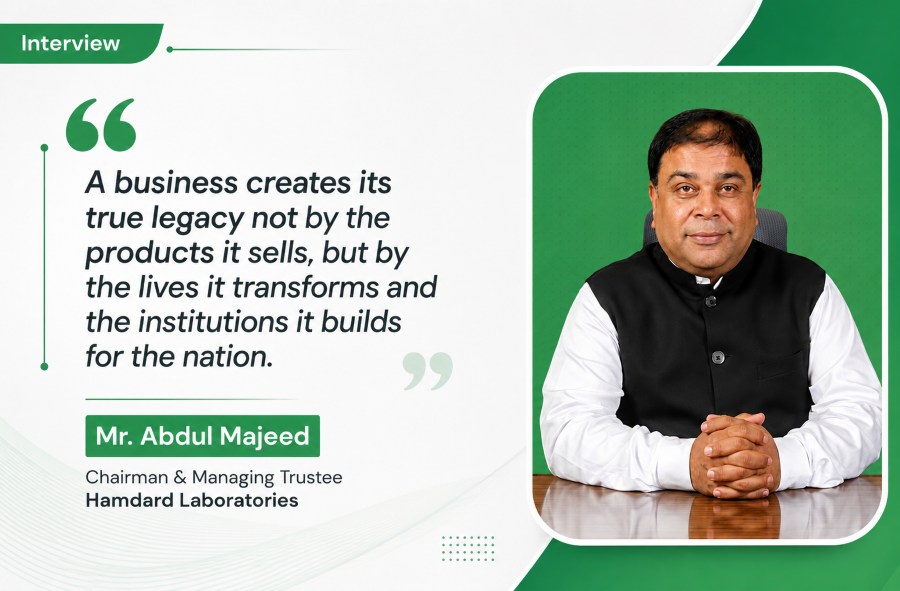
In this exclusive interview, Mr. Abdul Majeed, Chairman & Managing Trustee at Hamdard Laboratories, explains how this unique foundation-business structure operates today. He discusses how the organization balances commercial growth with long-term social impact, prioritizing sustainable institution-building over compliance metrics. Mr. Majeed highlights Hamdard’s integrated approach to public health, combining modern medicine with the preventive strengths of the Unani system, and underscores why true social responsibility must be embedded into the core business model rather than treated as an afterthought.
Read on for the full interview.
Q&A
Q. Hamdard’s model is often seen as very different from conventional CSR-led businesses. How would you describe the philosophy behind building social impact into the company's core structure rather than treating it as a separate responsibility?
A. Hamdard’s approach is fundamentally different because social impact is embedded into the organization’s very purpose rather than being treated as a separate CSR activity. Since its inception in 1906, Hamdard was founded on the principle that business should serve society through healthcare and education. This philosophy was formally institutionalized in 1948 when Hamdard was declared a public charitable trust.
The organization was never designed for wealth accumulation. Instead, its objective has always been to promote public welfare by advancing healthcare, particularly the Unani system of medicine, and by investing in education. The earnings generated through business activities are redirected towards educational institutions, hospitals, scholarships, and other social initiatives that benefit society at large.
Nation-building through healthcare and education remains the core ethos of Hamdard. Unlike conventional models where profits are first maximized and a portion is later allocated to CSR, Hamdard’s business and philanthropy are inseparable. Every commercial success directly contributes to strengthening institutions that improve public health, empower youth through education, and create long-term social value. This mission-driven structure has remained unchanged for more than a century and continues to guide the organization today.
Q. What makes Hamdard’s philanthropy-led business structure sustainable even after decades of growth and market evolution?
A. The sustainability of Hamdard’s philanthropy-led model rests on two pillars: unwavering consumer trust and continuous evolution. Over the decades, Hamdard has earned credibility through the quality and efficacy of its products, creating lasting consumer confidence that continues to drive growth. At the same time, the organization has consistently adapted to changing consumer needs and market expectations without compromising its founding mission.
While Hamdard’s core objective of promoting the Unani system of medicine has remained unchanged, the organization has continuously evolved through innovation driven by research and development, supported by modern technology, robust quality control systems, governance reforms, and digitization. Strategic modernization initiatives, including the adoption of standardized systems and processes, have strengthened operational efficiency and transparency.
The true measure of sustainability lies in the institutions that Hamdard has built over the years. These include Jamia Hamdard University, Hamdard Institute of Medical Sciences & Research (HIMSR), Hamdard Education Society, Hamdard Public School, Heritage Global Public School, Rabea Girls Public School, Hamdard Study Circle, and Hamdard Coaching Centre. Through these initiatives, Hamdard continues to invest in education, healthcare, leadership development, and social empowerment.
By balancing tradition with innovation and reinvesting its success into nation-building institutions, Hamdard has demonstrated that a philanthropy-driven business model can remain relevant, resilient, and sustainable across generations.
Q. Hamdard supports healthcare, education, scholarships, and community welfare initiatives across India. Which interventions have created the most meaningful impact so far, and why?
A. Among Hamdard’s many initiatives, the establishment of Jamia Hamdard and the Hamdard Institute of Medical Sciences & Research (HIMSR) have created the most far-reaching and lasting impact. These institutions have expanded access to quality education and healthcare while preparing future generations to contribute meaningfully to society and become self-reliant nation-builders.
The inspiration behind these achievements comes from three visionary figures whose ideals continue to shape Hamdard’s mission: Hakeem Abdul Hameed Sahib, a renowned Unani physician, educationist, philanthropist, and nation-builder; Rabea Begum Sahiba -Hakeem Sahab’s mother & a pioneering woman entrepreneur who embodied courage and conviction; and Mr. Abdul Mueed-eldest son of Hakeem Sahab who carried the legacy forward by modernizing and industrializing Hamdard.
To honor their contributions, Hamdard has instituted prestigious Excellence Awards recognizing outstanding achievements across fields such as Unani Medicine, Ayurveda, Education, Modern Healthcare, Sports, Public Service, Entrepreneurship, Women Empowerment, Art, and Literature.
Together, these institutions and recognitions foster excellence, innovation, leadership, and social responsibility, creating a multiplier effect that extends far beyond direct beneficiaries and contributes meaningfully to nation building.
5. Can you share how Hamdard measures the long-term impact of its social initiatives beyond numbers and compliance metrics?
A. For Hamdard, the true measure of impact extends far beyond compliance reports, statistics, or numerical targets. While quantitative indicators remain important, the organization places greater emphasis on the transformative stories of individuals whose lives have been positively influenced through its initiatives.
The success of students who receive quality education, scholarships, and coaching support; the achievements of healthcare professionals trained through Hamdard’s institutions; and the experiences of patients who find relief and improved well-being through accessible healthcare services collectively represent the most meaningful indicators of long-term impact. Hundreds of successful civil servants who have benefited from the Hamdard Study Circle are today serving the nation with dedication and pride, exemplifying the enduring value of investing in human potential.
The effectiveness of Hamdard’s work is reflected in the institutions it has built and sustained over generations. Universities, schools, hospitals, and community programs continue to produce outcomes that benefit society long after the initial intervention. The ability of these institutions to empower individuals, create opportunities, and strengthen communities demonstrates enduring value.
Ultimately, Hamdard evaluates success through the positive change experienced by people themselves. When individuals become healthier, more educated, self-reliant, and capable of contributing to society, the organization considers its mission fulfilled. These human stories remain the strongest evidence of lasting social impact and continue to inspire Hamdard’s work.
Q. Partnerships are becoming increasingly important in the development sector today. How does Hamdard collaborate with institutions, local organisations, or community stakeholders to strengthen the effectiveness of its initiatives?
A. Partnerships play a critical role in advancing Hamdard’s mission of promoting preventive healthcare, education, and public well-being. Over the years, Hamdard has actively collaborated with institutions and stakeholders that share a common vision of improving health outcomes and expanding awareness of traditional systems of medicine. This, along with the establishment of the Hamdard Institute of Medical Sciences & Research (HIMSR) and HAH Centenary Hospital, to promote teaching, research, and excellence in modern medicine, exemplifies Hamdard’s integrated approach to healthcare—one that combines the strengths of traditional and contemporary medical systems and is increasingly crucial for India and the world at large.
The evolution of Unani medicine into a structured national healthcare ecosystem, supported by the Ministry of AYUSH, has created significant opportunities for collaboration and knowledge exchange. Hamdard’s philosophy closely aligns with the Government of India’s vision of “Heal in India, Heal by India,” particularly in strengthening preventive healthcare and long-term management of chronic and lifestyle-related disorders.
To support this objective, Hamdard works closely with the Central Council for Research in Unani Medicine (CCRUM), the Ministry of AYUSH, Ayurveda and Unani medical colleges, healthcare professionals, and medical associations. These collaborations include Continuing Medical Education (CME) programs, regional and national medical conferences, awareness campaigns, and educational initiatives focused on major public health concerns such as Non-Communicable Diseases (NCDs).
By leveraging institutional expertise, community engagement, and shared objectives, these partnerships help strengthen outreach, enhance knowledge dissemination, and ensure greater effectiveness and sustainability of Hamdard’s social and healthcare initiatives.
Q. Community participation is now seen as essential for sustainable social change. How does Hamdard ensure that communities are not just beneficiaries but active participants in the development process?
A. Hamdard strongly believes that sustainable social change can only be achieved when communities actively participate in the development process rather than remain passive recipients of support. Therefore, the organization focuses on creating awareness, encouraging engagement, and fostering shared responsibility for health and well-being.
A key example of this approach is the Hamdard Health Quiz, conducted in collaboration with Inquilab–Jagran Prakashan. Over the years, this initiative has become an innovative and participatory platform for educating communities about Non-Communicable Diseases (NCDs) and preventive healthcare practices. By encouraging people to actively learn, interact, and engage with health-related information, the program transforms awareness into action.
Hamdard’s broader outreach efforts are similarly designed to involve individuals, families, healthcare professionals, educational institutions, and local stakeholders in meaningful conversations around preventive health and wellness. Through awareness campaigns, educational initiatives, and community-based programs, people are empowered to make informed decisions about their health and become active contributors to positive social outcomes.
This participatory model not only improves the effectiveness of interventions but also builds long-term ownership within communities, ensuring that awareness, healthy practices, and social progress continue well beyond the duration of any specific initiative.
Q. You have closely followed both traditional systems like Unani and evolving trends in healthcare. How do you see the role of alternative medicine and preventive healthcare in addressing India’s larger public health challenges?
A. We prefer to describe Unani as part of a broader holistic and functional healthcare approach rather than simply alternative medicine. Originating from the Greco-Arabic medical tradition, Unani shares historical roots with modern medicine while offering a distinctive perspective that emphasizes balance, prevention, and individualized care.
One of the greatest strengths of the Unani system is its focus on identifying and addressing the root causes of health issues rather than merely managing symptoms. This approach is increasingly relevant today as rising lifestyle disorders, chronic diseases, and stress-related conditions place growing pressure on healthcare systems. There is renewed interest among younger generations in preventive and wellness-oriented healthcare solutions that promote long-term well-being.
Preventive healthcare remains central to addressing India’s public health challenges. The principle that prevention is better than cure is deeply embedded in Unani philosophy. Through lifestyle guidance, dietary regulation, and holistic health practices, the system encourages individuals to maintain wellness and reduce disease risk before medical intervention becomes necessary.
As India seeks sustainable healthcare solutions for a large and diverse population, integrating preventive healthcare with evidence-based traditional systems like Unani can play a valuable role in improving health outcomes and reducing the burden of chronic disease.
Q. At a time when CSR conversations are becoming more compliance-driven, what lessons can the larger corporate sector learn from Hamdard’s approach to philanthropy, ethics, and nation-building?
A. At a time when CSR is increasingly viewed through the lens of compliance, Hamdard offers three important lessons. First, philanthropy is most effective when it is integrated into the business model rather than treated as an obligation. Since its inception, Hamdard has reinvested a substantial portion of its earnings into health & education, making social welfare an intrinsic part of its identity.
Second, ethics must be rooted in values rather than regulations alone. Hamdard’s work is guided by principles such as independence, impartiality, non-discrimination, professionalism, transparency, and integrity. These values stem from the vision of founder Hakeem Abdul Hameed, who believed that business should serve society through meaningful and sustainable contributions.
Third, nation-building is achieved through institution-building rather than one-time donations. Over the decades, Hamdard has established and supported institutions such as Jamia Hamdard University, HIMSR, HAHC Hospital, Majeedia Hospital, Rabea Girls School, and the Hamdard Education Society. These institutions continue to create opportunities in healthcare, education, research, and social development.
The broader lesson is that businesses can create lasting impact when purpose, ethics, and social responsibility are embedded into their long-term strategy rather than pursued solely as compliance requirements.
Q. In the years ahead, what are the key social and healthcare priorities that Hamdard aims to focus on, especially in a rapidly changing India?
A. As India continues to evolve, Hamdard remains committed to advancing healthcare, education, and social development while adapting to emerging needs. A key priority will be expanding access to affordable, quality healthcare through initiatives such as Hamdard Wellness Centres and mobile healthcare services that support underserved communities.
Preventive healthcare and awareness, particularly among younger generations, will remain central to our efforts through initiatives such as Unani Ki Kahani and broader public health campaigns focused on immunity, respiratory health, and healthy lifestyles. Strengthening knowledge among healthcare professionals through continuing medical education and scientific engagement will also be an important focus.
In healthcare, Hamdard aims to bridge traditional and modern systems by integrating the strengths of Unani medicine with contemporary medical practices. Research and innovation, particularly in addressing Non-Communicable Diseases (NCDs), will continue through institutions such as HIMSR. Simultaneously, the organization will continue identifying healthcare gaps and developing consumer-friendly products that meet evolving needs
Education remains another major priority. Hamdard plans to expand scholarships, support girls’ education, strengthen coaching and mentorship programs, and create opportunities for underprivileged students.
While methods may evolve, Hamdard’s mission remains unchanged: promoting good health, quality education, affordability, care, and compassion for all Indians.




.png)