
Mandatory CSR Spend Raises Cost of Equity When Seen as Compliance, Finds IIM Lucknow Study
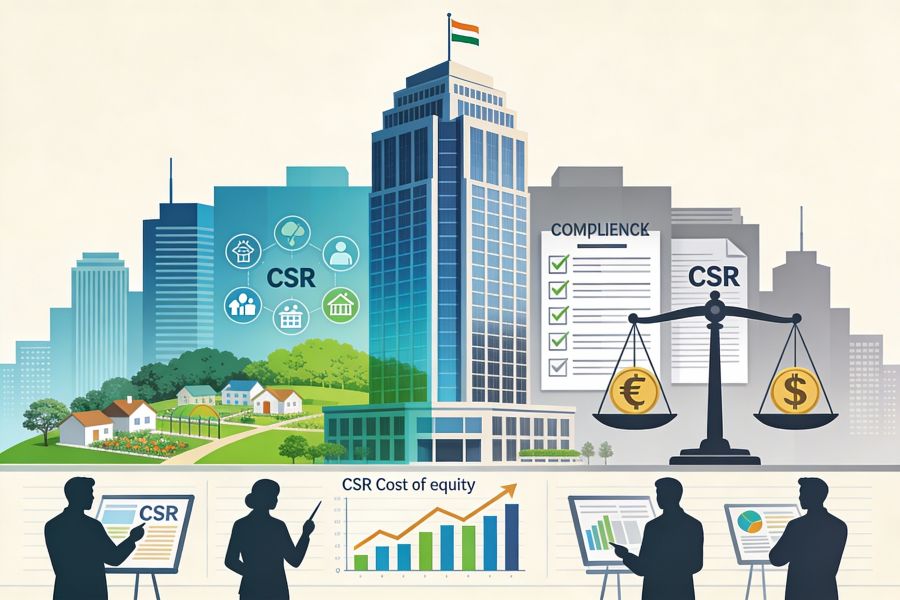
Lucknow, January 05, 2026: A recent study by the Indian Institute of Management (IIM) Lucknow has found that mandatory Corporate Social Responsibility (CSR) spending can increase the implied cost of equity for Indian companies when investors perceive such expenditure primarily as a compliance requirement rather than a strategic investment
The study examines the Indian CSR framework introduced under the Companies Act, 2013, and analyses how compulsory CSR spending influences investor perceptions and equity financing costs. Using data from 484 Indian companies between 2014 and 2020 that reported CSR expenditure on poverty alleviation, the research evaluates the relationship between mandated CSR outlays and the cost of equity capital
To estimate the implied cost of equity, the researchers applied the Ohlson and Juettner-Nauroth (OJ) model, a forward-looking valuation framework that reflects expected earnings growth and payout ratios. The findings show a positive association between CSR spending on poverty alleviation and the cost of equity for firms overall, indicating that investors often treat mandated CSR as an additional cost, leading them to demand higher returns
However, the study identifies a contrasting trend in the service sector. For service-oriented firms, current-year CSR spending is associated with a lower cost of equity, suggesting that investors may view CSR in these companies as supporting reputation, trust, and other intangible assets central to their business models
.The research highlights that investor responses to CSR are not uniform across sectors and depend significantly on whether CSR initiatives are perceived as strategically aligned with a company’s core operations. The study notes that compliance-driven CSR, when poorly communicated or disconnected from business strategy, is more likely to be viewed as a financial burden, whereas strategically integrated CSR can enhance investor confidence and reduce perceived risk
The findings have been published in the Journal of Accounting in Emerging Economies and add to ongoing policy and academic discussions on the financial-market implications of India’s mandatory CSR regime. The study underscores the importance for companies to move beyond minimum compliance and clearly articulate the long-term strategic value of their CSR initiatives to both investors and stakeholders.