Kyndryl’s Strategic Lens on Data, AI, and the Future of Corporate Sustainability in India
As India accelerates its transition toward a climate conscious and digitally enabled economy, sustainability is no longer confined to regulatory compliance or corporate reporting. It is increasingly shaping how businesses innovate, compete, and contribute to national development priorities such as inclusive growth, resource efficiency, and climate resilience. In this evolving landscape, the convergence of data, governance, and technology is redefining how organizations translate intent into measurable impact at scale.
In this conversation, Girija Mukund, Director, Global Citizenship and Sustainability at Kyndryl India and ASEAN, outlines how enterprises must move beyond fragmented approaches to build integrated, data driven sustainability ecosystems. She highlights the growing role of AI, the importance of embedding sustainability into core operations, and the need to bridge the persistent gap between ambition and execution. The discussion brings into focus how forward looking organizations are leveraging technology not only to meet environmental goals but to drive long term business value and societal progress in India.
Scroll down to read the full interview:
Q. As sustainability becomes a strategic priority for Indian enterprises, how do you see the role of corporate responsibility evolving beyond compliance to becoming a core driver of long-term business value and societal impact?
A. Corporate responsibility in India is clearly evolving from a compliance requirement to a core element of business strategy and value creation. While regulatory requirements remain an important mandate, organizations are proactively investing in sustainability and CSR because they recognize its direct link to long-term resilience, efficiency, and growth.
At Kyndryl, we embed sustainability into everything we do—from committing to net zero emissions by 2040 to using our technology and services to help customers reduce their carbon footprint and optimize their IT environments. For us, sustainability isn’t just internal; it’s about creating impact across the broader ecosystem.Infrastructure modernization, including circular IT practices and migration to energyefficient cloud architectures, further strengthens this transition.
In India, we are also deeply focused on scalable societal impact as part of our corporate citizenship goals. Initiatives like Cyber Rakshak, which aims to skill over 100,000 women from rural and semi urban areas in cybersecurity, reflect our commitment toaddressing critical socio-economic gaps while building resilientcommunities. We have recently launched an AI skilling program where we are using AI-enabled solutions across areas like rural governance, agriculture, and livelihood development. Over the next three years, we aim to enable 30,000 youth annually across multiple states in India, contributing to the development of sustainable, AI-ready rural ecosystems.
Ultimately, corporate responsibility is becoming a strategic bridge between business performance and societal progress, where organizations create value not only through financial outcomes, but also through driving inclusive growth and environmental stewardship at scale.
Q. From a CSR lens, how can organizations ensure that sustainability commitments translate into measurable, on-ground impact rather than remaining confined to disclosures and reporting frameworks?
A. For organizations, transitioning from "reporting" to "impact" requires embedding sustainability directly into their operational DNA. From a CSR lens, this transition happens when environmental and social goals are no longer treated as peripheral compliance tasks but as core business requirements.
But there is a clear gap. Kyndryl’s Global Sustainability Barometer findings show that 69% of Indian organizations rate sustainability as a top strategic priority but only 15% have embedded it as a core driver of innovation, cost saving and long-term resilience. To achieve measurable on-ground impact, organizations must leverage data-driven transparency, using real-time analytics to monitor energy consumption, emissions, water and waste spanning the entire value chain, enabling them to monitor performance continuously and course correct proactively.
Technology—especially AI—plays a critical role in turning sustainability intent into measurable impact by moving organizations from ambition to action. AI, used responsibly and efficiently, enables companies to convert vast, fragmented sustainability data into real-time insights, predictive intelligence, and automated decisions—helping them set clearer targets, prioritize interventions, and track outcomes with confidence.
Equally important is building organizational capability – we emphasize the democratization of sustainability, where employees are upskilled to apply a "sustainability-first" mindset to every technical architecture they build. By linking executive incentives to specific decarbonization milestones and fostering community-centric CSR initiatives that bridge the digital divide, we ensure that our commitments result in a more resilient society. Ultimately, sustainability is not a document we publish; it is the efficiency and equity we engineer into the world's vital systems every day.
Q. Despite a high percentage of organizations collecting sustainability data, there appears to be a significant gap in its utilization. What, in your view, are the deeper structural or cultural barriers preventing this data from informing decision-making?
A. At a structural level, sustainability data is still largely fragmented across disparate systems without a unified architecture. Many enterprises lack real-time visibility and integrated platforms that connect sustainability metrics with core business operations like finance, IT and supply chains. As a result, the data remains confined to reporting functions rather than being embedded into decision-making workflows. Additionally, limited maturity in data governance and analytics capabilities makes it difficult to translate raw data into actionable insights.
Cultural barriers compound this challenge. In many organizations, sustainability is still viewed as a compliance obligation rather than a core business driver tied to growth, resilience, and value creation. This often leads to sustainability teams operating in silos, with limited influence over enterprise-wide strategic decisions—reflected in the fact that only a small percentage of sustainability leaders have a meaningful role in IT or business governance. To bridge this gap, organizations need to move beyond data collection to integration—embedding sustainability metrics into everyday business decisions, strengthening cross-functional ownership, and aligning leadership incentives with measurable sustainability outcomes.
Q. The data suggests that while 74% of organizations collect sustainability data centrally, only 34% actively use it for optimization. What does this disparity reveal about the maturity of sustainability ecosystems in India, and where are companies falling short?
A. The gap indicates that many organizations in India still treat data for compliance and not for impact. Companies are gathering data to meet disclosure requirements such as SEBI’s BRSR or supply chain expectations, but they are not translating it into real-time decision-making. Clearly, the loop between insight and action remains weak.
We feel that what is holding companies back is the lack of integration with core business strategy. Sustainability data is rarely integrated to KPIs, operational dashboards or innovation pipelines, limiting the ability to drive cost efficiencies or new business opportunities. Without clear linkage to ROI, leadership ownership, and a stronger articulation of business value, it continues to be as a cost center. In a context of ongoing market uncertainty, many organizations prioritize short-term stability, slowing the shift from compliance-driven reporting to proactive, value-led optimization.
Q. How do legacy systems and fragmented digital infrastructure dilute the effectiveness of CSR and sustainability initiatives, particularly in sectors that are heavily dependent on data-driven operations?
A. Our study findings tell us that organizations with fragmented, legacy-heavy IT estates cannot achieve real-time, end-to-end visibility of energy, emissions, water, and e‑waste data. These are essentially the prerequisites that help companies turn CSR and sustainability targets into solid, operational action. Because 25 % of mission‑critical networks, storage, and servers in the typical enterprise are already at end‑of‑service, these legacy layers actually create data silos, incompatible formats, and manual reconciliation processes. These break the feedback loop that is required for predictive optimization.
Addressing this gap requires a much more integrated and data-led approach. For instance, solutions like Kyndryl Sustainability Advisor, available on the Kyndryl Bridge open integration platform, helps bring disparate data into a single view and translate it into actionable insights. By combining AI-driven analytics with automation and domain expertise, organizations can move from fragmented tracking to continuous monitoring of energy use, emissions, water and e-waste, enabling more informed decisions and measurable impact.
Q. Would it be fair to say that sustainability today is less of a reporting challenge and more of a data architecture and governance issue? How should organizations rethink their internal systems to address this shift?
A. Yes. The real bottleneck is not a lack of data, but the absence of a unified, AI-ready data foundation and clear ownership. Without a single, real-time view that integrates data across IT, OT and supply chains, information remains locked in static compliance filings and cannot drive meaningful outcomes such as emissions reduction, energy efficiency or improved community impact.
Our findings also point to a gap in how technology is being applied. They show us that while 58% of Indian enterprises report strong alignment between technology and sustainability teams, only about 31% are using AI centrally to advance sustainability goals. Adoption of more advanced capabilities remains quite limited, with only 9% piloting agentic AI and only 1% at full deployment. This tells us that while intent and alignment are improving, most organizations are still in early stages of building the data and AI backbone needed to move from reporting to execution.
Q. As AI adoption accelerates, how critical is the role of trusted, high-quality sustainability data in ensuring that technology-led interventions actually deliver environmental and social outcomes at scale?
A. Trusted and high-quality sustainability data is a fundamental requirement for AI-driven interventions to deliver quantifiable and relevant outcomes. Organizations are currently dealing with fragmented data sets in relation to the overall energy systems, supply chains, and IT environments, thus making it even more difficult for AI models to deliver reliable insights. Ultimately, the effectiveness of AI in driving sustainability is dependent on the quality and integration of the underlying data.
Q. From Kyndryl’s experience, what are the key elements required to embed sustainability into core business operations rather than treating it as a parallel or peripheral function?
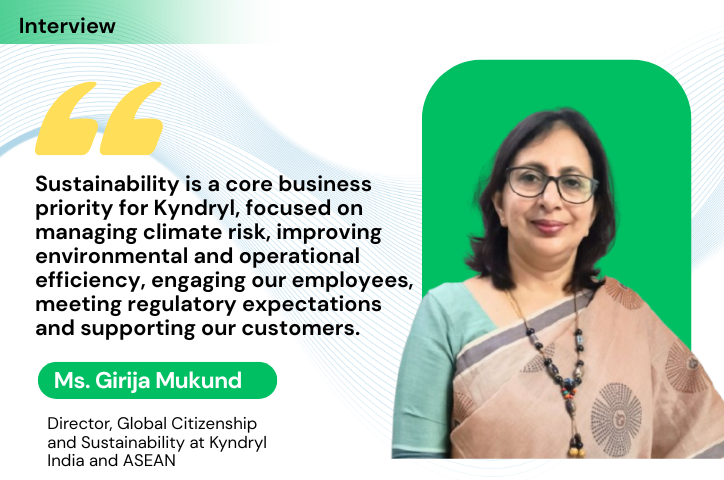
A. Sustainability is a core business priority for Kyndryl, focused on managing climate risk, improving environmental and operational efficiency, engaging our employees, meeting regulatory expectations and supporting our customers. From day one, Kyndryl mobilized cross-functional teams across the globe to build a bold, innovative and meaningful sustainability initiatives. Drawing on our experience, these are some of the key factors that enable sustainability to be embedded into the core of the business.
• Align sustainability priority to business objectives: The sustainability strategy should clearly outline benefits to the business. Ensure you have the organizational leadership support and commitment.
• Establish a cross-functional team: Sustainability can’t be the responsibility of one team. It has multiple key stakeholders, including finance, procurement, operations, IT and technology.
• Build a strong data foundation to move from reporting to action: Embedding sustainability requires trusted, connected data across operations and supply chains so leaders can set targets, measure progress and make realtime, informed decisions
• Technology and IT as enablers: treat them not as support functions but enablers, by embedding them directly into sustainability strategy, operations, and decisionmaking rather than using them only for reporting or compliance.
• Continuously monitor, report and improve: Ongoing measurement and transparent reporting provide the insight needed to track progress, identify gaps, and take necessary course corrections.
Q. Could you share any examples or indicative data points where integrating sustainability data into operational workflows has led to tangible improvements in efficiency, resilience, or environmental performance?
A. Kyndryl itself is a great example of data-driven progress in sustainability efforts. In FY2025 the company achieved:
• 18% reduction in scope 1, 2 (market-based) and 3 GHG emissions since FY2023 baseline
• 58% renewable electricity consumption
• 18% reduction in water consumption in high water-stressed areas since FY2023 baseline
• 99.99% of IT e-waste diverted from landfills.
• Kyndryl has received several major sustainability recognitions including,
- Gold rating from EcoVadis, placing Kyndryl in the top 5% of companies assessed globally for sustainability performance
- Global ISO 14001 and 50001 certifications for our Environmental and Energy Management System (E&EnMS)
- Named one of TIME’s World’s Most Sustainable Companies and ranked among Forbes’ Net Zero Leaders
- Ranked as a Leader by ISG in Sustainability and ESG: IT Solutions and Services
Q. Looking ahead, what opportunities do you see for Indian enterprises to leverage data, governance frameworks, and AI to move from incremental sustainability gains to transformative, system-level impact?
A. Indian businesses have a unique opportunity to build integrated sustainability systems as they modernise IT infrastructure. By embedding sustainability into cloud, data, and platform strategies from the outset, organisations can achieve a holistic view across IT, operations, and supply chains.
A strong governance framework covering data standardisation, ownership, and regulatory alignment such as BRSR are essential. AI can then be layered onto this foundation to drive further advanced use cases such predictive energy optimisation, demand forecasting, scenario modelling for emissions reduction at scale. Even small efficiency gains, when applied across India’s scale, can deliver transformative impact.







.png)