
ISDM CDSSI Report Finds Only 5% of Social Purpose Organisations in India Are ‘Beginners’ in Data Use
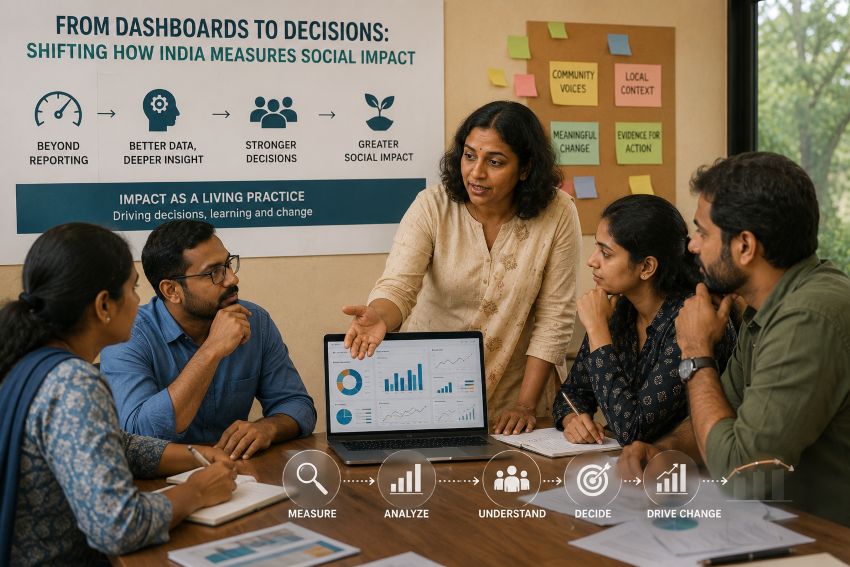
New Delhi, December 15, 2025: A new State of the Sector (SotS) report released by the Centre for Data Science and Social Impact (CDSSI) at the Indian School of Development Management (ISDM) indicates that the majority of Social Purpose Organisations (SPOs) in India are using data in some form, with only 5.3% classified as ‘Beginners’ in data maturity. The findings suggest that the sector is not data-averse and has established a baseline level of data adoption that can be strengthened to drive greater impact.
The report, described as the largest and most comprehensive study of its kind, draws on responses from more than 360 nonprofit organisations across the country. It provides the first national-level assessment of how SPOs collect, manage, and use data to inform decisions and improve programme outcomes.
Using ISDM’s Data Maturity Assessment (DMA) framework, the study evaluated organisations across five levels of data maturity, ranging from Beginner to Expert. The assessment benchmarks current practices and identifies gaps in systems, skills, and organisational culture related to data use.
Among the key findings, 66% of organisations reported that data is extremely important to their work. However, only 10% have access to an in-house data science team or consulting support, and just 34% have invested in structured data training. Around 70% of SPOs fall within the Emerging (about 30%) and Progressing (about 40%) categories, indicating growing recognition of data’s strategic value, but limited translation into robust governance mechanisms or advanced capabilities.
The report also found that 21% of organisations have reached an Advanced level of data maturity, while only 4% are categorised as Experts. Although 84.4% of SPOs use data to strengthen programme design, integration remains lower in functions such as fundraising management (58.6%) and finance or HR management (54.7%). Only 27.8% of organisations reported using data holistically across all decision-making functions. Budget constraints were identified as a key factor influencing data maturity, affecting investments in infrastructure, technology, and skilled personnel.
In addition to the SotS report, ISDM released an addendum titled ‘Funders’ Perspectives on the Data Maturity of Social Purpose Organisations in India’, based on a roundtable with philanthropic foundations, CSR entities, and outcome-based funders. The discussion highlighted that funders primarily view data as a tool for continuous learning and programme impact evaluation, though their use of data also remains concentrated in impact measurement.
The funders’ report noted challenges such as over-reliance on quantitative indicators, limited inclusion of frontline perspectives, and difficulties in capturing qualitative outcomes like empowerment or behavioural change. It also found that while funders value data maturity, it is not treated as a prerequisite for funding, with many expressing willingness to invest in strengthening SPOs’ data capacities.
Ravi Sreedharan, Founder & President, Indian School of Development Management, said, “The DMA is not just an assessment. The insights from the reports highlight that the most mature data ecosystems are not necessarily those with the most sophisticated tools, but those built on trust, transparency, and co-creation. We are seeing a sector gradually moving from data as proof to data for learning. This shift from compliance to collaboration is critical if India’s social sector is to make data a genuine driver of effectiveness and impact.”
The reports together underscore that data maturity in the social sector is shaped not only by technology and systems, but also by organisational culture, relationships, and shared learning between SPOs and funders.