How Jindal Foundation is Building Confidence, Capability, and Choice for Girls in India
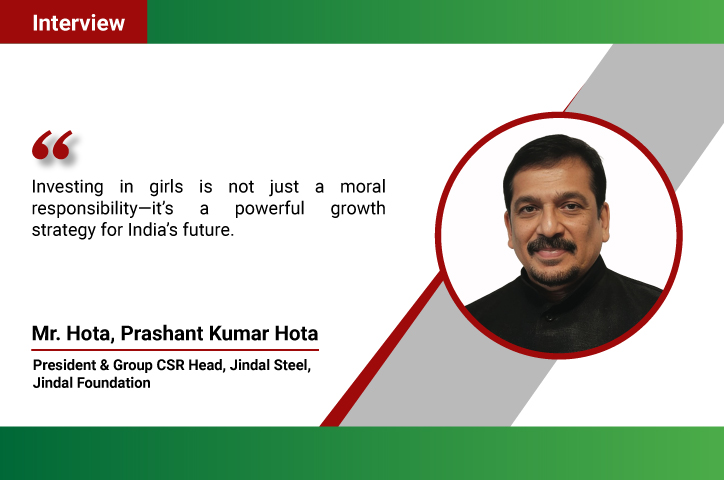
Investing in girls is not just a moral responsibility- it’s a powerful growth strategy for India’s future. However, despite significant strides being made towards empowering women, issues like school dropouts, early marriage, poor health, and limited livelihood access continue to persist.
In this exclusive interview with TheCSRUniverse, Mr. Prashant Kumar Hota, President & Group CSR Head at Jindal Foundation, shares deep insights on why empowering the girl child lies at the heart of Jindal Foundation’s social mission. He explains how their initiatives- like Yashasvi scholarships, Kishori Express, and Swawlamban- have supported thousands of girls with education, health, and livelihood opportunities across India.
From stories of girls fighting anaemia and returning to school, to community-led change makers like Tuleshwari Sahoo, Mr. Hota highlights how holistic, grassroots CSR interventions can drive real impact. The conversation also explores how corporate social responsibility can strengthen government schemes, and how lessons from Jindal Foundation’s work can inspire scalable models for others.
Q&A
Q. What inspired Jindal Foundation to focus on empowering the girl child, and what key challenges are you trying to address through your work?
A. At Jindal Foundation, we believe that empowering the girl child is one of the most powerful investments in shaping a nation’s future. A girl’s education, health, and confidence have a transformative ripple effect, uplifting not only her own life but also the well-being of her family and community.
Our commitment to girls’ empowerment stems from the conviction that true development begins with equality of opportunity. Yet, in many parts of India, girls continue to face barriers to education, healthcare and nutrition. Through our programmes, we strive to bridge these gaps—ensuring that every girl not only attends school but also grows into an informed, confident, and self-reliant young woman.
We are addressing this through a threefold approach: first, by breaking social and cultural barriers that limit girls’ access to education and opportunities (Yashasvi); second, by improving the health and well-being of adolescent girls through our flagship Kishori Express programme; and third, by fostering economic independence through Swawlamban, which provides financial assistance and capacity-building training to underprivileged women and girls to help them build sustainable livelihoods.
Q. Why do you see empowering girls as vital to India’s social and economic progress, and which areas—education, health, or livelihoods—reflect this most clearly?
A. Empowering girls is fundamental to India’s social and economic growth. When we invest in their education, health, and livelihoods, the benefits ripple across entire communities.
Education has been one of the core focuses. This year alone, over 4,200 girls were supported through Yashasvi scholarships, and more than 10,000 scholarships have been awarded so far across 10 states. Over 5,000 girls are now employed, earning between ₹12,000 and ₹25,000 a month.
On the health front, our Kishori Express initiative has reached 7.5 lakh adolescent girls across three states, leading to a 99% drop in severe anaemia. We’ve also distributed free sanitary napkins to over 1 million women and girls, while rural women producing them have collectively earned ₹1 crore, turning a health intervention into a livelihood opportunity.
These outcomes show how education, health, and economic empowerment together can unlock lasting change for girls and their communities.
Q. What are the biggest barriers still holding girls back in rural and industrial regions where Jindal Foundation operates, and how do these challenges differ across communities?
A. The biggest barrier holding girls back in rural and industrial areas is early marriage, which disrupts their education, affects health, and limits opportunities for skill development and independence. The reasons differ across regions- poverty and traditional beliefs in rural areas, peer pressure and secret marriages in towns, and deep-rooted customs in tribal regions. Poor financial conditions often push girls into work, keeping them away from school. Early marriage, poor nutrition, and limited healthcare further impact their well-being, while low aspirations and lack of mentors restrict growth.
Cultural norms continue to dictate what girls can or cannot do. Menstruation is still seen as shameful, keeping many from school or social life. Safety concerns and social opinions often prevent families from allowing higher education or work outside the home. Even in industrial areas, girls are often excluded from opportunities due to gender bias and lack of family support.
The Jindal Foundation addresses these gaps through education support, skill development programs and training, health awareness drives, and community sensitization, helping girls move toward greater self-reliance and equality.
Q. From your experience, what approaches have worked best to address issues like school dropouts, early marriage, or restricted mobility for adolescent girls?
A. From our experience, the most effective solutions are those that engage not just the girl, but her entire ecosystem, her family, school, and community. Real change happens when parents, teachers, and local leaders become partners in enabling girls to stay in school and pursue their aspirations.
By ensuring access to basic facilities like toilets, menstrual hygiene, and safe learning spaces, we also address practical barriers that often restrict girls’ mobility.
Our approach has therefore been holistic- combining awareness, access, and aspiration, to ensure that every girl not only stays in school but grows with confidence and dignity.
Q. Can you share any stories or examples from the ground that illustrate the real-life impact of your interventions on girls or young women?
A. Our programs are focused on empowering girls and women across multiple dimensions, from health and education to livelihood and dignity. Over the years, we’ve seen that true change happens when these areas intersect and reinforce each other.
For example, through large-scale health and nutrition initiatives, we’ve reached over 7.5 lakh adolescent girls in Odisha, Jharkhand, and Haryana to combat anaemia, achieving a 99% reduction in severe cases. Similarly, the maternal and child health services have reached 7.2 lakh women and children, ensuring safer pregnancies and healthier childhoods.
The Vatsalya Project in Odisha demonstrates this holistic impact vividly. Take the story of Tuleshwari Sahoo, a Village Health Volunteer from Basanpali, who once felt voiceless in the face of social issues. Through Vatsalya’s training, she not only became a strong advocate for maternal and child health but also led her village’s movement against domestic violence and alcoholism, helping ban the local brewing of mahua. Today, her community is healthier, safer, and more confident — proof that when one woman is empowered, an entire village transforms.
These stories remind us that real progress happens when women are equipped not just with opportunities, but with the confidence to shape their own futures.
Q. How do you see the role of CSR initiatives in complementing or strengthening government efforts in this space?
A. The strength of CSR lies in its ability to innovate locally, to move quickly, and to customize solutions based on what a community actually needs. These programs when aligned with Government policies and framework, help develop faster trust among locals, making them more accessible, and sustainable.
For example, many of our initiatives have worked hand-in-hand with district administrations and local bodies. In alignment with government’s Anemia Mukt Bharat and TB Mukt Bharat Abhiyan program we strengthen outreach through mobile health units and nutrition drives, these collaborations have helped reach remote tribal belts in Odisha, Chhattisgarh, and Jharkhand, improving maternal health, anaemia control, and early TB detection.
We consciously align our programs with government schemes to strengthen existing systems and ensure wider, more sustainable impact for communities in need.
Q. What lessons from Jindal Foundation’s programs do you believe are most relevant or scalable for other organizations working to improve outcomes for girls?
A. One key learning has been that programs for girls work best when they go beyond a single-issue approach and address interconnected needs- health, education, and livelihood together. For instance, our experience with initiatives like Kishori Express showed that tackling anaemia and menstrual health doesn’t just improve physical wellbeing; it also boosts school attendance and self-confidence.
Similarly, the importance of community participation and government linkage. When local ASHAs, Anganwadi workers, and district health officials become part of the process, the results are deeper and more sustainable.
Lastly, scalability comes from data and design. We document our work, measure impact, and adapt programs to different contexts rather than replicating them. This model helps us in creating a lasting change.
Q. In the coming years, what are Jindal Foundation’s top priorities for advancing opportunities for girls and young women, and how will you measure success?
A. In the coming years, our focus is on creating a deeper impact. We want our programs to go beyond solving immediate issues around health, education, and livelihood, and instead enable girls and young women to gain lasting confidence and independence.
We’ll continue to strengthen our programs around health and nutrition, especially anaemia and maternal care, while expanding opportunities in education, digital literacy, and skill training so that young women are better equipped for future jobs. Another key area will be entrepreneurship and leadership development, helping women move from employment to enterprise.

.png)