How Coca-Cola India Is Rethinking Waste Management at Scale
As India hosts some of the world’s largest cultural and religious gatherings, managing them sustainably has moved from aspiration to urgency. Events like Magh Mela 2026, which welcomed nearly 10 crore visitors over 44 days in Prayagraj, bring this challenge into sharp focus. They highlight the complexity of ensuring sanitation, resource efficiency, and environmental responsibility in a temporary city that exists only for a few weeks.
Traditional post event clean up models have struggled to keep pace with this scale. What is needed are systems that embed responsible waste practices into everyday operations, where collection, segregation, and recycling happen in real time alongside millions of pilgrims, vendors, and volunteers. In this context, Anandana – The Coca-Cola India Foundation, through its #MaidaanSaaf campaign, introduced a structured and collaborative approach to waste management. From integrating collection systems at key consumption points to deploying recycled plastic infrastructure and driving behaviour change, the initiative moved beyond conventional approaches.
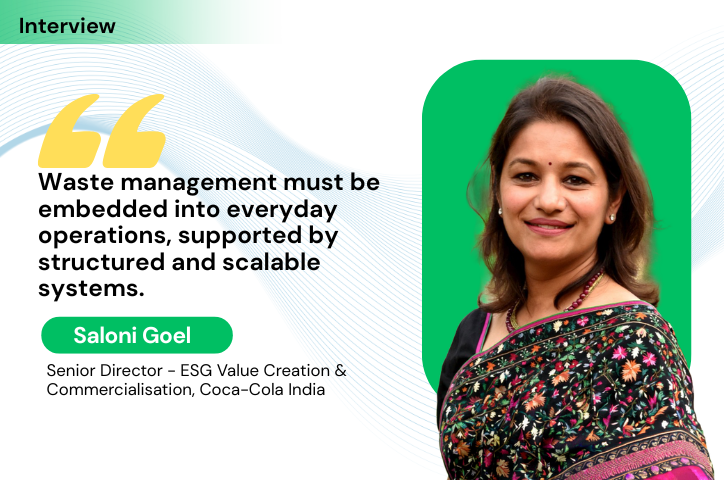
In this interview with TheCSRUniverse, Saloni Goel, Senior Director – ESG Value Creation and Commercialisation, Coca-Cola India, shares how partnerships, practical design, and local context can help shape a scalable model for responsible waste management at large public gatherings across India.
Read on for deeper insights into the systems, partnerships, and learnings behind this approach.
Q&A
Q. Magh Mela saw nearly 10 crore visitors in a temporary city setting. What were the key waste management challenges at this scale, and how did the #MaidaanSaaf model address them differently from conventional approaches?
A. Every year, Magh Mela creates a temporary city along the ghats of Prayagraj for several weeks, bringing together millions of pilgrims, vendors, and local communities. Managing waste at this scale, across 44 days and in a high-footfall setting, requires coordinated efforts from multiple stakeholders and structured systems that function consistently throughout the event.
Through #MaidaanSaaf, our effort has been on integrating responsible waste handling into the day-to-day functioning of the Mela in a way that is practical, visible, and relevant to the local context. The initiative supported organised waste collection and handling through structured waste collection systems at consumption points, deployment of 25,000 dustbin liners made from recycled plastic, and integration of hydration carts across the Mela area to enable responsible disposal of used bottles.
Rather than focusing only on post-event clean-up, the model embedded responsible waste practices within the event ecosystem itself through collaboration with implementation partners and local authorities.
Q. Could you share the estimated volume of plastic waste collected, segregated, and diverted for recycling during the initiative, and any measurable impact achieved so far?
A. Magh Mela brings together nearly 10 crore visitors in a temporary city environment, generating significant volumes of post-consumer plastic waste over a 44-day period. Managing Tonnes of waste in a time-bound, high-footfall setting requires systems that are both structured and scalable.
Under #MaidaanSaaf, Anandana – The Coca-Cola India Foundation supported organised waste collection and handling systems across key congregation areas, enabling the collection and segregation of plastic waste for responsible processing. Structured waste collection was strengthened through the integration of hydration carts at consumption points and the deployment of 25,000 dustbin liners made from recycled plastic across key locations.
In addition, 20 changing rooms made from recycled plastic waste were installed across the Mela area, demonstrating the practical reuse of post-consumer plastic in a high-visibility public setting. The measurable impact is reflected in improved on-ground segregation practices, streamlined waste handling systems, and increased awareness among pilgrims, vendors, and sanitation workers regarding responsible disposal throughout the event duration.
Q. How was the operational value chain designed, from collection and segregation to recycling, to ensure efficiency, traceability, and responsible end-of-life management?
A. The operational model was designed as a collaborative, multi-partner approach. Anandana partnered with Econscious and Ecodeco The Recycle Home Private Limited to support the deployment of public utility infrastructure made from recycled plastic waste across the Magh Mela area, including 20 changing rooms designed for high-footfall public use. These partners brought technical capability in converting post-consumer plastic into durable infrastructure solutions.
Structured waste collection systems were integrated at hydration carts and key consumption points to enable responsible disposal of used bottles, supported by the deployment of 25,000 recycled-plastic dustbin liners to strengthen primary collection.
To reinforce segregation and responsible handling practices, Anandana partnered with NGO Lakshya - A Society for Social & Environmental Development to lead Information, Education and Communication activities across the Mela grounds. Through direct engagement with pilgrims, vendors, sanitation workers, and local stakeholders, responsible disposal practices were promoted consistently throughout the event.
Aligned with our broader packaging waste reduction strategy under our Design and Partner to Collect approach, this end-to-end model reflects our focus on practical, collaborative solutions that support waste recovery while strengthening collection systems on the ground.
Q. What operational innovations or learnings from Magh Mela could help strengthen waste management systems for other large public events or high-footfall urban areas?
A. Large-scale gatherings that bring in huge volumes of people require us to innovate beyond conventional clean-up systems and embed waste management into everyday operations.
At Magh Mela, hydration carts operated by local vendors were integrated with structured waste collection systems, enabling responsible disposal at the point of consumption. This helped address waste generation where it occurred, rather than relying only on downstream clean-up efforts.
Another important learning has been the value of demonstrating the practical reuse of post-consumer plastic in high-footfall public settings through infrastructure such as changing rooms made from recycled plastic waste. Making recycling visible and tangible helps build awareness around the value of responsible disposal.
The initiative reflects a scalable model built on collaboration between implementation partners, NGOs, and local government authorities. Continued cross-sector partnerships can further strengthen responsible waste management practices across major cultural and sporting events in India.
Q. Behaviour change is critical in such settings. Which IEC approaches were most effective in encouraging responsible disposal among pilgrims, vendors, and other stakeholders, and how do you assess their impact?
A. To encourage wider participation, Anandana partnered with Lakshya - A Society for Social & Environmental Development to lead Information, Education and Communication activities across the Mela grounds.
Lakshya conducted structured on-ground engagement with pilgrims, vendors, sanitation workers, and local stakeholders, reinforcing segregation at source and responsible disposal practices. These activities were supported by visible segregation systems at hydration carts and consumption points, ensuring that awareness was directly linked to accessible infrastructure.
The presence of public-use infrastructure made from recycled plastic further strengthened behaviour-led cues by demonstrating the value of recycling in a practical way. Additionally, the changing rooms installed along the ghats featured illustrations promoting responsible waste management practices, helping to further spread awareness. The impact was reflected in improved adherence to segregation practices at designated points and greater participation by vendors and visitors in responsible waste handling systems during the event.
Q. From a CSR perspective, how can corporate initiatives like this complement municipal systems and contribute to strengthening long-term waste management infrastructure beyond event-based interventions?
A. Magh Mela is one of India’s most significant public congregations, and managing waste at this scale requires coordinated action across government, private sector, and civil society.
Corporate initiatives can complement municipal systems by adding structured infrastructure, technical expertise, and awareness-led interventions that strengthen existing waste handling mechanisms. Through #MaidaanSaaf, Anandana supported organised waste collection systems, deployed recycled-plastic infrastructure, and enabled behaviour change initiatives in collaboration with implementation partners and local authorities.
Such public-private partnerships enhance operational capacity during large-scale events while also demonstrating structured models that can be adapted for urban settings beyond the event period. By aligning with administrative efforts and strengthening collection systems, CSR-led initiatives can contribute to building more resilient and sustainable waste management ecosystems over the long term.
Q. How does this initiative align with India’s Plastic Waste Management Rules and Extended Producer Responsibility framework, and what policy support could help scale such models nationally?
A. #MaidaanSaaf reinforces our broader environmental goals by helping to build stronger waste collection systems, encouraging the reuse of materials like post-consumer PET, and raising awareness about the value of recycling.
The initiative aligns with India’s Plastic Waste Management Rules and Extended Producer Responsibility framework by strengthening structured collection at source and supporting responsible recovery systems in high-footfall public settings. It also supports national priorities such as the Swachh Bharat Mission and India’s broader push toward a circular economy by improving segregation practices and strengthening on-ground collection ecosystems.
Our environmental goals include aiming to use 35 per cent to 40 per cent recycled material in primary packaging, including increasing recycled plastic use to 30 per cent to 35 per cent globally, and helping ensure the collection of 70 per cent to 75 per cent of the equivalent number of bottles and cans introduced into the market annually.
Well-designed collection systems, enabling policies, and continued strengthening of local collection infrastructure will be essential to scaling such collaborative models nationally.
Q. The campaign is positioned as a scalable model. What financial, institutional, or partnership factors are essential for replicating it sustainably at other cultural or sporting gatherings?
A. The initiative reflects a collaborative, multi-partner approach, bringing together Anandana, implementation partners such as Econscious and Ecodeco The Recycle Home Private Limited, Lakshya - A Society for Social & Environmental Development for IEC engagement, and local authorities in Prayagraj to support responsible waste practices at large-scale public gatherings.
Clear alignment with event authorities, defined partner roles across collection, recycling, and awareness, early planning, and investment in visible, practical infrastructure are essential for replication. Continued collaboration and enabling policy environments will further support scalability across cultural and sporting events.


.png)