From Polio to Global Impact: How India Is Driving Rotary’s Blueprint for Scalable Change
At a time when development challenges are no longer siloed, when health intersects with climate, livelihoods with resilience, and volunteerism with systems change, the question confronting global institutions is no longer whether to act, but how to scale what works in ways that are community-owned and built to last.
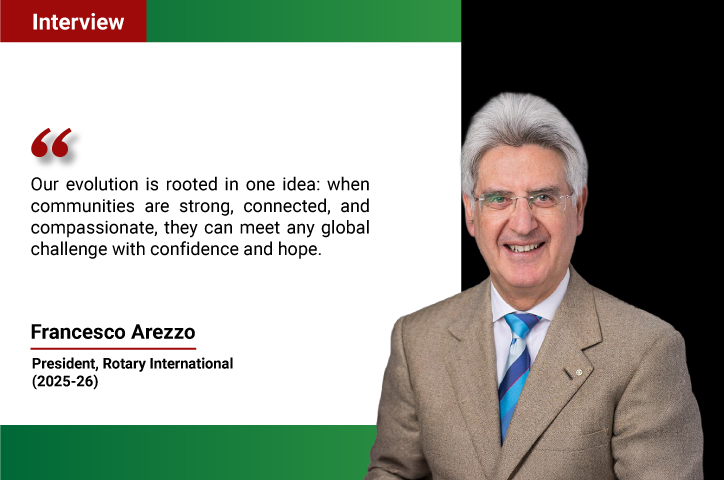
In this conversation with Francesco Arezzo, President of Rotary International (2025–26), TheCSRUniverse examines how Rotary is translating its century-long experience into large-scale, measurable outcomes. The discussion reflects Rotary’s emphasis on core principles for effective social impact: strong local partnerships, evidence-based design, human connection, and the ability to move from projects to long-term systems change.
A key focus of the interview is India’s evolving role as a driver of Rotary’s global impact, from the polio eradication model that continues to inform global health frameworks, to scalable initiatives in water access, climate-resilient agriculture, environmental restoration, and youth-led volunteerism. Together, these insights show how impact is strengthened when scale, trust, and accountability converge.
Scroll down for further insights.
Q&A
Q. Rotary has been at the forefront of humanitarian action for over a century. How do you see the organization evolving in an era where global challenges are increasingly interconnected, from health to climate to peacebuilding?
A. Rotary’s strength has always been its ability to evolve with the world’s needs, and today’s interconnected global challenges demand exactly that spirit of adaptation. Whether we talk about health, climate resilience, or peacebuilding, none of these issues exist in isolation — and Rotary’s model of community-driven action combined with global collaboration positions us uniquely to respond.
In this new era, Rotary is widening its lens from delivering projects to shaping long-term, system-level change. Our work in health now integrates climate-sensitive approaches; our peacebuilding efforts focus on social cohesion, youth empowerment, and conflict prevention; and our environmental initiatives emphasise sustainability and community resilience.
What remains constant is our belief that solutions must begin with people. As our challenges become more complex, Rotary is strengthening partnerships, investing in innovation, and empowering our 1.2 million members to lead change that is holistic, inclusive, and future-ready. Our evolution is rooted in one idea: when communities are strong, connected, and compassionate, they can meet any global challenge with confidence and hope.
Q. India has been a key partner in Rotary’s journey, both as a beneficiary and a global contributor. How do you perceive India’s role in shaping Rotary’s next phase of global impact?
A. India is not only a vital partner in Rotary’s past achievements; it is central to shaping our future global impact. With the second-highest membership and the second-highest fundraising contribution in the Rotary world, India brings unmatched scale, energy, and innovation to our collective mission. India is also home to one of the youngest and most dynamic volunteer communities within Rotary globally, with over 44,000 young members (Rotaractors) actively engaged in service and leadership. This youth energy is a powerful force shaping the next chapter of Rotary’s global impact. Their innovation, digital fluency, and community engagement are creating new models of service that resonate strongly with younger generations worldwide.
Beyond numbers, India has repeatedly demonstrated what purposeful community mobilisation can achieve. India has been Polio Free since 2014 and on 27th March 2024 India marked the 10-year anniversary of being certified Polio Free, serving as a powerful reminder of the collective will and commitment that made overcoming a seemingly insurmountable health challenge possible. India’s success in polio elimination demonstrated the power of community mobilisation, strong partnerships, and unwavering volunteerism. Those same strengths are now influencing Rotary’s work globally — from large-scale health programmes and disaster response models to youth leadership, literacy, and climate resilience initiatives.
Q. Rotary’s polio eradication model in India is often hailed as one of the greatest public health success stories in history. How is that legacy being leveraged today to strengthen global health frameworks for other preventable diseases?
A. India’s polio elimination experience remains one of the strongest demonstrations of what coordinated public health action can achieve, and its legacy is actively shaping global health frameworks today. The systems built for polio — from surveillance networks and micro-planning to cold-chain capacity and community mobilisation — have become foundational tools for addressing a wide range of preventable diseases.
Across many countries, these assets are now supporting measles–rubella immunization campaigns, HPV vaccination, routine immunisation strengthening, and rapid outbreak response during measles spikes in sub-Saharan Africa, polio detections in high-risk zones, and cholera flare-ups requiring quick community mobilisation. The polio legacy has also proven that real progress comes from empowering communities, building trust, and sustaining partnerships across government, civil society, and volunteers.
Most importantly, the polio programme taught the world that when data-driven planning, grassroots engagement, and political will come together, even the most complex public health challenges can be overcome. Rotary is committed to ensuring that this legacy continues to guide global health strategies — helping countries reach zero-dose children, close immunisation gaps, and build resilient systems that protect every child from preventable disease.
Q. What measurable outcomes or new partnerships have emerged from Rotary’s post-polio health initiatives, for instance in cervical cancer prevention or routine immunization campaigns?
A. Over the years, the Global Polio Eradication Initiative (GPEI)—of which Rotary is a core partner—has mobilized millions of frontline workers, reached underserved communities, and built one of the world’s most sensitive disease surveillance networks. Its rapid detection and outbreak-response systems are now being applied to other global health challenges such as malaria.
A significant way in which Rotary members are increasing our impact is through Programs of Scale. This multimillion-dollar initiative funds large-scale, high-impact projects that attract exceptional partners while making the most of the capacity, expertise, and enthusiasm of Rotary members.
Rotary's first Programs of Scale grant recipient Partners for a Malaria-Free Zambia aimed to reduce the incidence of malaria – the leading cause of death for pregnant women and children under five in that country – in ten target districts within two highly affected provinces. The Rotary Foundation, World Vision USA and the Gates Foundation, each contributed US$2 million to add 2,500 community health workers to the national health system in Zambia, allowing for more effective malaria diagnosis and treatment for more than 1.25 million people.
Success of the program-built way for Rotary Healthy Communities Challenge - US$30 million strategic partnership between Rotary, Gates Foundation and World Vision to create a new disease prevention and treatment grant program that will address some of the deadliest childhood diseases in four African countries: the Democratic Republic of Congo, Mozambique, Nigeria, and Zambia.
The 4th awarded Program of Scale grant for USD 2 million is from India - Partners for Water Access and Better Harvests in India (or PWABHI) aims to increase groundwater tables, extend cultivation areas, and raise the incomes of about 60,000 farmers by 25% to 30% across four states.
Q. Rotary’s Water Access and Better Harvests program exemplifies scalable sustainability. Could you share how evidence-based design and local partnerships have helped ensure long-term impact across the 60,000-plus rural farmers it aims to serve?
A. In India, the Partners for Water Access and Better Harvests (PWABHI) program (another Program of Scale) is advancing climate-resilient agriculture and groundwater recharge to support more than 60,000 rural farmers across Rajasthan, Uttar Pradesh, Madhya Pradesh, and Maharashtra. The programme’s evidence-based design and strong local partnerships have already delivered measurable impact, including an average 30% increase in harvests and significant improvements in water conservation.
A suite of water-recharge interventions — including check dams, dohas, and aquashafts — has helped replenish aquifers and raise groundwater levels. As wells regain water, farmers can irrigate their fields for longer durations, enabling up to three cropping cycles per year in regions where only one was previously possible.
Soil health is another key focus. Farmers are trained to adopt bio-resource–based practices that increase soil carbon content — currently around 0.3% due to long-term chemical fertiliser use — toward the ideal level of 3.0%. This shift not only improves soil fertility and moisture retention but also reduces input costs by lowering dependence on chemical interventions.
The program also encourages diversification into higher-value crops and livelihoods. Farmers transitioning to tissue culture bananas have reported income increases from INR 40,000–60,000 per acre per year to nearly INR 3 lakh in 1.5 years. Similarly, those adopting silkworm farming with mulberry have seen incomes rise from INR 40,000–60,000 per acre annually to INR 2 lakh in the first year alone.
Continuous training on judicious water use, crop selection, and modern farming techniques remains central to the programme’s success. By combining scientific evidence, local partnerships, and sustained community engagement, PWABHI is creating long-term pathways for climate resilience, improved harvests, and enhanced incomes for rural farming families.
Q. Environmental sustainability is a growing focus in Rotary’s agenda. How is Rotary aligning its community-level programs in India with broader national and global climate resilience goals?
A. Environmental sustainability is one of Rotary’s leading causes and India has been at the forefront of translating this commitment into meaningful community action. Rotary clubs across the country are designing programmes that align closely with India’s national climate priorities and global resilience goals — from water conservation and afforestation to waste management and renewable energy adoption.
In response to decades of environmental damage from tsunamis and cyclones, Rotary clubs in Tamil Nadu and Puducherry have undertaken a project creating 16 lakh sq. ft. of dense Miyawaki forests across Thanjavur, Nagapattinam, Thiruvarur, Cuddalore, and Puducherry. With over 70 clubs involved, the initiative includes a 33-year maintenance commitment including fencing and water supply.
ESRAG, the Environmental Sustainability Rotary Action Group, brings technical guidance, global best practices, and scientific expertise to Rotary projects. Through ESRAG’s support, clubs in India are implementing climate-smart solutions such as waterbody and firest rejuvenation, plastic reduction campaigns, rooftop gardening, and school-based environmental education.
Similarly, Rotary members globally are restoring local water bodies, promoting climate-resilient agriculture, installing solar infrastructure in schools and health centres, and leading large-scale tree-planting drives to strengthen green cover. ESRAG’s frameworks help ensure these initiatives are measurable, scalable, and environmentally sound.
Many of these projects are developed jointly with state governments, municipal bodies, climate experts, and civil society partners, enabling long-term impact and stronger community ownership.
Q. In a world increasingly polarized by politics and ideology, Rotary continues to emphasize dialogue and empathy. How do you personally define human connection as a tool for peace and social change?
A. Human connection is the single most powerful catalyst for peace. It begins with something very simple — “humanism of service” which is the importance of empathy in everything we do. Behind every statistic, every project, and every need is a person – a name, a face, a story. Too often we can fall into the habit of thinking in numbers, in reports, in abstract goals, but the human connection is what gives our work meaning.
In Rotary, service is not just about stepping in with solutions. It’s about showing up, listening, and working alongside people and communities. That mindset – respectful, grounded, and people-centered – is at the heart of what I mean by humanism in service. We’re not just delivering aid or funding projects; we’re building relationships and trust.
In a world divided by ideology and politics, real connection helps us see each other not as opponents, but as people with stories, aspirations, and concerns.
At Rotary, we believe peace is built not only through negotiations and policies but through everyday interactions that foster trust and empathy. When individuals connect across cultures, languages, and beliefs, barriers dissolve and understanding grows. This is where transformation begins.
That, to me, is the heart of peacebuilding — ordinary people choosing compassion, dialogue, and shared purpose over division.
Q. India today represents Rotary’s fastest-growing membership base and ranks second globally in fundraising. What factors do you think are driving this momentum, and what lessons might other countries draw from India’s model?
A. To set the context, India’s extraordinary momentum in Rotary — with the second highest membership base globally and the second-highest contributions to global fundraising — is driven by a combination of cultural values, community energy, and a deep-rooted spirit of service. Several factors stand out.
First, India has a strong tradition of volunteerism and collective action, which aligns naturally with Rotary’s ethos of ‘Service Above Self.’
Second, Rotary clubs in India have become increasingly agile and impact-driven, taking on large-scale, measurable projects in areas like health, education, environment, and women’s empowerment. This makes membership deeply meaningful, especially for young professionals who want to see tangible change.
Third, leadership within Rotary Clubs and Districts in India has placed strategic emphasis on diversity, digital engagement, and building strong public-private partnerships — strengths that resonate with today’s generation of changemakers.
India’s experience shows that when service, innovation, and collective ownership come together, Rotary becomes not just a club — but a nationwide movement for change.
Q. With over 4,000 projects worth US$1.5 billion dollars across seven focus areas, how does Rotary measure and communicate the long-term social return on its investments in India?
A. The Rotary Foundation (TRF) transforms contributions into service projects that change lives both close to home and around the world. Over the last 100 years, US $5.5 billion has been awarded through The Rotary Foundation – Rotary’s charitable arm that helps clubs work together to perform meaningful, impactful service.
In India, Rotary Foundation (India) furthers TRF’s mission as an associate foundation and is aligned with its objectives. Over the last ten years, RF(I) has supported 4000+ projects implemented by Rotary members worth 1.5 billion USD. Since 2016, RF(I) has further collaborated with nearly 500 corporations across the country to execute projects across its seven areas of focus.
Clubs are increasing their impact in their communities by:
1. Focusing on the issues and projects that matter most, guided by community assessments
2. Gathering data before and after each project and using that data to recognize improvements
3. Sharing stories that demonstrate measurable results and show a long-term commitment to a cause
Our clubs and districts use globally aligned monitoring frameworks that track not only outcomes— such as number of vaccines administered or trees planted — but also meaningful impact, including reductions in disease burden, learning gains in schools, and improvements in community resilience.
For us, impact is not just measured in numbers — it is seen in healthier children, more confident learners, empowered women, and communities that are better equipped for the future.
Q. Volunteerism itself is changing, especially among younger generations seeking quick, cause-driven engagement. How is Rotary reimagining its approach to attract, retain, and inspire this new wave of socially conscious citizens?
A. Volunteerism today is evolving rapidly, and Rotary is evolving with it. Young people are passionate, purpose-driven, and eager to create visible change — but they seek models of engagement that are flexible, meaningful, and community-centric.
To meet this shift, we are reimagining our approach on several fronts.
• Rotary has expanded ways to get involved through Rotaract (Rotary’s global network of young professionals and students who develop leadership skills while driving community projects), cause-based clubs, satellite clubs (operate under the sponsorship of an existing Rotary club but offer more flexible meeting formats, timings, and entry points for new members), and short-term project memberships that allow younger volunteers to participate without long-term commitment.
• Our emphasis on social innovation, climate action, mental health, and gender equity speaks directly to the priorities of today’s youth. Initiatives through ESRAG give young leaders the opportunity to design and scale solutions that matter to them.
• We continue to nurture a culture where young people feel heard, valued, and empowered to lead. Rotary is not only welcoming the next generation — we are giving them the space to redefine service itself. This is how we will continue to inspire socially conscious citizens who want to turn empathy into action.


.png)