From Invisibility to Inclusion: Advancing Dignity, Mental Health, and Independence for Persons with Deafblindness
Inclusion begins with recognition. Yet, for thousands of persons with deafblindness in India, access to education, healthcare, livelihoods, and even basic communication continues to remain a distant reality. Despite significant progress in the disability rights landscape, deafblindness remains one of the least understood and most underserved disabilities, often leaving individuals and their families invisible within mainstream systems.
For nearly three decades, Sense International India has been working to change this reality by building pathways for communication, education, mental health, livelihood, and social inclusion for persons with deafblindness across the country. From advocating for the recognition of deafblindness as a distinct disability under the Rights of Persons with Disabilities Act, 2016, to pioneering mental health interventions and leveraging technology to democratize access to support services, the organisation has consistently championed a rights-based approach to inclusion.
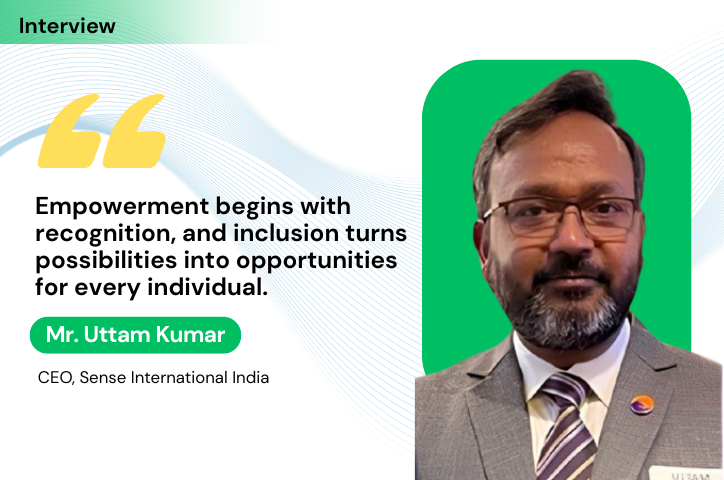
In this insightful conversation with TheCSRUniverse, Mr. Uttam Kumar, CEO, Sense International India, reflects on the evolving landscape of disability inclusion in India and discusses the critical need for systemic change to ensure that persons with deafblindness can live with dignity, independence, and equal opportunities. The discussion also explores pioneering initiatives in mental healthcare, digital learning, livelihood creation, and multi-stakeholder partnerships that are reshaping the inclusion ecosystem.
Scroll down to read how Sense India is working to transform invisibility into agency—one individual, one family, and one community at a time.
Q. Sense International India has spent nearly three decades working in one of India's most underserved disability spaces. What initially drove the organisation to focus exclusively on deafblindness, and why does this community continue to remain largely invisible in mainstream discourse?
A. Sense International India, also known as Sense India, was founded in 1997 with the support of Sense International UK, beginning on the dining table of our Chief Mentor, Akhil Paul, in Ahmedabad, at a time when there was only one programme in the entire country supporting approximately 23 deafblind children. The decision to focus exclusively on deafblindness was driven by the recognition that this was a community with no national voice, no dedicated institutional support, and no systemic pathway to education, healthcare, or livelihood. The founding commitment was simply that no one should be left to live in that kind of total invisibility.
Deafblindness remains largely invisible in mainstream discourse for several structural reasons. It is a low-incidence condition, estimated to be 0.04% of total population, relative to other disabilities, which means it rarely generates the critical mass of advocacy that shapes public policy or media attention. Additionally, because individuals with deafblindness often cannot communicate in conventional ways, their voices are absent from the conversations that are meant to represent them. They are excluded not just from society but from the very processes designed to address their exclusion. The issues around screening and identification of deafblind people remain critical. Many people still don't understand that deafblindness is a spectrum, where a range of visual impairments, from low vision to total blindness and hearing impairments, from moderate to profound, can combine in any form. Either people think we work deafness separately and blindness separately; or all persons with deafblindness are totally deafblind.
At Sense India, we believe that invisibility is never accidental. It is produced by the absence of representation, the absence of reliable data, and the absence of systems designed to recognize people who experience the world differently. Changing that has required us to work on multiple fronts at once. On the ground, we work directly with individuals and families, building communication, skills, and dignity one person at a time. Within government systems, we engage in policy, most visibly through our advocacy that led to deafblindness being recognized as a distinct disability. And in the broader public sphere, we work to shift awareness, because without public understanding, policy change alone cannot create the social inclusion that people with deafblindness deserve.
Q. Sense India's interventions span education, livelihoods, mental health, and policy advocacy. How do you ensure that these programmes move beyond welfare support and genuinely enable long-term independence and dignity for persons with deafblindness?
A.The distinction between welfare and genuine empowerment is what we have been thinking about constantly and being cautious. Welfare is what happens when systems do things for people. Empowerment is what happens when systems build the conditions for people to do things for themselves. From the beginning, Sense India's approach has been holistic precisely because we understand that independence for a person with deafblindness cannot be achieved through any single intervention. It requires communication, education, health, livelihood, and community participation to work together as a continuum. Our approach has always been “working with’ rather than working for.
In practice, this means every intervention we design begins with a detailed individual assessment and is built around an Individualised Education Plan or livelihood pathway tailored to that person's abilities, context, and goals. It means that every child and young adult with deafblindness are supported with their individualised needs and not ‘compared’ with anyone else. Our vocational training is not a one-time skill transfer but is accompanied by seed capital support, caregiver involvement, and follow-ups throughout the journey. It means that our mental health tools are not standalone assessments but are integrated into IEPs, counselling plans, and long-term rehabilitation systems.
The measure we use is life outcomes and not just programme delivery . Over 600 adults have been trained in vocational skills, more than 150 micro-entrepreneurs have been supported with seed capital, and 63,500 children have been enabled to access mainstream education through the Samagra Shiksha. These numbers reflect not welfare but the slow, careful, deeply human work of building independence, one person at a time.
Q. The inclusion of deafblindness as a distinct disability category under the Rights of Persons with Disabilities Act, 2016, was a landmark achievement. Could you share the advocacy journey behind this milestone and its practical impact on the ground?
A.The recognition of deafblindness as a unique disability category under the RPWD Act, 2016, was the result of years of sustained, multi-level advocacy that Sense India led with determination and patience. The argument we made was both simple and urgent: deafblindness is not merely the coexistence of hearing and visual impairment. It is a distinct condition that creates a unique set of communication, mobility, educational, and psychosocial challenges that are not addressed by frameworks designed for either blindness or deafness alone. Without separate recognition, people with deafblindness were systematically excluded from disability benefits, services, and rights.
The journey involved engaging with lawmakers, disability rights advocates, medical and rehabilitation professionals, and government bodies over many years, building an evidence base, demonstrating the scale and specificity of the need, and making the case at every level of the policy process. When deafblindness was finally included under the RPWD Act, 2016, it became the first time in Indian history that this community had legal recognition as a distinct category. Specific mention of ‘deafblindness’ in the UNCRPD also made a strong case for recognising unique needs of persons with deafblindness.
The practical impact has been meaningful, though the full realization of these rights remains a work in progress. Recognition has opened pathways to disability certification, UDID cards, pension entitlements, and inclusion in government welfare schemes that were previously inaccessible. It has also strengthened our ability to engage with state governments and education departments to build deafblindness-specific services into mainstream systems. Recognition does not automatically produce inclusion, but without it, inclusion is nearly impossible to demand.
Q. Mental health challenges among persons with deafblindness remain deeply underreported and poorly understood. In your view, why has inclusive mental healthcare historically been absent from India's disability ecosystem?
A.Inclusive mental healthcare has been absent from India's disability ecosystem for several intersecting reasons. First, India's mental health infrastructure more broadly remains severely underdeveloped, with significant gaps in community-based care, trained professionals, and culturally sensitive service delivery even for the general population. When mainstream mental health systems are already strained, the needs of people with disabilities are almost inevitably deprioritized.
Second, there is a fundamental conceptual gap: mental health is rarely understood as a disability issue, and disability is rarely understood as a mental health issue. The two fields have historically operated in separate silos, with disability services focused on physical, educational, and vocational dimensions, and mental health services designed for people who can communicate verbally and navigate clinical environments independently. People with deafblindness fall between these silos entirely.
Third, and perhaps most fundamentally, emotional distress in people with deafblindness does not present in ways that conventional systems recognize. It manifests through behavioral changes, withdrawal, aggression, sleep disturbance, and reduced engagement, signals that are routinely misread as behavioral problems rather than as expressions of psychological suffering. Until there are tools, trained professionals, and systemic frameworks capable of recognizing and responding to these signals, mental health will continue to be the most invisible dimension of an already invisible community's experience.
Q. Sense India has developed two pioneering mental health initiatives, the SII-SAMWED assessment tool and the Psycho-Social First Aid programme. What gaps did these initiatives seek to address, and what makes them unique in the Indian context?
A.Both SII-SAMWED and the Psycho-Social First Aid programme were developed in response to a single, glaring gap: there was no structured, culturally relevant, disability-inclusive framework in India, and world over, for identifying or responding to mental health needs among people with deafblindness. Caregivers and professionals were operating without tools, without training, and without a common language for understanding what emotional distress looked like in this population. The COVID-19 pandemic made this gap impossible to ignore, as families reported dramatic increases in behavioral challenges and emotional deterioration among their deafblind children and adults. When we started work on mental health, we could find very few references for previous work on the mental health of persons with deafblindness. Even among organizations focused on mental health, references addressing deafblindness specifically were not available.
SII-SAMWED is India's first, perhaps world’s first, structured mental health screening and assessment tool developed specifically for this population. It covers five core domains of mental health, assesses children aged 10 to 18 and young adults aged 19 to 29, and was statistically validated with 425 individuals. What makes it unique is not just its specificity but its functionality: it is not only a screening tool but a full monitoring and intervention planning system, integrated into IEPs and counselling frameworks, and designed to be administered by caregivers and educators in field settings, not only by clinical professionals.
The Psycho-Social First Aid programme, developed in collaboration with the Indian Institute of Public Health, Gandhinagar, addresses a different but complementary gap: building the capacity of professionals, caregivers, and community workers to provide early, empathetic, communication-sensitive psychosocial support before mental health concerns escalate to clinical levels. Grounded in the RAPID model, it represents a systematic effort to make mental health responsiveness a standard part of disability support, rather than a specialized service available to very few.
Q. The SII-SAMWED tool takes a continuum-based approach to mental health assessment and intervention planning. How has the tool changed the way caregivers, educators, and rehabilitation professionals identify and respond to emotional distress among persons with deafblindness?
A. Before SII-SAMWED, the identification of emotional distress among people with deafblindness was largely intuitive and inconsistent. Caregivers and educators who knew an individual well might sense that something was wrong, but they had no structured framework for documenting what they observed, no common language for describing it to other professionals, and no systematic basis for designing a response. The result was that mental health concerns were frequently missed entirely, or were addressed reactively and in isolation, without the longitudinal understanding that effective intervention requires.
SII-SAMWED has changed this by providing a structured, repeatable assessment framework that tracks mental health across five domains over time. It enables baseline assessments that establish a reference point, endline assessments that measure change, and regular monitoring that captures deterioration or improvement before it becomes a crisis. Because it is designed for field settings and can be administered by parents, caregivers, and special educators rather than only by mental health professionals, it has extended the reach of mental health awareness deep into communities where clinical services are unavailable.
The integration of SII-SAMWED findings into Individualised Education Plans and counselling programs has been particularly significant. It means that mental health is no longer treated as a separate concern managed by a separate professional, but is embedded into the core support plan for each individual. This is what a continuum of care looks like in practice: assessment, intervention, monitoring, and follow-up, all connected and sustained over time.
Q. Technology appears to be playing an increasingly important role in your work, particularly through the Global Resource Hub launched in 2025. How do you see digital platforms helping democratise access to knowledge, training, and support services for the deafblind community?
A. At Sense India, we have always believed that quality support for people with deafblindness should not be determined by where someone lives. The reality in India is that our community is spread across various geographies, and a significant majority of the 500,000 people living with deafblindness receive little to no specialist support. Digital platforms allow us to close that distance in ways that physical infrastructure alone simply cannot, by putting training, knowledge, and guidance directly into the hands of caregivers, educators, and CBR workers who are often working in remote and under-resourced settings.
A concrete example of this is our Psycho-Social First Aid programme, delivered as a structured web-based course that professionals and caregivers can access and complete regardless of location. Similarly, our Online Teacher Training Course on Deafblindness has allowed us to build capacity among educators across the country who would otherwise have no access to deafblindness-specific training. These platforms do not replace the depth of in-person intervention, but they extend the circle of informed, empathetic support that people with deafblindness depend on every day.
Most recently, the launch of the Global Resource Hub in July 2025 reflects our commitment to making this democratization truly borderless by bringing multilingual resources and accessible information together in one place for families, educators, and policymakers. But technology is always a means, not an end. What we are ultimately trying to democratize is not just information, but the capacity to see and respond to people with deafblindness with the understanding and skill they deserve.
Q. Livelihood and social participation are critical themes in Sense India's work, from vocational training to enabling voting rights. What have been some of the most meaningful indicators of social inclusion and self-reliance among the individuals you work with?
A. The most meaningful indicators of social inclusion are rarely found in programme metrics alone. They are found in the moments when a young adult with deafblindness runs their own small grocery shop and speaks about the confidence it has given them. They are found when a child who was once labelled mad by their neighbors for touching and throwing things in frustration is, years later, navigating their home independently, attending school, and learning sign language. They are found when a deafblind adult casts their vote for the first time, supported through a collaboration with the Election Commission of India to access the democratic process. It is found when more and more students with deafblindness successfully complete their 10th and 12th standard exams and go on to enroll in higher education.
In more measurable terms, over 600 adults have received vocational training, more than 100 micro-entrepreneurs have been supported to establish their own income-generating enterprises, and more than 450 deafblind adults have been enabled to vote. Through the Samagra Shiksha partnership, 63,500 children have been enrolled in mainstream schools. Our national networks, Udaan for adults with deafblindness, Prayaas for families, Abhi-Prerna for special educators and Bandhan for siblings, connect thousands of members in ongoing relationships of peer support and advocacy.
What unites all of these indicators is the shift from dependence to agency. Social inclusion is not merely about being present in a community, it is about having a role in it, a voice in it, and a stake in it. Every person with deafblindness who earns an income, casts a vote, attends a mainstream school, passes an examination, goes to colleges, or trains another caregiver is not just a programme beneficiary, they are evidence that inclusion, when genuinely pursued, produces dignity.
Q. Sense India collaborates with governments, grassroots organisations, and major corporate CSR partners across India. What lessons have emerged from building such a large multi-stakeholder ecosystem around disability inclusion?
A. The most important lesson is that no single actor can achieve systemic inclusion alone. Governments have reach and legal authority but often lack the specialized knowledge and community trust that NGOs build over decades. Grassroots partner organisations have deep local relationships but may lack resources, technical capacity, or national visibility. Corporate CSR partners bring financial resources and organizational capabilities, but need partners who can translate their investment into a credible, measurable impact. The only model that works at scale brings these actors into genuine collaboration, where each contributes what it does best.
A second lesson is that trust is built slowly and must be protected carefully. Over nearly three decades, Sense India has developed partnerships with more than 68 organizations across 25 states, and with CSR, trust and foundation partners including Azim Premji Foundation, Kamal India Foundation, Kamal Udwadia Foundation, Nelumbo Foundation, Rangoonwala Foundation, Adobe, Cisco, Microsoft, Samsung, Bajaj group companies, Oracle, GAIL and many more. These partnerships did not emerge from a single pitch or proposal. They were built through consistent accountability, transparent reporting, and demonstrated impact over time. Credibility is the most valuable asset an NGO can hold, and it is always more fragile than it appears.
A third lesson, and perhaps the most important for CSR partners specifically, is that disability inclusion is not a communications exercise. It requires sustained, multi-year investment in systems change, not short-term, high-visibility projects. The work of enabling a child with deafblindness to communicate, access education, and eventually earn a livelihood takes years, not months. Partnerships that understand and commit to this timeline are the ones that produce transformative outcomes.
Q. What is your long-term vision for inclusive development and mental healthcare for persons with deafblindness in India, and what systemic changes are still urgently needed to make inclusion a lived reality rather than a policy aspiration?
A. Our long-term vision is an India where every person with deafblindness, from early childhood through adulthood, has access to the identification, communication support, education, health services, mental health care, and livelihood pathways they need to live with independence and dignity. This is not a distant aspiration. It is an achievable goal if systemic investment matches the stated commitment. Of the estimated 500,000 people with deafblindness in India, nearly 90% currently receive little to no support. That figure represents not just a service gap but a national failure of inclusion.
The systemic changes most urgently needed are several. First, deafblindness must be integrated into mainstream disability services, teacher training curricula, healthcare systems, and social protection schemes, so that support is not dependent on the presence of a specialist NGO in a given geography. Second, disability-inclusive mental health must become a recognized and funded priority within India's health system, with trained professionals and community-based workers capable of serving people who cannot communicate verbally. Third, data on deafblindness must be collected and disaggregated in the national census and in disability surveys, because what is not counted is not addressed and not funded.
Finally, and most fundamentally, the voices of people with deafblindness and their families must be at the center of the systems designed to serve them. Our networks, Udaan, Prayaas, Bandhan and Abhi-Prerna, exist precisely to ensure this. Inclusion becomes a lived reality not when policies are written but when the people most affected by those policies have the power to shape, challenge, and hold them accountable. That is the long-term work, and it is the most important work Sense India does.



.png)