From Access to Empowerment: Strengthening Rural Education Through Safe School Mobility
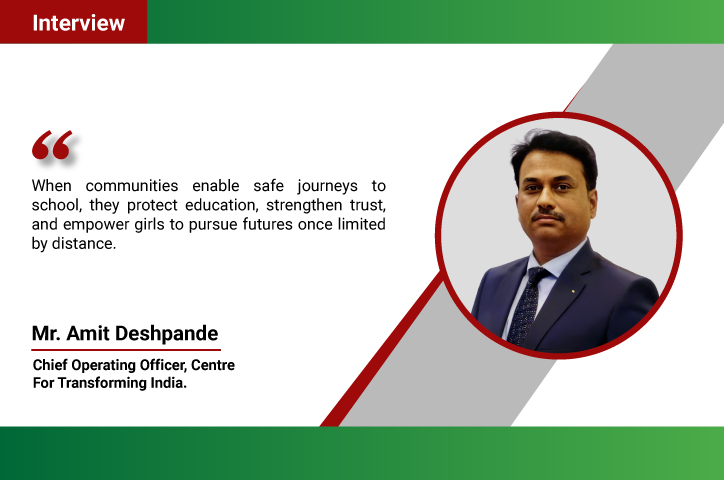
In many of India’s tribal, hilly, and remote regions, the journey to school is often more daunting than the classroom itself. Long distances, unsafe routes, harsh weather conditions, and deep-rooted social norms silently push adolescent girls out of the education system. Addressing this overlooked yet critical barrier, the Savitrichya Leki Chalalya Pudhe initiative by the Centre For Transforming India (CFTI) is redefining access to education through safe school mobility.
In this exclusive interaction with TheCSRUniverse, Mr. Amit Deshpande, Chief Operating Officer, Centre For Transforming India, shares how on-ground insights, home visits, and conversations with families revealed that mobility — not just enrollment — was the missing link in girls’ education. What began as a response to declining attendance among adolescent girls has evolved into a structured intervention combining bicycle distribution, self-defense training, and strong community engagement.
Read the complete interview below.
Q. Can you briefly tell us about the Savitrichya Leki Chalalya Pudhe initiative and what inspired CFTI to start it? How did early field insights shape the program’s design?
A. Savitrichya Leki Chalalya Pudhe was established from the on-field experience of CFTI, where we observed firsthand that girls were gradually opting out of school due to the distance and lack of safety in commuting to school. Although the numbers seemed to be stable, the attendance rate plummeted once the girls entered adolescence. The initial experiences in the field, home visits, and interactions with parents made it clear that the solution lay not in the mere distribution of bicycles but in the combination of bicycle distribution, self-defense training, and community engagement.
Q. How important is safe school mobility in preventing dropouts among adolescent girls, especially in tribal and hilly regions?
A. The ability to travel safely has a significant impact on girls’ ability to obtain their education in these areas. When schools are too dangerous or difficult to access, education is seen as optional, particularly for girls. In many tribal and mountainous areas, public transportation is limited or unavailable, which restricts mobility and leads to girls missing school, being exhausted by the time they get home from school, and ultimately dropping out of school. When girls have access to a safe, reliable form of transportation, their school attendance increases, their parents worry less, and that education is no longer optional. Mobility is not just an extra; it is an important part of keeping children in school
Q. Could you share specifics on the on-the-ground challenges girls face while commuting to school, and how these challenges differ across regions?
A. Difficulties differ based on where you live, but they are typically extreme challenges. For instance, in tribal areas, many girls walk through the forest to get to school and are at risk of being attacked by wild animals, as well as being trafficked by humans. In hilly areas, there is danger from steep hills, small bridges, and crossing rivers while on their way to school, especially during the rainy season. In coastal and high-rainfall districts, girls often have to travel on flooded paths and slippery surfaces. In addition, many girls in hot areas such as Vidarbha must travel very long distances in extremely hot weather, which can lead to exhaustion and health problems. Additionally, as a result of the varying risk factors related to gender-based violence, girls face additional risks regardless of where they live.
Q. The initiative has supported over 35,000 girls with bicycles. Beyond attendance, what tangible changes have you observed?
A. Apart from the enhanced attendance, the most observable impact is in the area of confidence and autonomy. The girls feel more in control of their time and feel safer during their journeys to and from school, which is directly linked to their academic success. The girls also have more time to learn and participate in school activities due to the reduced travel time. Over time, this has shifted community attitudes; education is no longer seen as fragile or conditional but as something girls can realistically sustain.
Q. Are there any individual or community-level success stories that stand out?
A. Multiple stories illustrate how girls who were about to leave school ended up staying in school, and some have become community leaders. For example, in many villages, community members initially opposed girls riding bicycles to school; however, after noticing greater rates of attendance, increased safety, and consistent academic success due to that mode of transportation, they became more supportive. As such, many younger girls now look to older girls as role models who have shown that distance is not an obstacle to being successful in school. These changes in acceptance show how successful transportation-based interventions can be.
Q. How does CFTI measure success for mobility-led education interventions?
A. Success is identified using qualitative and quantitative metrics, regular home visits, validated school attendance/absenteeism by principals, tracking dropout rates and trends in retention, and measuring what parents feel about their child’s experience and acceptance of the program from the community. These are all ways we monitor success over time. Although retention and attendance are critical, the most important measure of success for us is whether or not students continue to remain in their respective schools over multiple years. This represents that the support provided for a given student through mobility assistance has transitioned to educational stability.
Q. How have collaborations with CSR partners, local administrations, and community groups contributed to scaling the initiative?
A. The collaborative effort of CSR partnerships has been fundamental in successfully implementing large-scale programs with the help of local schools and their principals identifying beneficiaries and monitoring their progress. Community volunteers provide credibility and day-to-day surveillance of the program at the local level, and local government is involved with outreach in areas that pose the highest level of risk. By using a multi-stakeholder approach, we have been able to successfully support over 35,000 girls across the state of Maharashtra with strong accountability, community ownership, and sustainability.
Q. What have been the biggest operational or cultural challenges, and how has CFTI navigated them?
A. The initial resistance is usually due to safety issues associated with girls cycling. We deal with this by holding structured meetings with parents, school principals, and local leaders, as well as providing self-defense lessons for the beneficiaries. Logistical issues such as terrain, weather, and last-mile connectivity are handled by partnering with locals and decentralizing planning. Building trust has been essential; once the benefits are seen, resistance is replaced by cooperation.
Q. How do initiatives like this complement government education schemes?
A. Most government programs are centered around capital improvements, grants for higher education, and enrolling children into school. Savitrichya Leki Chalalya Pudhe is working to bridge the last mile gap by allowing girls safe and secure access to schools to reduce their risk of dropping out. There may be significant synergies between education and tribal welfare agencies regarding identifying high-risk dropout areas and jointly developing retention strategies for these areas.
Q. Looking ahead, does CFTI plan to expand this initiative further?
A. In the past few years the initiative has greatly expanded geographically, with much of the expansion happening in aspirational districts. Looking ahead, efforts will continue to focus on the most underserved areas of India and to increase our impact through CSR partners. Future geographical expansion will be based upon need, vulnerability, and the potential to effect holistic development.
Q. How does ensuring safe school mobility contribute to broader social outcomes?
A. A girl who remains in school has a significant impact beyond just her own life. The effects of this decision can include delaying marriage, achieving better health, increasing participation in the workforce, and enhancing progress across generations. Safe mobility serves as an accelerator for gender-equity; it enables education to be converted from aspiration to access and then into long-term social change.


.png)