Sambhav at 20: Why Systems Matter More Than Scale in Building Inclusive Livelihoods
As Sambhav Foundation completes 20 years, its journey stands out for the choices it consciously did not make. Instead of chasing scale or short-term training targets, the organisation has focused on going deep within communities, building local ownership, and creating systems that can sustain change even after it steps back.
Working across 20+ states, Sambhav supports first-generation learners, women, and persons with disabilities through a cluster-based approach that integrates skilling, inclusive education, digital access, and long-term support. In 2025–26 alone, it trained over 200,000 youth and adults across green, digital, manufacturing, and service sectors, with a focus on retention, dignity, and career progression rather than quick placements.
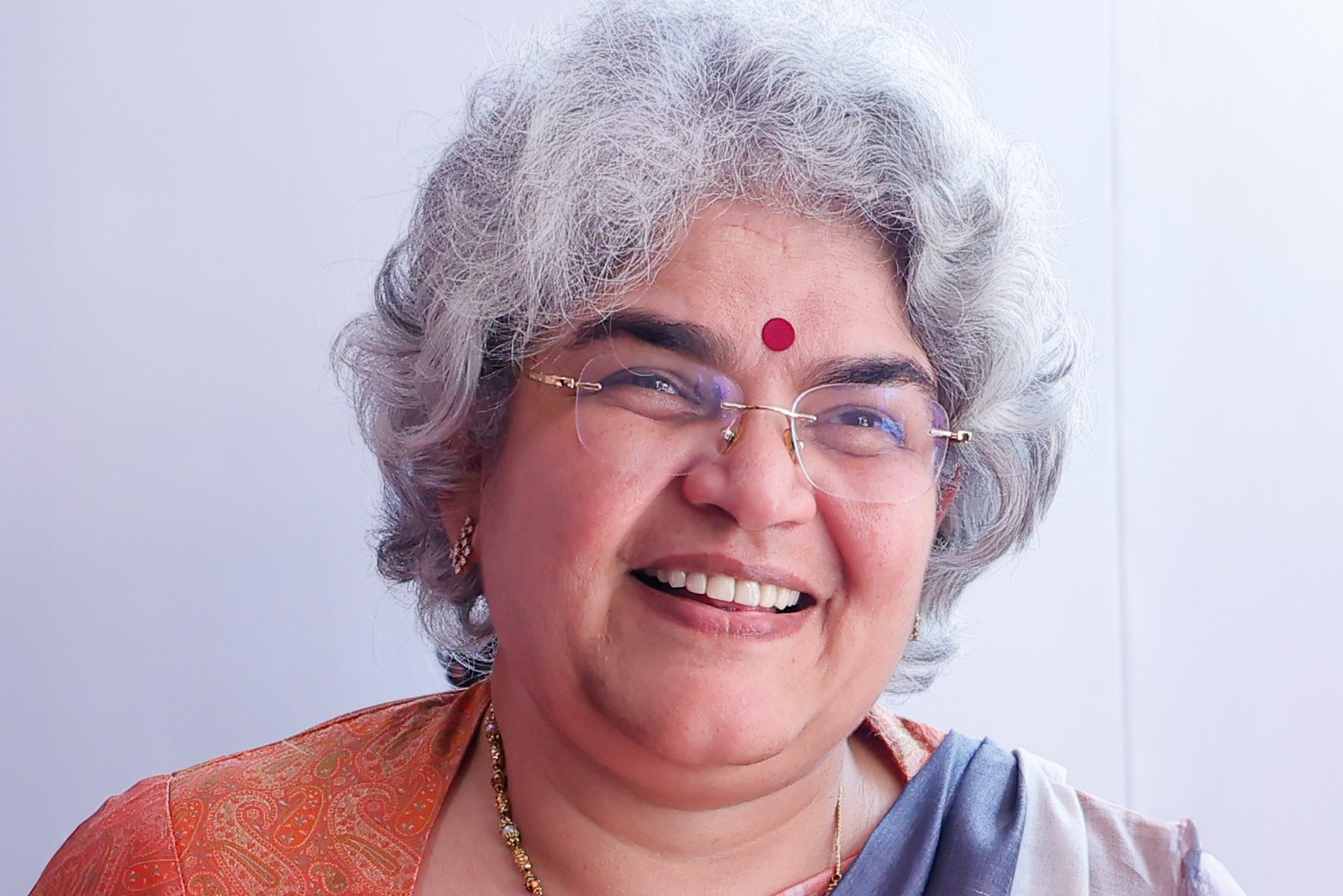
In this interaction with TheCSRUniverse, Gayathri Vasudevan, Chief Impact Officer at Sambhav Foundation, shares how these deliberate choices have shaped the organisation’s evolution and what systems-led, long-term impact truly means for CSR and development practice.
Scroll down to read the full interview.
Q&A
Q. Twenty years is a significant milestone for any nonprofit. From your vantage point as Chief Impact Officer, what has Sambhav Foundation deliberately chosen not to do over the years in order to remain systems-led rather than project-driven?
A. Over the years, Sambhav has made some very deliberate choices about what we would not do.
We chose not to chase scale for its own sake. If a program asked us to enter a community, deliver a short-term training, and exit without building local leadership or ownership, we said no. We have resisted the pressure to treat skilling as a transactional output or employment as a quick win.
We also chose not to fragment our work across geographies. Rather than spreading thin, we committed to going deep in clusters, staying long enough to understand the social, economic, and care realities that shape livelihoods, and withdrawing only when the ecosystem could sustain itself without us. For us, success has always included the ability to step back.
Equally important, we chose not to separate livelihoods from the systems around them. We did not limit our work to classrooms and placements. We invested in school infrastructure, digital access, health, and environmental transitions because livelihoods do not exist in isolation from the lives people lead.
Finally, we chose not to remain indispensable. If Sambhav is still the primary driver of change in a community after many years, we see that as a signal to reflect. Our aim has always been to build systems that outlast us, not projects that depend on us.
Q. How does the organisation currently identify and prioritise its focus areas, and which organisational capabilities have been most critical in enabling systems-level impact at scale?
A. We begin by listening to where exclusion concentrates, not where funding opportunities appear. Our focus areas emerge from mapping intersections like the number of first-generation learners, women carrying disproportionate care responsibilities, neurodivergent/ disabled individuals, and communities with limited digital and economic access. When these factors overlap within a geography, we know that this is where Sambhav needs to invest to uplift the society.
Equally important is our geographic discipline. Our work today spans 64 sub-cluster geographies across 20 states and over 12,000 pincodes. We work within clusters because systems change requires density of institutions, partnerships, infrastructure, and trust. Rather than launching new verticals each year, we deepen our presence where the need and conditions for long-term transformation already exist.
Certain organisational capabilities have been particularly important. We begin with aspiration mapping. We do not design livelihoods by pushing people into available roles; we start by understanding their goals, constraints, and the social return their progress can generate within families and communities.
The second is our ability to integrate technology without losing the human thread. Our data systems help us track journeys across skill, employment, and enterprise over time, but they are designed to inform learning and course correction, not to reduce people to metrics.
Finally, our strongest capability lies in partnership design. We have moved away from implementer models toward shared-outcome partnerships where responsibility, risk, and learning are distributed. This allows us to operate at scale without becoming project-driven.
Together, these choices have enabled us to build systems that endure beyond individual programs, and to pursue scale that is measured in resilience and agency, not just numbers. Over time, it helped us engage more than 3.2 million individuals, with over 1.5 million trained and more than 7 lakh placed across sectors.
Q. Sambhav’s journey began with Saadhya School. What early learnings from this phase continue to inform how you design interventions centred on dignity, retention, and long-term outcomes?
A. Saadhya shaped our thinking far more deeply than we anticipated at the time. Working with neurodivergent children taught us very early that “one size fits all” is not just ineffective, it is undignified.
One of the most important learnings we had was to shift our lens to designing environments that enable each individual. When we started focusing on creating sensory-safe, calm, patient, and predictable spaces, we saw confidence and engagement emerge naturally. That insight now underpins how we design adult skilling environments as well.
Saadhya also taught us that retention is rarely about motivation or discipline. When learners disengage, it is often because the system has failed to accommodate emotional overload, care responsibilities, or fear of failure. This is why our programs prioritise pacing, mentoring, and psychological safety alongside technical training. Dignity, for us, begins with being seen and supported as a whole person.
Perhaps most importantly, Saadhya grounded us in the idea that long-term outcomes cannot be rushed. Progress may be non-linear, and that is not a flaw in the learner. This patience-led approach continues to guide how we define success. We focus less on immediate outputs and more on sustained participation, confidence, and agency over time.
These early lessons remain central to Sambhav’s work today. The context may change, but the principle remains the same: systems must adapt to people, not the other way around.
Q. Which collaborations have been most critical to the organisation's ability to scale sustainably, and what distinguished these partnerships in terms of design, roles, and shared outcomes?
A. Some of our most meaningful growth has come through collaborations where the partnership itself was designed as a system, not a transaction. What distinguished these relationships was a shared willingness to move beyond funder-implementer roles and toward joint ownership of outcomes.
For instance, in our work with waste picker communities in Bengaluru, Sambhav took on the role of the alternate livelihood layer, while other Saamuhika Shakti partners focused on other requirements of the community, like social security and infrastructure, and civic systems. This allowed livelihoods to evolve without destabilising existing ecosystems. Each partner stayed within their strength, but the outcomes were collectively defined.
Similarly, partnerships such as those with Oracle evolved over time. What began as infrastructure and WASH (Water, Sanitation, and Hygiene) interventions expanded into green entrepreneurship for women within the same geographies. The continuity of engagement allowed us to build layered outcomes rather than parallel projects, and to deepen impact without re-entering communities afresh.
Our long-standing collaboration with Nykaa is another example. Over multiple phases, the partnership moved from training to enterprise creation and ecosystem building in the beauty and wellness sector. The distinguishing factor was the patience to invest in pathways and to adapt design based on what women needed to sustain their livelihoods.
Across these collaborations, the common thread has been shared risk, learning, and accountability. Partners were willing to stay engaged long enough to see systems take root, and we were clear that success meant our eventual withdrawal from the cluster.
Q. What programme design choices have been most effective in ensuring that Sambhav’s skilling initiatives translate into stable and dignified livelihoods across sectors such as digital, green livelihoods, manufacturing, and services?
A. Across sectors, we have learned that dignified livelihoods emerge from design discipline rather than from the choice of sector itself. One of our most effective choices has been to recognise and build on what people already know. Through recognition of prior learning, we make invisible skills visible, allowing informal workers to enter formal pathways with confidence and fairer wages, while layering in new technical capabilities relevant to evolving industries.
A second critical choice has been to align skilling with local demand within our cluster geographies. Whether in digital roles, green energy, manufacturing, or services, we avoid training for abstract job markets. Instead, we work closely with local enterprises and sector partners so that skills translate into real opportunities and sustained employment.
We have also invested heavily in wraparound support. Stable livelihoods require more than technical training, particularly for women and first-generation earners. Flexible schedules, mentoring, financial counselling, digital access, and post-placement support are integral to our programs, not add-ons. These elements are often what determine retention and progression.
In geographies where wage employment is limited, we have made a conscious shift toward enterprise-led models. Through our Social Enterprise and Economic Development centres, we support micro-entrepreneurship with mentoring, market linkages, and working capital, enabling livelihoods to grow where formal jobs are scarce.
Finally, we design for progression, not placement. Our aim is to create pathways that allow individuals to move across roles, sectors, and responsibilities over time. Dignity, for us, lies in the ability to grow, adapt, and exercise choice. This approach has supported over 20,000 micro-entrepreneurs, the majority of whom are women.
Q. Could you share a success story that best reflects how Sambhav’s integrated, cluster-based approach has enabled individuals or communities to move from exclusion to meaningful economic participation?
A. An example that comes to mind comes from Angul in Odisha. Our engagement there did not begin with skilling. It began with understanding how education, infrastructure, and aspiration intersect within the community.
We first worked with local schools, installing solar infrastructure in educational institutions. As an emerging hub of youth-centric conversation, and given its proximity to Odisha, youth over there did not have access to an uninterrupted education experience due to frequent power cuts. Hence, Solar intervention felt ideal. This was not treated as a standalone intervention. Alongside the installations, we ran behaviour-change and awareness programmes that helped students and teachers understand renewable energy and its relevance to their future. Over time, this exposure shifted perceptions of what was possible within the community.
As these students progressed, we created pathways that allowed them to transition into formal skilling in solar and electric vehicle technologies at our centres in Bhubaneswar. Because the skills were connected to infrastructure they had already seen and trusted, the learning felt relevant rather than abstract. Many of these young people went on to secure employment in the green energy sector, while some returned to their communities to support local installations and maintenance.
What is significant is not just the individual outcomes, but the ecosystem that emerged. Schools became sites of aspiration, skilling centres became pathways rather than endpoints, and livelihoods were linked to a growing local green economy.
This is what the cluster approach enables. It allows us to move from isolated interventions to circular systems, where education, infrastructure, skills, and employment reinforce one another. The result is meaningful economic participation rooted in context, continuity, and community ownership.
Q. How has Sambhav’s shift from running programmes to strengthening ecosystems reshaped expectations from CSR partners around timelines, ownership, and accountability for impact?
A. As Sambhav moved from running programmes to strengthening ecosystems, it required an equally important shift in how we engage with CSR partners. Early on, we realised that systems change cannot be delivered within quarterly timelines or measured only through immediate outputs. This meant having more honest conversations about what meaningful impact actually takes.
Today, many of our partners come to understand that timelines need to reflect the pace of communities, not reporting cycles. Instead of short-term targets, we align on longer horizons that prioritise income stability, retention, and progression. This has reshaped expectations from “how many were trained” to whether livelihoods are sustained and capable of growth.
Ownership has also evolved. Rather than Sambhav being the sole driver of delivery, partners are involved at the design stage and share responsibility for outcomes. In some cases, this means staying engaged across multiple phases within the same geography, allowing interventions to build on one another rather than operating as standalone projects.
Accountability, in this model, is less about compliance and more about learning. We track outcomes rigorously, but we also create space to adapt when assumptions do not hold. Partners who work well with us recognise that course correction is not a failure; it is a necessary feature of systems-led work.
This shift has helped move CSR conversations from transactional funding to patient capital, where success is defined by resilience, local ownership, and the point at which external support can responsibly step back.
Q. During periods of disruption, including the pandemic, what organisational practices helped you sustain continuity and community trust, and what lessons does this hold for long-term CSR investments?
A. Periods of disruption tend to reveal the strength of systems that already exist. During the pandemic, what allowed Sambhav to sustain continuity was not rapid programmatic pivots alone, but the depth of relationships and infrastructure we had built over time.
Because we were embedded within communities, our first response was not to protect programmes, but to respond to what people needed most. We supported vaccination drives, health screenings, and information helplines, even when livelihoods and training had temporarily paused. This reinforced a simple truth; trust is built quietly over years of consistent engagement, and it is during moments of crisis that it is tested.
Operationally, our investments in digital literacy and decentralised teams allowed us to stay connected with learners and families. Regular phone-based check-ins, local facilitators, and flexible program designs helped maintain engagement until economic activity resumed.
Our CSR partners, too, learnt that long-term impact requires investment in resilience and not just delivery. Digital access, social security linkages, and local leadership are often seen as ancillary, but they become critical during disruptions. CSR strategies that account for these layers are better positioned to protect both people and progress when external shocks occur.
Ultimately, continuity during disruption comes from trust, adaptability, and systems that are designed to hold even when conditions change.
Q. As Sambhav enters its next phase of growth, which new areas does the organisation plan to venture into, and which existing programmes are expected to be scaled up to deepen impact?
A. As Sambhav enters its next phase, our focus is less on adding new verticals and more on deepening the systems we have already built. Growth, for us, is about density and continuity rather than expansion alone.
One priority area is strengthening our cluster ecosystems. We will deepen our presence in select geographies by layering education, skilling, enterprise, and infrastructure more deliberately, so that pathways from school to livelihoods are clearer and more sustained. This includes linking school-based digital and green exposure to formal career transitions for youth.
We are also expanding our work at the intersection of green and digital futures. Circular economy trades, renewable energy pathways, and AI-enabled digital fluency for first-generation learners will be scaled, particularly where they align with local economic demand and environmental transitions.
Another important focus is leading with disability. Building on the learning from Saadhya, we intend to extend disability-first design across our livelihood programmes, ensuring neurodivergent individuals are not only included, but supported to lead and progress within the workforce.
Alongside programmatic growth, we are investing in organisational resilience. This includes strengthening post-placement support systems, alumni networks, interoperable technology platforms, and second-line leadership, so that scale does not dilute learning or care.
In this phase, success will be defined not by how widely we expand, but by how deeply our interventions embed themselves within communities, and how confidently we are able to step back as local systems take ownership.



.png)