Engineering the Future with Purpose: Cyient on AI, Education, and Inclusive Workforce Readiness
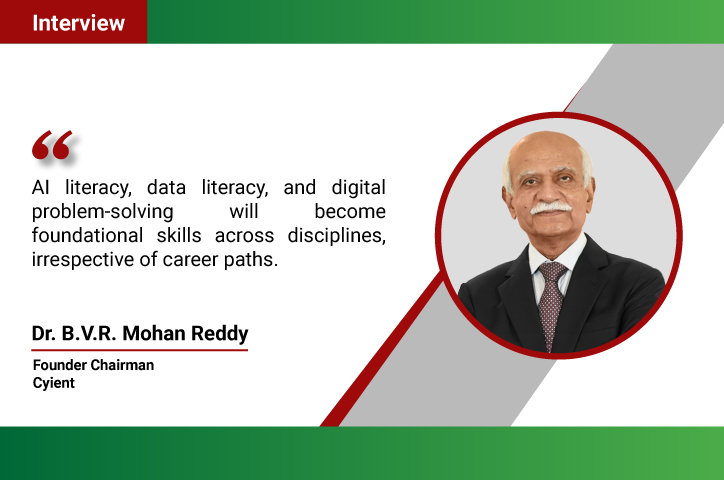
As Artificial Intelligence reshapes industries, economies, and societies, the Cyient Foundation is working to ensure that the benefits of technology extend well beyond urban centres, reaching government schools, rural youth, and underserved communities. In this conversation, Dr. B.V.R. Mohan Reddy, Founder Chairman, Cyient, outlines Cyient Foundation’s philosophy of technology-led nation-building and explains why preparing India’s workforce for the future must begin at the grassroots.
Scroll down to read the full interview.
Q&A
Q. Why is investing in AI education and future skills at the grassroots level critical?
A. Artificial Intelligence is rapidly becoming a foundational layer of the modern economy, much like electricity and computing were in earlier eras. If India’s demographic dividend is to translate into sustainable economic strength, AI education must begin at the grassroots—not only in universities or urban centres, but in government schools and rural communities where aspiration often exists without opportunity.
At Cyient Foundation, we are building a continuum of future-skills learning that starts early and progresses toward employability. This journey begins with CyAILS – Cyient AI Labs for Schools, implemented across 50 government schools in Visakhapatnam. It extends through CYIENT vijAIpatha AI/STEM Labs in five government schools in Hosapete, Karnataka, and advances into livelihood-linked skilling through the AI & Future Skills Hub at Digital Bhavan in Pedamainavani Lanka, West Godavari district, Andhra Pradesh, as well as the AI & Future Skills Centre of Excellence at the Nagaland Tool Room & Training Centre (NTTC), Dimapur.
At its core, grassroots AI education is about democratizing innovation capability—ensuring that students from rural and underserved communities are not merely consumers of technology, but active participants in the global digital economy.
Q. What gap were you aiming to address through AI Labs and rural skilling centres?
A. We observed a growing disconnect between traditional education systems and the rapidly evolving workforce requirements shaped by AI, automation, digital engineering, and advanced manufacturing. While government school students often lacked early exposure to computational thinking and emerging technologies, rural youth faced limited access to industry-aligned, employability-focused skilling pathways.
Our AI Labs and Future Skills Centres are designed to bridge this divide by integrating education, hands-on technology exposure, and livelihood opportunities. By extending innovation ecosystems beyond urban geographies, these initiatives help ensure that talent and potential are not constrained by location.
Q. How do these centres bridge the digital divide and the employability gap?
A. The digital divide today is no longer defined solely by access to devices or connectivity—it is fundamentally about access to capability development. True digital inclusion means enabling people to build the skills and confidence required to participate meaningfully in a technology-driven economy.
Across Cyient Foundation initiatives, students engage in robotics, coding, IoT systems, AI-enabled problem-solving, and project-based learning. These experiences foster computational thinking, data literacy, and an innovation mindset—capabilities that are increasingly essential across all sectors.
To date, Cyient Foundation has enabled AI, STEM, and ICT access in over 200 government schools, reaching more than 35,000 children annually. In parallel, AI-enabled skilling programs are creating tangible employment and entrepreneurship pathways in rural regions. When learning is directly connected to livelihoods, both the digital divide and the opportunity divide begin to close.
Q. What differentiates meaningful AI education from superficial digital exposure?
A. Meaningful AI education is not about learning how to use technology—it is about understanding how technology works. Students must develop problem-solving logic, systems thinking, and an appreciation of how AI and automation can be applied to real-world challenges.
Through initiatives such as CyAILS and vijAIpatha, students learn by doing—through experimentation, innovation challenges, and hands-on projects. This shift from technology consumption to technology creation is what makes AI education truly transformative, enabling learners to see themselves as creators, innovators, and problem-solvers.
Q. Why is teacher capability building essential?
A. One of the clearest global lessons from technology adoption in education is that infrastructure alone does not transform learning—teachers do. Technology becomes impactful only when educators are confident and capable of integrating it into everyday teaching.
Recognizing this, Cyient Foundation has trained over 5,000 government school teachers in ICT and digital pedagogy. By equipping teachers to integrate AI, robotics, and project-based learning into classrooms, we create a multiplier effect—converting technology investments into sustained educational transformation.
Q. How do you ensure AI-led skilling initiatives remain relevant as technology evolves?
A. While technology evolves rapidly, the core requirements of the future workforce remain consistent: adaptability, interdisciplinary thinking, and a commitment to continuous learning. Our programs, therefore, emphasize foundational digital competencies, an innovation mindset, and strong industry partnerships rather than narrow, tool-specific training.
For example, the AI & Future Skills Centre of Excellence at NTTC Dimapur integrates AI into vocational domains such as robotics, coding, digital manufacturing, and creative industries—creating a dynamic skilling ecosystem rather than static infrastructure. Similarly, the Cyient AI & Future Skills Hub in Pedamainavani Lanka is designed to empower youth, women, farmers, self-help groups, and local entrepreneurs with future-ready skills aligned to emerging workforce demands and local livelihood opportunities.
Q. How can industry-led CSR complement formal education systems?
A. At Cyient, CSR has always been viewed as nation-building through technology, not as a peripheral activity. Industry can play a critical role in complementing formal education by bringing real-world engineering challenges, emerging technology exposure, and employability insights into learning environments.
Through initiatives such as CyAILS, vijAIpatha, the NTTC Centre of Excellence, and the Future Skills Hub in Pedamainavani Lanka, CSR serves as a bridge between education systems, industry ecosystems, and the evolving needs of the future workforce.
Q. What early outcomes reaffirm the importance of inclusive AI education?
A. Across regions, we are already witnessing increased student engagement, growing digital confidence, and higher levels of teacher participation. Cyient Foundation currently supports over 21,000 students annually through school adoption initiatives, with more than 56% girl participation, and has improved learning environments for over 2.5 lakh children.
Beyond these metrics, the most meaningful outcome is aspirational transformation—students beginning to envision themselves as future technologists, engineers, and innovators.
Q. How can CSR-led AI skilling initiatives contribute to inclusive growth?
A. Inclusive growth depends on equitable access to capability, technology, and livelihoods. Cyient Foundation has provided digital literacy to more than 37,000 individuals, including 14,000 women, and continues to train around 2,000 rural women annually for employment and entrepreneurship.
AI-enabled skilling initiatives such as the Pedamainavani Lanka Future Skills Hub and the NTTC AI & Future Skills Centre of Excellence extend these pathways into emerging technology domains—helping communities move toward self-reliance and active participation in the digital economy.
Q. How do you see AI education evolving over the next decade?
A. Over the next decade, AI education will increasingly become part of mainstream learning, much like computer education did in earlier decades. AI literacy, data literacy, and digital problem-solving will become foundational skills across disciplines, irrespective of career paths.
Industry leaders and foundations have a responsibility to ensure that this transformation is inclusive, ethical, and scalable. At Cyient, our journey since 1991 has been guided by a simple yet enduring belief: values outlast business cycles. From the very beginning, we built the organization on fairness, integrity, transparency, and long-term thinking—what we call our Values FIRST—and on the conviction that the sustained development of society is vital to sustained business growth.
Democratizing AI education, therefore, is not merely a CSR priority. It is a national workforce imperative—closely aligned with the visions of Digital India, Skill India, NEP-2020, and Viksit Bharat 2047.






.png)