
Carbon Masters, BBMP and Saatarem Partner to Develop Bengaluru’s First Integrated Waste-to-Value Park
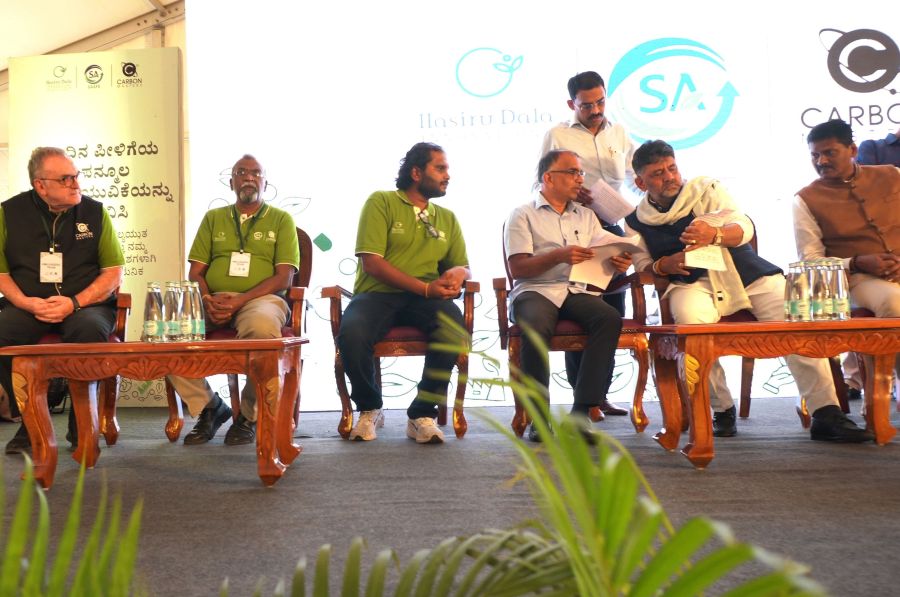
Bengaluru, December 2, 2025: Carbon Masters India Pvt. Ltd. (CMIPL), in collaboration with Bruhat Bengaluru Mahanagara Palike (BBMP) and Saatarem Alternative Fuel and Energy Pvt. Ltd. (SAAFE), has announced plans to develop Bengaluru’s first integrated waste-to-value park at the Kannahalli Municipal Waste Plant in Bengaluru West. The initiative aims to significantly reduce the city’s landfill burden by converting organic waste into clean energy and high-quality fertiliser.
The foundation stone for the project was laid on December 1 by Bengaluru Deputy Chief Minister D.K. Shivakumar. The BBMP-owned facility currently processes 350 tonnes per day (TPD) of segregated waste into compost but has an installed capacity of 1,000 TPD. Under the public–private partnership model, BBMP and its concessionaire SAAFE are partnering with Carbon Masters and other technology collaborators to transform the site into a large-scale circular economy hub.
Once fully operational, the integrated park is expected to process around 900 TPD of organic waste to produce approximately 30 TPD of Carbonlites® biomethane and 750 TPD of organic fertiliser. In its first phase, a compressed biogas plant will handle 300 TPD of organic waste to generate 10 TPD of biomethane and 250 TPD of organic fertiliser.
Deputy Chief Minister D.K. Shivakumar said, “Bengaluru has been challenged by the rapid growth of both our population and our waste. With this project at Kannahalli, we are demonstrating that waste is not a liability but a resource. By converting our city’s waste into clean fuel, power and organic fertiliser, we will reduce the pressure on landfills, cut pollution and create new green jobs. This can become a model for cities across Karnataka and India.”
Abhishek Gowda said, “SAAFE has been committed to finding sustainable solutions for Bengaluru’s waste. This partnership allows us to scale up from composting alone to a truly integrated waste-to-value model that benefits the city, the environment and local communities.”
Som Narayan, Co-Founder, Carbon Masters, said, “By bringing together biomethane, organic fertiliser, power generation and RDF on a single site, Kannahalli will be India’s first-of-its-kind circular economy waste-to-value park, a model that can be replicated across every urban centre. We want to demonstrate that a problematic municipal ‘waste stream’ can be transformed into multiple value-added products that save both costs and carbon emissions.”
Two additional technology partners have joined the consortium to strengthen the integrated model. Professor Dasappa from IISc’s Centre for Sustainable Technologies will lead the conversion of residual waste into 1 MW of renewable electricity and explore gasification technology for green hydrogen generation. HasiruDala Innovations, led by CEO Shekar Prabhakar, will develop a Material Recovery Facility capable of processing 100 TPD of dry waste to recover recyclables and produce refuse-derived fuel.
The Kannahalli project aligns with the Swachh Bharat Mission and Solid Waste Management Rules, 2016, by promoting source segregation, resource recovery and scientific disposal. The initiative is expected to reduce landfill-bound waste, cut greenhouse gas emissions and supply farmers with high-quality organic fertiliser to improve soil health.