

Bisleri International’s Sustainability Roadmap Towards Water Security, Circular Economy and Climate Resilience
Environmental sustainability has moved beyond being a corporate commitment to becoming a business imperative in a world increasingly shaped by climate uncertainty. For India, where water stress, plastic waste, and climate induced disruptions continue to pose significant developmental challenges, the private sector has an important role in driving solutions that create lasting value for both communities and ecosystems. Integrating responsible resource management into business strategy is now central to building resilient economies and sustainable societies.
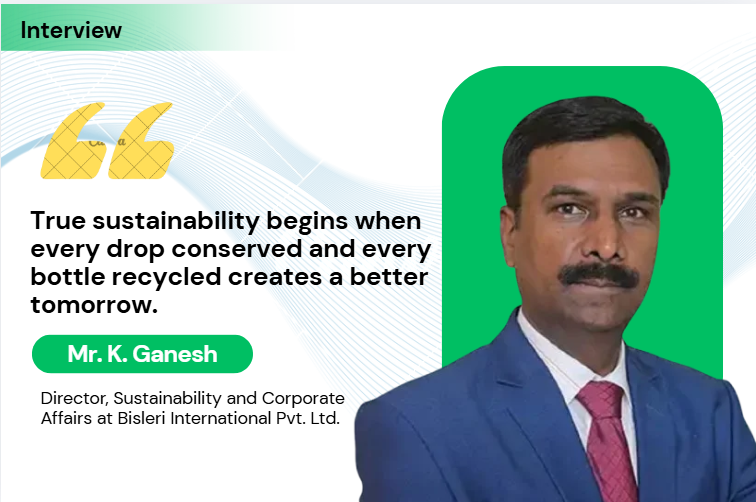
In this interview, Mr. K. Ganesh, Director, Sustainability and Corporate Affairs at Bisleri International Pvt. Ltd., speaks about Bisleri International’s approach to embedding sustainability across its operations through long term investments in water stewardship and circular economy initiatives. He reflects on the impact of Project NAYI UMEED in strengthening water resilience, the evolution of Bottles for Change in promoting responsible plastic waste management, and why collaboration, community ownership, and sustainable business practices will be essential to shaping a more resource conscious and climate resilient India.
Scroll down to read the full interview:
Q. How do you see the relationship between climate change, water security, environmental sustainability, and community resilience evolving in India today?
A. The relationship between climate change, water security, environmental sustainability and community resilience are deeply interconnected. Rising temperature, erratic rainfall, droughts, floods and depleting groundwater tables are directly impacting livelihoods, agriculture, health and economic stability. This evolving fact requires businesses, government and communities to work together through sustainable water management, plastic waste management, circular economicpractices and climate resilient infrastructure. Bisleri is contributing through its initiatives project NAYI UMEED for water conservation and Bottles for Change for plastic waste management. These efforts demonstrate how corporate sustainability can strengthen environmental protection while building long-term community resilience and resource security across India.
Q. Water conservation is emerging as one of the most urgent sustainability priorities globally. How is Bisleri approaching water stewardship and long-term water resilience through initiatives such as Project Nayi Umeed?
A. As a beverage company, water stewardship is a priority for us. Since 2001, Project NAYI UMEED has focused on harvesting rainwater, building / repairing and restoring of check dams, andrecharging groundwater ensuring water security for communities. To date, we've built, repaired and restored 378check dams, 3 reservoirs, 2 lakes and harvested nearly 31.4 billion liters of water. The initiatives have supported more than 14,666 farmers, improved water accessibility and strengthened irrigation across thousands of acres. Local community ownership is central to every project we undertake; therefore, these projects are sustained by the communities. The initiative also promotes community participation and ownership, ensuring long-term maintenance and sustainability of the water assets created. By combining scientific water management, community engagement, and scalable infrastructure development, Project Nayi Umeed demonstrates how corporate water stewardship can create lasting social, economic, and environmental benefits while supporting India’s journey towards water security and sustainable development.
Q. Plastic waste management and circular economy discussions are rapidly evolving in India. In your view, how can companies move beyond compliance-led approaches to create meaningful and measurable environmental impact?
A. As Plastic Waste Management and circular economy discussions evolve in India, companies must move beyond compliance driven approaches and embed sustainability into the core business. Companies that confine their plastic management efforts to meet regulatory requirements are missing the larger opportunity and responsibility to drive systemic change. Any waste management system to be successful, it is imperative that people adopt it and the system is acceptable to adhere & sustain for a long period. Our focus has always been on driving awareness and behavioral change at scale, in addition to the collection. We educate citizens on source segregation and responsible disposal so that used plastic reaches recycling facilities rather than landfills or water bodies. Through Bottles for Change program, we've shown that when people understand used plastic is a valuable resource, that can become fabric, benches, and even art. That mindset is what moves the needle, beyond compliance.
Q. Through initiatives such as Bottles for Change, Bisleri has worked extensively on recycling and waste management awareness. What key learnings or impact have you observed through these interventions at a community and ecosystem level?
A. Bottles for Change Program is built on one simple belief: plastic, when managed responsibly, is a valuable resource, not waste. As I have said before, plastic, once used, should be disposed of responsibly and sent for recycling. Unfortunately, that often does not happen, and plastic waste ends up in landfills where it causes environmental problems. Our program, therefore, focuses on educating citizens on source segregation, responsible disposal, and ensuring that used plastic reaches recycling facilities rather than ending up in landfills or water bodies. As a business, it is also our responsibility to enable our consumers and larger communities to take action. In collaboration with municipal corporations & education institutes, we have set up six Material Recovery Facilities which are run by self-help groups (SHG). The SHG members collect used plastic from communities, segregate it at these facilities, and then send it to recycling units. We are building a circular waste management ecosystem that encourages community participation and promotes responsible disposal and recycling practices. We are progressing towards our goal of ‘Zero Plastic Waste to Landfill’. To date, we have collected and recycled over 34,888 metric tons of used plastic.
Q. How important is it for businesses today to integrate sustainability, environmental responsibility, and climate resilience directly into core operational and business strategies rather than treating them as standalone CSR initiatives?
A. Sustainability today cannot be treated as a standalone CSR activity because environmental and climate-related challenges directly affect business operations. Issues such as water availability, waste management, resource efficiency, and climate risks have a direct impact on costs, supply chains, and long-term growth. Businesses that integrate sustainability into their core strategy are better equipped to manage these challenges while creating value for stakeholders. At Bisleri, we see sustainability as a core business responsibility. Whether through water stewardship or strengthening plastic recycling ecosystems, embedding sustainable practices into operations helps build resilience, efficiency, long-term business viability, and security for people and communities.
Q. Looking ahead, what do you believe should be the key priorities for businesses and industry leaders to build a more sustainable, climate-resilient, and resource-conscious future for India?
A. Looking ahead, businesses must focus on resource efficiency, circular economy practices, and climate resilience as core priorities. In India, this means using water more responsibly, reducing waste, increasing recycling, and investing in sustainable supply chains. Equally important collaborationsbetween industry, government, and communities drivemeaningful change at scale. Businesses also need to move beyond short-term goals and invest in solutions that strengthen long-term environmental and economic resilience. Ultimately, building a sustainable future will require balancing growth with responsible resource management, ensuring that development today creates lasting value without compromising the needs and aspirations of future generations.





.png)