Beyond Classrooms and Exams: How Teach For India is Shaping Future-Ready Leaders
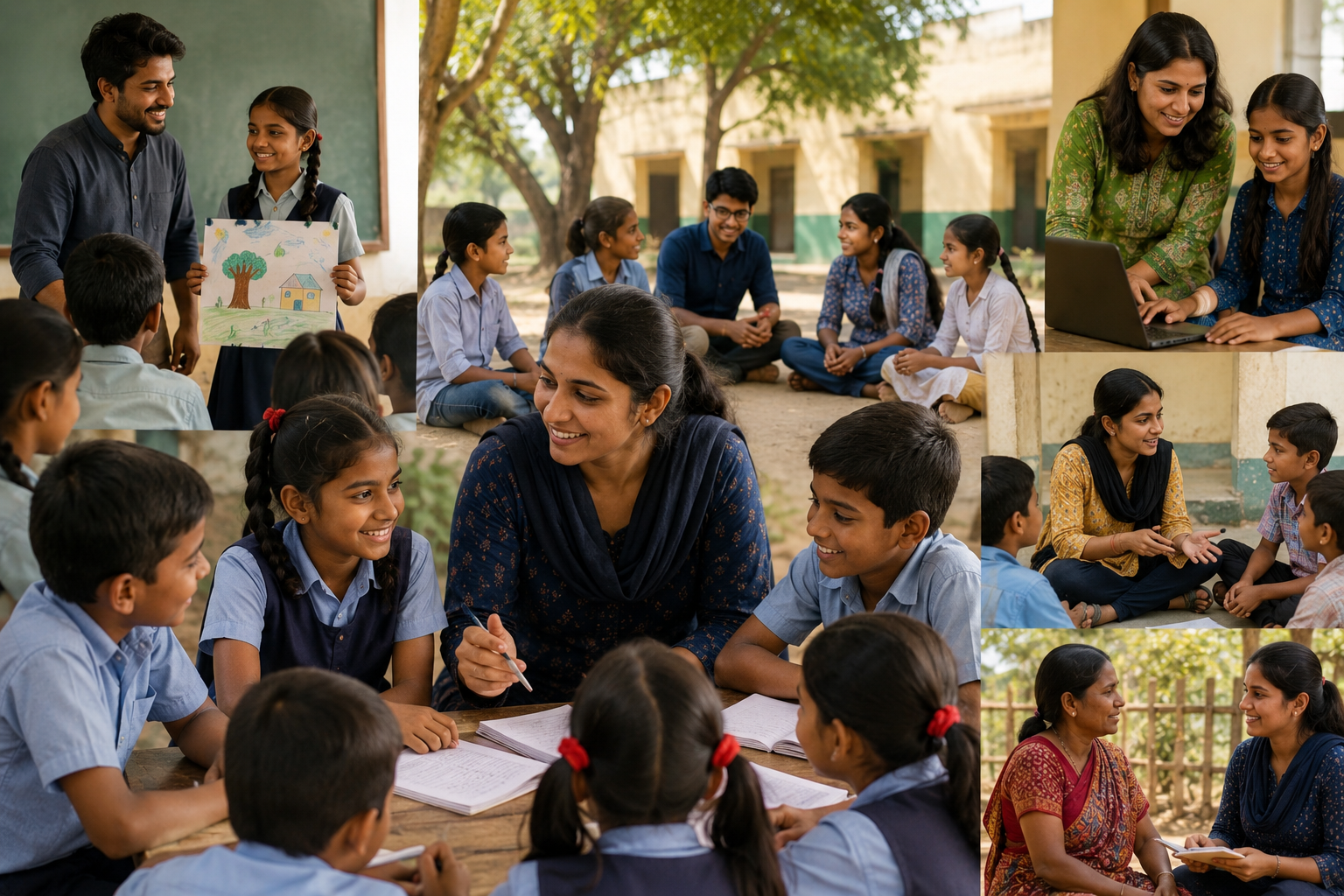
As India navigates a rapidly evolving future shaped by artificial intelligence, climate challenges, economic shifts, and social transformation, the role of education is being redefined. While access to schooling has expanded significantly, questions around the quality, relevance, and purpose of education remain central to the nation's development journey. How can schools move beyond rote learning and examination-driven outcomes to nurture critical thinkers, problem-solvers, empathetic leaders, and active citizens?
In this exclusive conversation with TheCSRUniverse, Revathi Ramanan, Senior Director, Regions, Teach For India, and Ashwath Bharath, Senior Director, Movement Building, Teach For India, share their perspectives on building an education ecosystem that places children at the centre of learning. They discuss the philosophy behind Teach For India’s Student Vision framework, the growing importance of leadership development, life skills, and socio-emotional learning, and the challenges of implementing student-centred approaches in under-resourced communities.
The interview also explores how technology can support, rather than replace, human connections in education, the lessons emerging from long-term government partnerships, and the role of grassroots innovators in driving systemic change. Looking ahead, both leaders offer valuable insights into the shifts they believe will shape India’s education landscape over the next decade—highlighting the need for equity, adaptability, and collective leadership in preparing young people for an increasingly uncertain world.
Scroll down to read more:
Inputs by Revathi Ramanan, Senior Director, Regions, Teach For India
Q. Teach For India emphasizes student-centred learning through its Student Vision framework. What inspired this shift, and how does it differ from traditional education approaches in India?
A. At the heart of Teach For India’s work is a deep belief that every child, regardless of their socio-economic background, deserves the opportunity not just to survive the system, but to thrive and lead a life of choice, agency, and dignity. Over the years, we realised that while access to schooling has improved significantly in India, access to transformative learning experiences and excellent quality education has not.
Traditionally, much of India's education system has focused on compliance, memorisation, exam performance, and syllabus completion. In many classrooms, success is narrowly defined by marks, and the teacher is seen as the sole owner of knowledge. While this model may help students perform in standardised systems, it does not adequately prepare children for a rapidly changing world that requires adaptability, collaboration, creativity, empathy, critical thinking, and leadership.
Teach For India’s Student Vision framework emerged from the understanding that education must be fundamentally child-centred and rooted in the holistic development of students. We asked ourselves: “What should children know, feel, and be able to do in order to shape a better future for themselves and their communities?”
The SVS (Student Vision Scale) shifts the focus:
- From teaching content to developing children
- From passive learning to active ownership
- From uniform instruction to recognising individual strengths and identities
- From short-term academic achievement to long-term life outcomes
- From viewing children as beneficiaries to seeing them as leaders and changemakers
The Student Vision framework focuses not only on academic mastery but also on leadership, mindsets, values, socio-emotional learning, problem-solving, civic consciousness, and sense of possibility. It recognises that children learn best when learning is relevant, joyful, rigorous, culturally connected, and rooted in their lived realities.
This approach is important in the Indian context because many children from under-resourced communities are often denied opportunities to exercise voice, choice, and leadership. Student-centred learning restores agency to children and helps build the confidence that “my voice matters, my experiences matter, and I can shape my future.”
Ultimately, the shift was inspired by the belief that the purpose of education is not merely to produce good test-takers, but to nurture compassionate, thoughtful, resilient leaders who will collectively build a more just and equitable India.
Q. What foundational capabilities do you believe children must develop at this stage to become future-ready?
A. The world our children are living in and will live in, in the future is fundamentally different from the world previous generations prepared for. Many of the jobs, challenges, and opportunities they will encounter do not even exist yet. In such a context, future readiness cannot simply mean technical knowledge or exam success.
I believe children need a combination of foundational literacies, human capabilities, and leadership mindsets.
1. Academic Mastery
Children must develop strong literacy, numeracy, communication, and analytical thinking skills because these remain the gateway to opportunity and further learning.
2. Critical Thinking and Problem Solving
Children need the ability to question, analyse, synthesise information, and navigate ambiguity rather than simply memorise answers. In a world shaped by AI, automation, and misinformation, discernment and reasoning become even more important.
3. Agency and Sense of Possibility
One of the most important capabilities is believing that “I can influence my circumstances.” Many children in underserved communities inherit systems that often communicate limitation. Education must help children develop confidence, aspiration, and ownership over their lives.
4. Collaboration and Empathy
The future will require people who can work across differences, build relationships, and solve collective problems across sectors. Empathy, listening, teamwork, and cultural understanding are no longer “soft skills”; they are essential human skills.
5. Adaptability and Lifelong Learning
The ability to continuously learn, unlearn, and relearn will matter more than static knowledge. Children should leave school curious, reflective, and comfortable with change.
6. Ethical Leadership and Civic Consciousness
At Teach For India, we deeply believe education should help children not only build successful lives, but also contribute meaningfully to society. Future-ready children must care about equity, justice, sustainability, and collective progress.
7. Socio-emotional Resilience
Children need emotional awareness, resilience, self-regulation, and the ability to navigate setbacks. Especially after the pandemic, we have seen how critical mental and emotional wellbeing is for learning and life.
Ultimately, future readiness is about helping children become not only employable, but also empowered individuals who can lead meaningful lives, navigate uncertainty, and contribute positively to their communities and the world.
One of the most powerful outcomes of student-centred learning is that children begin to see themselves not just as learners in a classroom, but as active contributors to society.
Across Teach For India classrooms and the broader Alumni movement, we have seen numerous examples of this transformation.
Student Leadership and Community Change
In many classrooms, students have identified issues within their own communities, such as waste management, gender stereotypes, water access, or literacy gaps and designed projects to address them. What is remarkable is not just the projects themselves, but the shift in identity. Children begin to see themselves as problem-solvers and leaders.
For example, students in several Teach For India classrooms have led neighbourhood cleanliness drives, awareness campaigns, peer tutoring initiatives, and community surveys. These experiences build ownership, communication skills, and civic leadership far beyond textbook learning.
Girls Developing Voice and Agency
We have seen many young girls from underserved communities who initially entered classrooms hesitant to speak or participate, gradually become confident public speakers, debate leaders, artists, and student council representatives. Student-centred classrooms intentionally create spaces where every child’s voice matters, which can be transformative for children who have historically been unheard.
Alumni Movement and Long-Term Leadership
One of the strongest examples of long-term impact is Teach For India’s growing Alumni movement. Thousands of Alumni continue working across education, policy, entrepreneurship, government, social impact, and community leadership.
Many Alumni have gone on to found schools, education organisations, mental health initiatives, skilling ventures, and policy platforms because they deeply believe children deserve an excellent and equitable education. Teach For India Alumni today serve as educators, IAS officers, social entrepreneurs, school leaders, and policymakers who are influencing systems at scale. This demonstrates the larger vision of Teach For India of not only transforming classrooms today, but building a movement of leaders working collectively toward educational equity.
Q. What are the biggest challenges in implementing student-centred learning models, especially in under-resourced communities?
A. Implementing student-centred learning at scale is meaningful work, but it is also complex.
One major challenge is that the broader education ecosystem is still heavily oriented toward standardisation, examinations, and content completion. Teachers are often under immense pressure to complete the syllabus and demonstrate immediate academic results, leaving limited room for exploration, inquiry, or differentiated learning.
A second challenge is resource inequality. Many schools operate with large class sizes, limited infrastructure, constrained access to technology, and significant teacher workload. Designing deeply personalised learning experiences within these realities requires extraordinary creativity, resilience, and support for educators.
Another important challenge is mindset shift.
Student-centred learning requires adults in their lives, teachers, parents, school leaders, and systems to fundamentally rethink the role of children in education. In many contexts, children are socialised to obey rather than question, and teachers are expected to control rather than facilitate learning. Shifting these deeply ingrained norms takes time, trust, and sustained capacity building.
There is also the challenge of inequity/systemic injustice outside the classroom. Many children in under-resourced communities navigate poverty, instability, discrimination, family responsibilities, or limited exposure to opportunities. Therefore, schools are not just academic spaces; they often become spaces of emotional safety, affirmation, and possibility. This means teachers need support not only as instructors, but also as mentors, community builders, and leaders.
At Teach For India, one thing we have learnt is that student-centred learning cannot simply be reduced to a set of techniques or activities. It requires a broader ecosystem of strong relationships, teacher development, school leadership, community engagement, and belief in children.
Despite these challenges, we continue to see that when children experience classrooms rooted in love, rigor, high expectations, and agency, extraordinary transformation becomes possible.
Q. Looking ahead, what key shifts do you foresee in India’s education ecosystem over the next decade, particularly in terms of preparing youth for an uncertain future?
A. India is entering a defining decade for education. The world young people are preparing for will be shaped by rapid technological change, AI, climate challenges, shifting economies, longer life spans, and increasing uncertainty. In that context, the question for education systems can no longer simply be, “How do we help children succeed in exams and get good jobs?” It must become, “How do we help young people build the capability, agency, and values to navigate and shape an unpredictable future irrespective of the jobs they do?”
Over the next decade, I foresee several important shifts in India’s education ecosystem.
1. A Shift from Content Delivery to Competency Development
For many years, success in education has been closely tied to memorisation and high-stakes examinations. While foundational knowledge will always matter, the future will increasingly reward skills such as critical thinking, problem-solving, communication, collaboration, creativity, and adaptability.
Schools will need to move beyond simply completing the syllabus toward helping children apply learning to real-world situations.
2. Education Becoming More Student-Centred and Personalised
Children learn differently, aspire differently, and come from vastly different contexts. I believe we will see greater movement toward personalised learning journeys where students have more voice, ownership, and choice in how they learn.
Technology and AI can support this shift by making learning more adaptive and accessible, but the deeper transformation is philosophical: recognising children not as passive recipients of education, but as active participants and leaders in their own learning.
3. Human Skills Becoming More Important in an AI-Driven World
As automation and AI take over more transactional tasks, deeply human capabilities will become even more valuable.
Empathy, ethical reasoning, leadership, resilience, creativity, relationship-building, and the ability to collaborate across differences will become essential. The future will belong not only to those who are technically skilled, but also to those who can think deeply, act ethically, and work collectively.
4. Greater Focus on Wellbeing and Socio-Emotional Development
The pandemic reminded us that learning cannot happen without emotional safety and wellbeing. I believe schools will increasingly invest in mental health, identity development, belonging, and socio-emotional learning. Future-ready education must help children not only perform, but also develop confidence, self-awareness, resilience, and a strong sense of self-worth.
5. Stronger Connections Between Classrooms and Real Life
Young people want learning that feels meaningful and connected to the world around them. We are likely to see more experiential learning, internships, project-based learning, entrepreneurship, civic engagement, and community problem-solving integrated into schooling. Education will increasingly move from “learning that I can use some day” to “learning through real-world engagement today.”
6. A Larger National Conversation Around Equity
India’s future depends on whether quality education becomes truly accessible to all children, not just a privileged few. I believe the coming decade will require much deeper collaboration between government, educators, communities, philanthropy, and civil society to address systemic inequities in access, learning outcomes, language, technology, and opportunity. At Teach For India, we often speak about building a collective leadership movement because sustainable educational transformation cannot happen in isolation.
7. Education as Leadership Development
Perhaps the most important shift I hope to see is a broader understanding that education is ultimately about developing human potential and leadership. Our children are not just future workers; they are future citizens, community builders, caregivers, innovators, and changemakers. Schools therefore must nurture not only academic excellence, but also purpose, compassion, courage, and responsibility toward society.
At Teach For India, our north star is not simply that children do well in school, but that they grow into leaders who can imagine and build a more just, loving, and equitable India. Ultimately, I believe the future of education in India will belong to systems that are rigorous yet humane, innovative yet equitable, and ambitious not only about economic success, but also about human flourishing.
Inputs by Ashwath Bharath, Senior Director, Movement Building, Teach For India
Q. In your view, are current education systems adequately addressing life skills such as decision-making, financial literacy, and problem-solving? Where do the biggest gaps lie?
A. Not yet, and the gap is structural. Our system still optimises for syllabus completion and standardised exam outcomes, with the implicit purpose of education collapsed onto a single track: school, higher education, and employment. That leaves little room for the skills life actually demands. The World Bank's April 2024 India Learning Poverty Brief estimates that 55% of Indian children cannot read and understand a basic age-appropriate text by age 10. NCFE's Financial Literacy and Inclusion Survey pegs adult financial literacy at 27%. The ILO India Employment Report 2024 finds that 65.7% of India's unemployed youth are educated, up from 54.2% in 2000. The gap is not policy intent. NEP 2020 and NCF 2023 name 21st-century skills with admirable clarity. The gap lives in classrooms, in teacher preparation, and in assessments that still reward recall over reasoning. Until what we measure changes, what we teach will not.
Q. Could you elaborate on how Teach For India nurtures leadership among students, Fellows, and Alumni to drive long-term social impact?
A. We hold an unfashionable definition of leadership: leadership in service of advancing self, advancing others, and advancing society. It is rooted in love and a sense of belonging across stakeholders. The accompanying skills are familiar (compassion, consciousness, critical thinking, curiosity, communication, creativity, collaboration), but it's the orientation that makes them stick.
For students, we run programmes that build voice, agency, and ownership inside and beyond the classroom. For Fellows, the two-year Fellowship is itself a leadership crucible. For Alumni, educators, government officials, and entrepreneurs, we run accelerated programmes that surround them with community and the long-term scaffolding sustained leadership requires. Across 16 years, 5,500+ Fellows have become a movement of 13,500+ leaders. Over 200 Alumni hold senior leadership roles across the social, public, and private sectors, and 160+ organisations in the social space have been founded or co-founded by Alumni.
Q. How are you leveraging educational technology and digital platforms to reach underserved communities and educators at scale?
A. Education is not solved through silver bullets. It is a deeply human process of unlocking each child's potential, and no platform alone can do that work. Where technology earns its place at Teach For India, it does so by extending the reach of strong people, not replacing them.
In practice, this looks like learning content delivered to students through WhatsApp; Firki, our platform for educators, with a companion bot that helps teachers find the resources they need; and synchronous and asynchronous spaces for educators to learn from one another. ASER 2024 shows a meaningful but fragile recovery in foundational learning: the share of Class 3 government-school children able to read a Class 2 text rose from 16.3% in 2022 to 23.4% in 2024, the highest level since 2005. That progress was won by people in classrooms. Technology used well can compound that work. Used as a substitute, it tends to widen inequities rather than close them.
Q. Can you share insights from your long-term government partnerships, particularly in Maharashtra? What have been the key learnings?
A. Maharashtra is our oldest ground. We have run the Fellowship in Mumbai and Pune for over 16 years, and Alumni today sit at every level of the system: in district and state offices, at SCERTs and DIETs, and within teacher-training and curriculum bodies.
The work has spanned reforms across foundational literacy and numeracy aligned with NIPUN Bharat, parent participation, coding in classrooms, and teacher coaching through classroom observation and feedback by experienced practitioners. We have also partnered on teaching festivals, new school models, and public-private partnerships to lift enrolment and outcomes in government schools.
Three learnings stand out. One, change at scale requires capacity inside the system, not around it; that is why Alumni serving in government matters. Two, teachers grow through coaching far more than through one-off training. Three, durable reform takes a decade-long horizon and a shared vision across officers, principals, teachers, parents, and civil society.
Q. How does Teach For India engage with grassroots innovators and social entrepreneurs to co-create scalable education solutions
A. Through two incubation tracks. TFIx partners with entrepreneurs from rural, tribal, and remote India to help them launch contextualised, locally-led Fellowships in their own regions and languages. InnovatED, run in partnership with NSRCEL at IIM Bangalore, supports TFI Alumni starting their own organisations across curriculum design, arts education, sports, public-private school models, assessment, early childhood, special education, etc.
Post-incubation, we bring entrepreneurs together to unlock funding opportunities, engage in peer learning, and build partnerships with school networks, district administrations, and state systems. We also deliberately work with them to invest in their second-line leadership because solo-founder burnout is a real risk in this sector, and a sustainable organisation cannot rest on one set of shoulders. India's education system is too varied for any single model to scale uniformly. We need a constellation of contextual solutions, run by leaders close to the ground and networked with one another. That is what we are trying to build.
Q. Reflecting on your journey, from the Teach For India Fellowship to leading movement-building initiatives, what has been your biggest learning about driving meaningful change in education?
First, that children are changemakers today, not in some imagined future. The moment adults around them relate to them as such, the teaching-learning transactions changes character. Second, that sustainable change is multi-level. A great classroom is necessary and insufficient; the same shared vision and values must show up in schools, blocks, districts, states, donors, and civil society. Third, that everything ultimately depends on relationships, the one a teacher holds with a child, the one a community holds with a school, the one actors across the system hold with each other.
If I had to compress it into one sentence, education work is not engineering; it is gardening. The variables you cannot control matter more than the ones you can, and the patient cultivation of safe, loving spaces is the most leveraged thing adults can do for children. That has held true from my first classroom to the movement architecture I work on today.
Q. Looking ahead, what key shifts do you foresee in India's education ecosystem over the next decade, particularly in terms of preparing youth for an uncertain future?
A. Revathi has covered the pedagogical shifts well, so I will lean into systems, talent, and leadership.
First, curricula across primary, secondary, and higher education will move from content-as-king to skills mapped age by age, with delivery calibrated to each child's readiness. NCF 2023 and NIPUN Bharat articulate that approach.
Second, teacher education will be reshaped by the four-year Integrated Teacher Education Programme and a broader push to attract higher-calibre, more compassionate talent into the profession. The ILO Employment Report 2024 reminds us why this matters: 65.7% of India's unemployed youth are educated, and nearly two in five technically qualified young people are working below their qualifications. The supply of teaching talent shapes everything downstream.
Third, AI will force a curricular rethink, whether we are ready or not. Children will need to learn with AI, alongside AI, and for a world AI is rewriting.
Fourth, the biggest lever - the only way India can institutionalise change at the required pace is by building a critical mass of leaders within the system who share common values and a vision and come together as a collective, driving this future.


.png)