Beyond Awareness: How PFI is Transforming Family Planning Through Community-Driven Change
In Uttar Pradesh, one of India’s most complex demographic landscapes, the Population Foundation of India (PFI) is leading a transformative shift in how communities understand and engage with reproductive health, early marriage, and family planning. At the heart of this effort is the Itni Bhi Kya Jaldi Hai campaign under the UMEED project, a behaviour change initiative that is challenging entrenched social norms by engaging not just individuals, but the full ecosystem that shapes their choices. From adolescents and newly married couples to parents, local leaders, and frontline health workers, the campaign is fostering dialogue, reflection, and informed decision-making across 6,000+ villages.
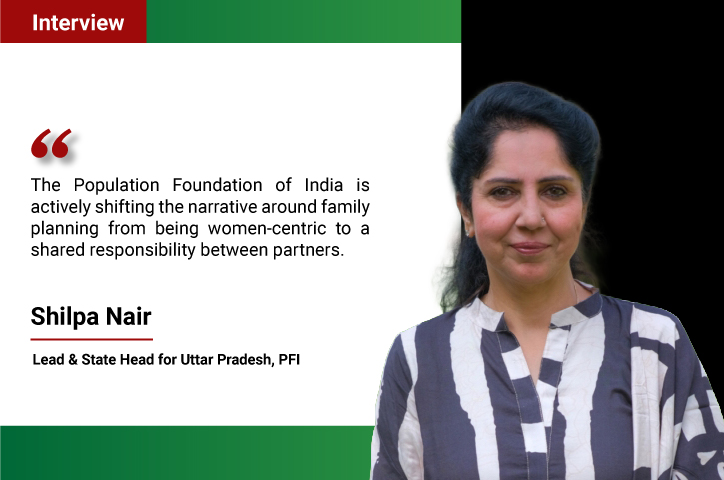
In this conversation, Shilpa Nair, Lead & State Head for Uttar Pradesh at PFI, offers an inside look into how multi-level engagement, strengthened service delivery, and inclusive communication models are accelerating change on the ground. She discusses what it takes to shift long-standing cultural expectations, the early impact of male engagement, the vital role of counselling corners and frontline workers, and how UMEED’s government-led partnership is helping scale reproductive health services sustainably across high-fertility districts.
Read on.
Q&A
Q. The Itni Bhi Kya Jaldi Hai (IBKJH) campaign places a strong emphasis on behavioural change rather thanjust awareness. What specific strategies have proven most effective in shifting deep-rooted social norms around early marriage and family planning?
A. Social norms around early marriage and family planning are reinforced by families, peer groups, caste and community networks, older generations, and local institutions such as the Panchayati Raj. Recognizing this, the IBKJH campaign adopts a multi-level engagement approach, targeting not only individuals but also the wider ecosystem that influences their decisions.
Engaging multiple levels of influence:
Rather than simply advising adolescents “not to marry early” or urging newly married couples to “delay their first pregnancy,” the campaign engages adolescents, parents, elders, teachers, community leaders, elected representatives, and frontline health workers together. This collective engagement helps reshape what communities perceive as “normal,” understand the negative consequences of early marriage, reduce resistance, and foster shared accountability. Nearly 400 Family Planning Champions from diverse stakeholder groups have been mobilized to challenge norms related to early marriage, son preference, and the pressure on couples to prove fertility soon after marriage.
Aspirational, identity-based communication:
The campaign’s social and behaviour change communication (SBCC) materials—films, jingles, posters, and digital content- connect the idea of “delay” with positive aspirations. The slogan “Itni Bhi Kya Jaldi Hai?” (“What’s the hurry?”) prompts reflection and reframes delay as a sign of progress and empowerment: delaying marriage enables education, delaying first pregnancy allows couples to build their relationship, and spacing births ensures family wellbeing. By emphasizing aspiration and progress rather than fear or restriction, the campaign makes change feel desirable and achievable.
Public commitments and community dialogue:
Pledge-taking events, open community discussions, and participatory activities involving men, elders, and local influencers have been used in the campaign to make new norms visible and socially endorsed. These public affirmations help shift perceptions of what is acceptable and admirable within the community.
Strengthening service delivery and counselling:
Alongside the campaign, Population Foundation of India has established counselling corners, trained ASHAs and ANMs, and ensured contraceptive availability at all times - even during community film screenings and outreach events.
360° SBCC approach:
IBKJH combines mass media, entertainment-education, interpersonal communication, digital outreach, and community outreach to deliver consistent messages and reinforce them across platforms. This multi-channel approach ensures repetition, resonance, and reach.
In sum, by combining multi-level engagement, peer mobilization, aspirational storytelling, public commitments, and strengthened services, the IBKJH campaign has gone beyond raising awareness to transform collective beliefs and community expectations.In just three months of implementation in four out of seven districts, improvements in knowledge, attitudes, and perceptions are visible on the ground. Nearly 40,000 people have participated in 780 mobile van film shows conducted across as many villages. Of these, over 8,200 men and women have already availed family planning counselling services on the spot with more than 25,000 condoms, 3,500 oral contraceptive pills (Mala N), and 2,900 non-hormonal pills (Chhaya) being distributed.
Q. How do counselling corners, mobile outreach vans, and trained frontline health workerswork together to create trust and meaningful engagement within rural communities?
A. Under the Umeed project, “Family Planning Counseling Corners” have been established within public health facilities (PHCs and CHCs) as dedicated, confidential spaces where clients receive non-judgmental, client-centred counselling on contraceptive options, side-effects, birth spacing, and early marriage prevention. These corners act as anchor points within the health system — transforming abstract messages about family planning into a visible, credible service option. When community members hear about “that counselling room at the health centre,” it signifies that family planning is a routine, reliable part of healthcare, not just a one-time campaign. The corners also enable follow-up, method switching, and side-effect management, ensuring continuity of care.
Complementing these facility-based services are mobile video vans that travel to villages, screen edutainment films, distribute PFI’s IEC materials, and provide on-site counselling and contraceptive supplies. These outreach efforts are designed to “meet people where they are” — both physically and socially. They reduce access barriers such as distance, transport, and time, while enhancing program visibility and trust, and also frequently referring clients to the counseling corners.
A critical pillar of the Umeed model is its trained cadre of over 11,500 frontline health workers — including ANMs, ASHAs, staff nurses, and counsellors — who deliver high-quality family planning counseling, support informed choice, and engage male and family decision-makers. Deeply embedded in their communities, these workers speak the local language, understand prevailing norms, and enjoy the trust of families. Through home visits, group meetings, follow-ups both in-person and through WhatsApp groups, and referrals, they mobilize newly married and low-parity couples and integrate family planning into routine services such as ANC and PNC. Their continuous local presence transforms engagement from a one-off outreach activity into an ongoing relationship.
Together, these three components — Family Planning Corners (stable service points), mobile outreach vans (access, visibility, and mobilisation), and trained frontline workers (local link and continuity) — form a synergistic “triangle of engagement.” Each element reinforces the others: outreach creates awareness and demand; frontline workers mobilize and sustain relationships; and counselling corners provide trusted, quality services. This layered, interconnected approach not only improves service uptake but also helps shift deeper social norms around early marriage, fertility, and contraceptive choice.
Q. The campaign also focuses on engaging men through messages of responsible masculinity. What kinds of responses or behavioral shifts have you observed amongmen and boys so far?
A. The campaign explicitly promotes the idea of “positive masculinity,” signaling that men and boys are being invited into conversations that were traditionally seen as the exclusive domain of women. This approach reframes family planning, birth spacing, and household chores as shared responsibilities, rather than solely women’s burdens.
Shifting deep-seated norms around masculinity, age at marriage, and fertility is a gradual process, and given that the campaign began in early 2024, it is still in its formative stages. However, early qualitative evidence suggestsencouraging behavioral shifts. In communities where the campaign has been active, there has been a visible increase in men accompanying their wives to Family Planning Corners and outreach events — a sign of shared decision-making and greater comfort in accessing reproductive health services together. Frontline workers and counsellors have reported more couples jointly discussing contraceptive choices and men showing openness to the idea of spacing rather than insisting on early childbearing. In several villages, young men have started questioning peers or elders about early marriage practices, and male community leaders and Panchayat members have publicly endorsed the campaign messages, even organizing community events to celebrate the girl child and support delayed marriage.
These shifts, though still emerging, suggest a gradual realignment of attitudes — where masculinity is being redefined in terms of care, support, and responsibility. As the campaign deepens its engagement, such visible acts of participation and endorsement are helping normalize men’s involvement in reproductive health and strengthen the foundation for lasting gender-equitable change.
Q. Behavior change can be gradual and complex to measure. What indicators or tools does PFIuse to assess progress in attitudes and practices related to early marriage, spacing, and familyplanning?
A. PFI uses a mixed-indicator framework that tracks both tangible outcomes and shifts in social norms. This includes:
- Service statistics such as increased use or continuation of specific contraceptives.
- Process and output indicators like the number of community events, trainings, counselling corners established, and clients counselled.
- Campaign and outreach metrics, including the number of villages reached through mobile video vans and other media.
- Outcome indicators such as age at marriage, birth spacing, and contraceptive prevalence.
To track progress, we use tools like our Project Management Information System (MIS), service statistics records, and survey instruments such as baseline and endline studies that measure changes in knowledge, attitudes, and practices. These are also linked with government systems like the Health MIS.
While service uptake data are available regularly, assessing deeper normative shifts—such as changes in gender attitudes or male participation—requires multi-year tracking and external surveys. Attribution is also complex, as improvements often result from the combined effects of social and behaviour change communication (SBCC) efforts, service-strengthening components, and broader social trends.
Q. The Umeed project operates in collaboration with the Department of Health and Family Welfare. How has this public-private partnership strengthened on-ground implementation and service delivery?
A. The UMEED Project represents a strong public-private partnership between the Population Foundation of India (PFI) and the Department of Health and Family Welfare, Uttar Pradesh. Rather than creating parallel service delivery channels, UMEED focuses on strengthening the existing public health system. The project’s mandate, endorsed by the Director General of Family Welfare, has ensured institutional acceptance, better resource allocation, and coordination with government staff and facilities. This partnership has strengthened on-ground implementation and service delivery by combining technical innovation and social and behaviour change communication by PFI, while leveraging the government’s public health infrastructure, workforce, mandate, and scale. This synergy enhances reach, data-driven monitoring, government ownership, and the institutionalization of services such as counselling corners—resulting in better access to and demand for family planning and reproductive health services.
This collaboration offers significant advantages to the government while driving systemic change. It is improving the capacity and motivation of over 11,500 frontline workers, strengthening service quality and data systems, and helping the government meet its reproductive health and family planning goals in the high-fertility districts. The use of the government’s Health Management Information System (HMIS) ensures that progress is continuously tracked and integrated into official work. Joint reviews, facility assessments, and coordination committees have further strengthened quality assurance and accountability.
With reported increases of over 70% in the use of condoms, Centchroman, and emergency contraceptive pills within a year, UMEED is effectively demonstrating how a well-aligned public-private partnership—anchored in government systems but powered by NGO expertise—can deliver scalable, sustainable, and high-impact results.
Q. Many messages in Itni Bhi Kya Jaldi Hai target young people. How are you ensuring thatadolescents and newly married couples have both the information and agency to make informed reproductive choices?
A. The ‘Itni Bhi Kya Jaldi Hai’ campaign under the UMEED initiative goes beyond awareness—it aims to enable adolescents and newly-married couples to make informed and confident reproductive and marital choices. The campaign targets those at transitional life stages—newly married or low-parity couples—who have the highest need for information and support to delay marriage, prevent teenage pregnancy, and adopt healthy spacing. Its messaging is framed positively, encouraging young people to see delayed marriage and planned parenthood as empowering life choices linked to education, aspirations, and wellbeing. Information is delivered through multiple channels—mobile audio-video vans, community events, infotainment, and social and behaviour change communication (SBCC) materials—ensuring reach and engagement across diverse settings.
Equally importantly, the campaign is tightly linked to the service delivery system: family planning counselling corners in public health facilities provide private, client-centred counselling, while the trained ASHAs and ANMs offer contraceptive information, side-effect management, and method switching support. By connecting community messaging with accessible services, the campaign ensures that young people not only hear about choices but can act on them.
The transition from information to agency is built into the campaign’s design. Adolescents and newly married couples gain access to a basket of contraceptive choices, non-judgmental counselling, and male-inclusive outreach that encourages shared decision-making. Messages link life aspirations—such as completing education or developing livelihoods—to reproductive timing, helping couples see spacing and delay as steps toward broader life goals. Engaging men, elders, and community influencers is further strengthening the enabling environment, reducing resistance, and normalising informed choice.
To ensure that real agency is achieved, the campaign continues to monitor not just awareness levels but actual behavior and context. Key areas of focus include whether young couples are actively using services, whether choices are genuinely informed and voluntary, whether communities are supportive, and whether services remain youth- and couple-friendly. By addressing both individual empowerment and structural barriers, IBKJH is transforming reproductive decision-making from a matter of awareness into one of genuine autonomy and opportunity.
Q. What are some of the most common misconceptions or taboos around contraception and family planning that your teams encounter, and how does the campaign address them?
A. In Uttar Pradesh, the IBKJH campaign has often encountered deep-rooted myths and taboos surrounding contraception and family planning. Common misconceptions include the belief that contraception is solely a woman’s responsibility, fears that modern methods like Antara injectable contraceptive cause infertility, and the social expectation that newly-married women must conceive immediately to “prove” fertility. Taboos around discussing sexual health—especially among adolescents and young couples—further limit informed decision-making. Limited awareness of method choices and side-effect management often reinforces these fears, leading to underuse or discontinuation of spacing methods.
The campaign is tackling these barriers through a mix of communication, capacity-building, and service delivery interventions. Its social and behaviour change communication (SBCC) materials—films, mobile video vans, flip-books, and community events—debunk myths and frame delayed marriage, spacing, and shared responsibility as positive life choices linked to education and empowerment. Family planning counselling corners and ASHAs and ANMs offer accurate information, manage side-effects, and promote a full basket of contraceptive choices.
Engaging men and community influencers is also a core feature. The campaign’s emphasis on positive masculinity and joint decision-making challenges gendered taboos and encourages family planning as a shared responsibility. Panchayat members, elders, and community groups help normalisethe discussion of contraception and reproductive health. By linking accurate information with accessible services and a supportive social environment, IBKJH is transforming family planning from a taboo topic into a conversation about choice, dignity, and opportunity.
Q. With over 11,500 ASHAs and ANMs trained under Umeed, what kind of impact have you seen in terms of improved counselling quality, continuity of contraceptive use, and community confidence in health services?
A. The UMEED Project’s training of over 11,500 ASHAs and ANMs has substantially enhanced the quality and reach of family planning counselling in Uttar Pradesh. Beyond training, these frontline workers have been equipped with practical job aids—such as family planning flipbooks and handouts—that enable them to address client questions with greater accuracy, confidence, and sensitivity. Equally important, the initiative has strengthened community trust in public facilities. With trained staff, improved privacy, and responsive counselling, families increasingly see government health services as reliable, respectful and responsive points of care.
The Umeed supported family planning counseling corners have till date served over 47,000 clients across 77 sites, helping translate awareness into actual service uptake.
Another example is from Jarwal block in Bahraich district, where, between April 2024 and March 2025, the project recorded sharp increases in contraceptive use — including a 38% rise in condom use, 82% in interval IUCD, 49.9% in injectable contraceptive Antara 4th dose, and 6.9% in oral contraceptive pills— reflecting improved counselling and follow-through
Thus, the PFI–Department of Health & Family Welfare (UP) partnership under the UMEED initiative has created a model that combines social and behaviour change communication with service strengthening — improving both demand for and quality of family planning services.
Q. Family planning is often viewed as a women-centric issue. How is PFI reframing it asa shared responsibility between partners, and what difference has that approach made on the ground?
A. The Population Foundation of India (PFI) is actively shifting the narrative around family planning from being women-centric to a shared responsibility between partners. Through strategic engagement with policymakers at the national and state levels, community engagement, and social behaviour change communication, PFI challenges traditional gender norms that place the burden of contraception on women. Its programmes promote spousal communication, equitable access to contraceptive choices, and inclusion of male methods in the family planning mix. By positioning men as active participants instead of passive supporters, PFI advances a rights-based approach that fosters gender equality and shared accountability in family planning and reproductive health.
Under UMEED, this involves targeted messaging that encourages male engagement, promotes “positive masculinity,” and highlights men’s role in supporting partners’ reproductive choices. SBCC materials, outreach events, and counselling corners are designed to include men, foster joint decision-making, and make male-oriented methods such as condoms and vasectomy more visible and acceptable.
On the ground, this approach is yielding tangible results. Men are increasingly participating in community discussions and counselling sessions, fostering spousal communication and joint decision-making around spacing and contraceptive choice. Early evidence under UMEED is showing improved uptake of male-oriented methods. By reframing family planning as a couple’s decision, Population Foundation of India is helping reduce the burden on women, expand method choice, and build a culture of shared reproductive responsibility.
Q. Looking ahead, what are PFI’s priorities for scaling the Itni Bhi Kya Jaldi Hai campaignand Umeed project? Are there plans to replicate this model in other high-fertility states or expand its thematic focus?
A. Because the UMEED model is embedded within the government health system and implemented through state frontline workers, it serves as a durable and cost-effective approach for sustained community engagement and improved service delivery. Building on this strength, the Population Foundation of India is focused on scaling both the UMEED Project and the Itni Bhi Kya Jaldi Hai campaign across Uttar Pradesh, while deepening sustainability and government integration. An online campaign is also planned as part of scaling up the reach of the initiative, promoting awareness on key issues, and engaging diverse audiences across social media platforms.
From a pilot in 120 villages of Jarwal block in Bahraich, the initiative now reaches over 5,800 villages across 50 blocks in seven districts—training more than 11,500 frontline health workers and establishing over 100 dedicated family planning counselling corners. Within just one year of scaling, Chief Medical Officers from six UMEED districts have requested expansion to an additional 40 blocks covering more than 4,000 villages—demonstrating strong local ownership and institutional buy-in.
Looking ahead, PFI aims to extend UMEED’s learnings to Bihar, where the Foundation already has a substantive presence. While replication in other high-fertility states is not yet formalised, the model is designed for easy adaptation to similar contexts. Thematically, future expansions may encompass adolescent reproductive health, male contraceptive uptake, gender equity, birth spacing, and linkages to education and livelihoods—further broadening the programme’s impact.



.png)