Beyond 80G: Why Trust, Impact and Relationships Will Define the Future of Giving in India
India's culture of giving has long been shaped by a blend of faith, community values, social responsibility and, at times, tax incentives. However, as a growing majority of taxpayers move to the new tax regime where Section 80G benefits are no longer available, the nonprofit sector is confronting an important question: what will motivate donors when tax savings are no longer part of the equation?
For many organisations, this moment presents both a challenge and an opportunity. While year-end fundraising campaigns have traditionally relied on tax-linked appeals, the shift could encourage nonprofits to build deeper and more sustainable relationships with supporters based on trust, transparency and demonstrated impact. It also brings renewed focus on recurring giving, donor stewardship, community participation and long-term engagement.
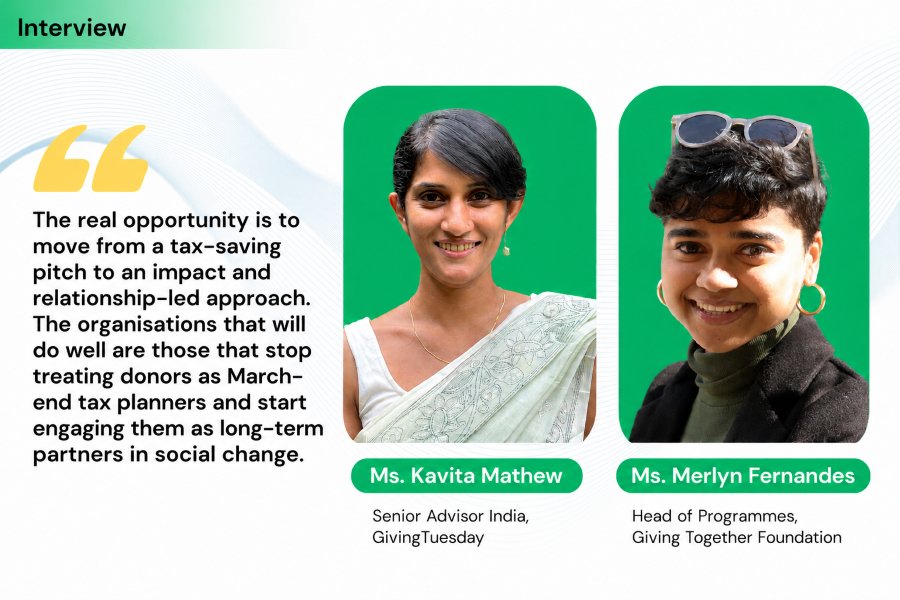
In this interview with TheCSRUniverse, Kavita Mathew, Senior Advisor India at GivingTuesday, and Merlyn Fernandes, Head of Programmes at Giving Together Foundation, discuss how nonprofits can adapt to this changing landscape and strengthen a more resilient culture of everyday giving in India.
Read the full interview below.
Q&A
Q. With the growing adoption of the new tax regime, how significant could this shift be for India’s nonprofit fundraising landscape, especially for organisations that have traditionally relied on 80G-linked year-end giving?
A. This shift is significant, but not simply because tax savings are a major driver for giving. In fact, the evidence suggests the opposite. Tax benefit has never been the primary motivator for most Indian donors. The How India Gives study by the Centre for Social Impact and Philanthropy at Ashoka University shows that giving in India is deeply rooted in religious, social and community practices. The awareness about tax benefits on donations to ‘non-religious organisations’ was also limited with a majority (71%) of the households thinking that they could not claim any tax benefit against their donations. Nearly one-fourth of the households were unsure/unaware if such a provision exists.
The issue however, is that many nonprofits have believed tax saving to be a major donor trigger and have built a disproportionate part of their fundraising strategy around the March-end 80G window. That assumption now needs to be revisited. For AY 2024–25, 5.27 crore ITRs were filed under the new tax regime, compared with 2.01 crore under the old regime, meaning about 72% of taxpayers opted for the new regime. Under the new tax regime, Section 80G deductions cannot be claimed.
So, the shift is significant because it exposes a strategic gap. If donors were not primarily giving for tax savings, then nonprofits should not be over-reliant on tax-led messaging. The end of the financial year may still remain a useful giving moment, but it cannot be the centrepiece of donor engagement.
The real opportunity is to move from a tax-saving pitch to an impact and relationship-led approach. The UDARTA:EG report shows that everyday givers already matter, surveyed nonprofits reported that donations from everyday givers account for roughly 30–33% of their funding, and 96% of nonprofits currently fundraising from everyday givers find it worthwhile.
In that sense, the new tax regime is not a crisis for giving. It is a wake-up call for nonprofits. The organisations that will do well are those that stop treating donors as March-end tax planners and start engaging them as long-term partners in social change.
Q. Do you see donor behaviour in India gradually moving from tax-driven giving to more impact-led and values-based philanthropy? What early signals of this shift are already visible?
A. Yes, though we would frame it slightly differently. Giving in India has always had a strong emotional and social foundation. How India Gives found that India’s household giving ecosystem is worth approximately ₹540 billion annually, with 68% of Indians contributing in some form through cash, in-kind support, or volunteering. Nearly 45.9% of contributions flow to religious organisations, while 41.8% go directly to individuals. That shows that people give because of faith, community, responsibility, and personal connection.
The real shift now is that this instinctive giving is slowly becoming more organised. Digital payments, UPI, WhatsApp appeals and crowdfunding platforms have made it easier for people to support causes in smaller, quicker and more regular ways. At the same time, donors are becoming more conscious. They want to know what their contribution enabled and whether the organisation is credible.
One important early signal is the gap between donor potential and nonprofit strategy. In the UDARTA:EG study, 79% of nonprofits reported some engagement with monetary donations from everyday givers, but only 37% had actively fundraised from them in the past five years. So, the willingness to give exists, but the sector is still learning how to engage these donors more systematically.
This is less about donors suddenly becoming values-led and more about nonprofits recognising that they already are. The opportunity is to inspire more structured and sustained giving from the already existing generosity.
Q. In a post-tax-incentive environment, what will actually drive donor stickiness beyond one-time or seasonal giving?
A. What will keep donors coming back is not another appeal. It is the feeling that their giving matters, that it is noticed, and that it is creating visible change. This becomes especially important as nonprofits move beyond the March-end, tax-saving mindset. A donor may give once because there is urgency, a festival, a campaign, or a personal request. But they give again when the organisation builds a relationship after that first donation.
That is where many nonprofits still have a large opportunity. Nearly half of the nonprofits surveyed do not have structured donor retention strategies. Even among organisations that have repeat or recurring givers, almost 60% said less than a quarter of their everyday givers come back to give again.
The encouraging part is that the most effective actions are not complicated. A quick, warm thank-you. A specific update on what the donation enabled. A story from the field. A message that feels personal rather than mass-produced. The study found that acknowledging each donation is associated with a 20.3 percentage point increase in the share of funds raised from everyday givers, while showing donors the impact of their contribution is associated with an 11.3 percentage point increase in recurring giver percentage.
The insights from the study have also been converted into actionable templates and tools through these field guides that nonprofits can use to create meaningful donor journeys.
So, donor stickiness comes down to meaningful stewardship. People do not want to feel like they are only being contacted when money is needed. They want to feel included in the journey of the cause. The organisations that will build long-term giving are those that can move from “please support us again” to “here is what we are building together.”
Q. Trust remains central to individual giving. What are the most critical trust deficits nonprofits in India still need to address today?
A. Trust is really the foundation of individual giving. Most donors are not necessarily looking for very complex disclosures. They are asking a few simple but important questions: Is this organisation credible? Will my money be used well? Will I know what happened after I gave?
That is why personal networks continue to matter so much in India. People are often more comfortable giving when the ask comes through someone they know, or when there is some existing relationship with the organisation. In our UDARTA:EG study, 60% of nonprofits rated outreach through existing donor networks as the most effective way to reach new supporters, and this approach was associated with a 16-percentage point increase in the share of funds raised from everyday givers.
The issue is not that people are unwilling to give. Very often, they are unsure whom to trust, how their contribution will be used, and whether the organisation will stay connected with them after the donation. So, the trust gaps nonprofits need to address are quite practical. First, they need to make their work easier to understand. Second, they need to communicate impact in a way that feels specific and credible. Third, they need to avoid generic, one-size-fits-all appeals. And fourth, they need to follow up after the donation, because that is where a one-time transaction can become a relationship.
The encouraging part is that trust does not always require big systems or expensive campaigns. It can be built through consistent communication, transparent updates, credible champions, WhatsApp-led engagement, field stories, and simple proof of how donations are being used. The organisations that do this well will be able to move donors from hesitation to confidence, and from confidence to long-term support.
Q. As donor expectations evolve, how should nonprofits rethink transparency and impact communication to build deeper long-term trust?
A. First, make transparency human. A short audio note from the field, a two-minute video, a real story of one person's changed circumstances will move a donor more than any spreadsheet of outputs. Second, make it timely and consistent. One small two-person nonprofit in our study transformed its retention simply by sending thank-yous within twelve hours of a gift, pairing quarterly impact reports with personalised updates, and leading its social media with community success stories rather than repeated asks, and they saw stronger retention and steady referral-led growth as a result. Third, make it personal through segmentation, so the message genuinely fits the person receiving it rather than being broadcast to everyone identically.
And there's a fourth dimension that's easy to overlook: transparency increasingly means letting donors in, not just sending information out. Inviting supporters to visit, meet the community, attend a session, even a virtual walkthrough, is one of the practices most strongly linked to recurring giving in our data. Proximity does what polish cannot. The organisations building the deepest trust aren't the ones with visually appealing annual reports; they're the ones that have made their donors feel like genuine participants in the work, not distant funders of it.
Q. Recurring giving remains relatively underdeveloped in India. What practical shifts are needed for monthly or sustained giving models to truly scale?
A. Recurring giving in India will not scale only by asking people to “donate monthly.” That is too transactional. It will scale when nonprofits make sustained giving feel simple, reliable and emotionally worthwhile for the donor.
The first shift is from campaign-thinking to relationship-thinking. Many donors are willing to give again, but nonprofits often do not build the rhythm needed to keep them engaged. A one-time donor needs to be brought into a journey: thanked properly, updated regularly, shown what changed, and invited to stay connected. Monthly giving is ultimately a habit, and habits need reinforcement.
The second shift is infrastructure. Even basic systems can make a difference. Nonprofits using automated tax receipt systems had 5.9 percentage points more recurring givers, and those using CRMs were 18.7% more likely to have recurring givers. That tells us that recurring giving is not only about donor intent; it is also about whether the organisation has the backend capacity to track, remind, acknowledge and retain donors properly.
But technology cannot be treated as a silver bullet. The practical reality is that recurring payments can fail. Our study records expert inputs that recurring transaction failure rates can be as high as 60%, which means nonprofits cannot depend only on automated debits. They need a hybrid model: good payment systems on one side, and human follow-up on the other.
The third shift is segmentation. A monthly donor, a first-time donor, a March-end donor and a volunteer-turned-donor cannot all receive the same message. The study found that segmenting donors by frequency is associated with a 21-percentage point higher share of budget raised from everyday giving. That is a very important signal because it shows that relevance drives retention.
So, the real task is to design recurring giving as a relationship model, not just a payment model. Donors should know what their monthly support enables, why it matters consistently, and how they are part of the organisation’s longer-term mission. When people feel they are not just making a recurring debit but backing a continuing story of change, sustained giving becomes much easier to build.
Q. Beyond financial contributions, are donors increasingly seeking deeper participation and community connection with causes they support? How should nonprofits respond to this?
A. Absolutely, and the data shows this isn’t a nice-to-have, it's how generosity behaves. We saw this vividly in the field.
Organisations that deliberately blur the line between donor and volunteer get the best of both: donors who start volunteering, and volunteers who become donors and then advocates who mobilise their own networks. At one organisation, the most powerful fundraisers turned out to be people who had first been participants in the programme. Researchers call this the “champions model”, motivated supporters evolving into advocates, mentors, even staff, and it's one of the most cost-effective forms of growth available to a nonprofit, because it compounds.
There's also a striking spillover in our data: organisations that offer flexible volunteering opportunities don’t just retain more volunteers, they also see a higher share of funding from everyday givers and more recurring donors. Multi-dimensional engagement strengthens every dimension at once.
And there’s a human truth underneath the numbers. Three in five organisations told us they engage volunteers specifically to build communities of like-minded people. As one team member put it, “urban loneliness is skyrocketing volunteering becomes an avenue to fight that, come hang out with the kids, make friends.” Increasingly, people aren't just looking to do good; they’re looking for belonging, purpose, and connection, and the cause is the vehicle.
So, nonprofits should offer flexible, meaningful ways to participate across the full spectrum including time, skills, voice, goods, and money, and let people engage in whatever form suits their life. Build community, not just a donor list. The organisations that thrive in the next decade will be the ones that treat their supporters as members of a movement rather than entries in a database, because that’s where both resilience and growth ultimately come from.
Q. Smaller grassroots organisations often deliver strong on-ground impact but struggle with visibility and donor confidence. How can they strengthen engagement in a crowded fundraising ecosystem?
A. Smaller grassroots organisations should not see visibility as only a branding challenge. Very often, they already have what many large organisations work hard to build: proximity, community trust, and real stories of change. The challenge is that this impact is not always packaged in a way that makes new donors feel confident enough to give.
What is encouraging is that everyday giving is not only for large, established nonprofits. The UDARTA:EG study found no significant link between an organisation’s success with everyday givers and its age, size, geography, cause area, or operating model. That is an important message for grassroots organisations. They do not need to look like big institutions to build strong donor relationships.
Their first advantage is trust through people. Donors are far more likely to respond when the ask comes through someone they know, a local champion, an existing supporter, a volunteer, or a community member who can vouch for the work. This is why grassroots organisations should activate their existing circles more systematically instead of relying only on cold digital outreach.
The second shift is to make giving easy and visible. Simple tools can make a big difference. The study found that having a website donation button was associated with a 12.01 percentage point higher share of funds from everyday givers. Similarly, using engagement tools such as WhatsApp increased the percentage raised from everyday givers by 7.5 percentage points and increased the odds of raising from everyday givers by 103%.
But the real differentiator is follow-through. A donor who gives to a smaller organisation needs reassurance that their money reached the ground and made a difference. That can be done through a short WhatsApp update, a field photo, a beneficiary story, a simple impact note, or a transparent explanation of how funds were used.
So, for grassroots organisations, the path is to become more consistent and easier to trust. Their strength is the work on the ground. If they can combine that with credible storytelling, simple digital giving options, and regular donor updates, they can stand out even in a crowded fundraising ecosystem
Q. In the future, could this transition away from tax-incentive-driven giving ultimately help strengthen a more conscious and resilient culture of philanthropy in India?
A. We genuinely believe it can and this is the optimistic heart of our study as well. The fragility of the current model isn’t really about tax at all, it’s about over-dependence on a narrow base of institutional donors and large grants. Genuine resilience comes from broadening that base to include thousands of everyday citizens.
Consider what everyday giving already delivers for the organisations that engage it: it makes up roughly a third of their funding, and 96% of them call it worthwhile. And it’s worthwhile for reasons that go well beyond the rupee value. Everyday-giver money tends to be flexible and mostly unrestricted, which matters enormously in a sector where an estimated 83% of nonprofits struggle to cover their indirect costs because so much institutional funding is locked to specific programmes.
Unrestricted everyday giving lets organisations pay for operations, respond to emergencies, and pilot new ideas, the very things that keep them alive and adaptive. On top of that, it builds a community of invested people around the mission.
The transition does demand a real mindset shift: away from fundraising as a series of one-off, reactive asks, and toward sustained relationships, plugging the leaky bucket rather than endlessly refilling it. That's harder work, and it requires investment in skills, systems, and strategy, which is precisely where funders and ecosystem enablers can step in, as partners in building long-term capability. But the organisations that make that shift won’t merely replace lost tax-timed gifts; they’ll build constituencies of citizens who give their time, money, and voice, and who stay. If India’s nonprofits seize this moment, a policy change that looks like a setback could become the catalyst for a more conscious, community-owned, and durable culture of philanthropy. The generosity is already there. This is the sector’s chance to finally build the relationships worthy of it.
What is important now is to convert this insight into practice. The UDARTA:EG field guide frames this well through the idea of “donor gardening”: moving from a one-time donation to a cultivated relationship. It reminds us that nonprofits often spend significant time and resources finding new donors, even though continuing a relationship with someone who already believes in the work is far more efficient.
The guide breaks this journey into clear stages: expanding existing networks, converting the first donation, stewarding donors, and growing supporters into champions. That is exactly the shift India’s nonprofit sector now needs to make. Fundraising has to start with the people already in the organisation’s circle, volunteers, existing donors, local champions and community supporters, and then build structured journeys that help them deepen their engagement over time. Just as importantly, stewardship cannot sit with the fundraising team alone.
Programme, communications and fundraising teams all need to work together so that donors experience consistency, continuity and trust. If nonprofits can make this shift, everyday giving can move from being an occasional act of generosity to a durable community of supporters who give, advocate, volunteer and stay.



.png)