UDGAAR and ISKCON India: Channeling Youth Resolve Towards a Nasha Mukt Bharat
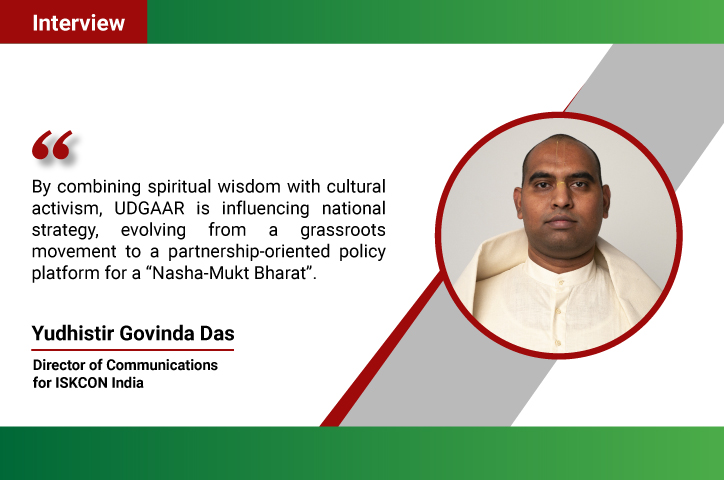
Addiction today is no longer confined to substances alone. It manifests quietly through digital excess, emotional burnout, academic pressure, and a growing sense of purposelessness among young Indians. As the country aspires to harness its demographic dividend, the mental and emotional wellbeing of its youth has become a national imperative, demanding responses that go beyond awareness and enforcement to address meaning, discipline, and belonging. In this conversation, Yudhistir Govinda Das, Director of Communications for ISKCON India, reflects on UDGAAR 2025 emerging as a powerful cultural and spiritual intervention in India’s anti addiction landscape. He speaks about what record breaking youth participation reveals about the inner lives of young Indians, how regional and behavioural triggers of addiction are evolving, and why experiential learning, spirituality, and community driven discipline are critical to sustaining long term behavioural change. The interview explores UDGAAR’s role as both a grassroots youth movement and a policy facing platform, positioning cultural wisdom and spiritual practice as vital complements to India’s vision of a Nasha Mukt Bharat.
Scroll down to read the full interview:
Q. UDGAAR 2025 recorded the highest number of anti-addiction pledges in 24 hours. What does this overwhelming response reveal about the current emotional and psychological landscape of India’s youth?
A. There is a significant amount of drug and substance abuse in the colleges. Several studies and reports from the government and healthcare agencies are bringing forth this alarming trend. In spite of that, the Udgaar festival saw the highest number of anti-addiction pledges recorded in just 24 hours reflecting a powerful shift in the emotional and mental well-being of India's youth. This signifies the deeper desire among the youths to connect with peers and mentors to help steer their lives in a direction that helps them grow holistically. The festival worked to develop discipline and positive attitudes and drug-free lifestyles for young people through its promotion of healthy lifestyle choices and peer association for their future success. Young people now recognize their stress factors and actively search for beneficial ways to deal with their stress and anxiety and social pressures. The research shows that young people today understand addiction problems and emotional distress, so they choose to practice self-discipline while receiving support from their communities and following ethical values. People have started working together because they want to find their life purpose while developing mental toughness and maintaining emotional stability. Overall, the high number of participants shows that young people recognize their challenges while working to create a stronger future without substance abuse problems.
Q. ISKCON’s Nasha Mukta Bharat Abhiyan has reached 15 lakh young people so far. Based on this scale, what key behavioural patterns or triggers of addiction have your teams identified across different regions?
A. The festival is just the beginning of a movement for ISKCON. Reaching 15 lakh young people through this movement has allowed our teams to observe distinct behavioural patterns and addiction triggers across regions. Drug addiction is a concern across the country, as it poses serious challenges for individuals, families and communities as a whole. Among youth, peer pressure remains one of the strongest influences, particularly in urban and semi-urban areas, where exposure to drug consumption through social circles or social media is higher. In contrast, rural regions often see addiction linked to unemployment, recreational opportunities, or stress related to familial and financial pressures. The other important factor is the type of association that a student keeps.
Other common patterns include academic stress, mental health challenges, and the absence of strong mentorship and spiritual grounding. We have also observed that cultural and social norms play a role; regions where drug use is normalized or stigmatization is low, tend to report higher experimentation rates. Recognizing these patterns is necessary and our teams focus on early awareness, personalized counselling, and community engagement programs. By addressing both environmental and psychological triggers, the campaign aims not only to prevent initiation but also to support recovery, building resilience and promoting long-term behavioural change among young people across India.
Q. As someone who interacts with policymakers and youth at multiple levels, what gaps do you see in existing national anti-addiction frameworks, and how is UDGAAR attempting to address them?
A. There are several important gaps in existing national anti-addiction frameworks which UDGAAR is working to address. Although initiatives such as the Nasha Mukt Bharat Abhiyaan and the National Action Plan for Drug Demand Reduction have successfully made awareness a priority and provided treatment, the enforcement and rehabilitation facilities are still inconsistent, especially in the hard-to-reach or less developed areas. Besides, many frameworks barely address youth-specific factors such as peer pressure, academic stress, and lack of mentorship, which are essential causes of addictive behaviours. Moreover, the existence of cultural and regional differences in India implies that standardized messages and interventions are not always completely effective. The recovery process is also obstructed by stigma, shortage of trained counsellors, regional differences in infrastructure, and weak follow-up care.
UDGAAR is an ongoing movement that continually works on these issues by involving youth in large-scale festivals, drama and peer-led pledges, talks, counseling and mentorship programs. Such programs not only give youth guidance, community support, and healthy lifestyle choices but also focus on cultural involvement and spiritual wisdom. This comprehensive approach helps to develop the mental and emotional strength, encourages the practice of drug-free living, and is compatible with the national programs as it facilitates prevention, involvement, and sustainable change of behavior in different communities in India.
Q. Many youth today face silent addictions such as digital overload, substance dependence, and emotional burnout. How does UDGAAR approach these less-discussed forms of addiction through cultural and spiritual engagement?
A. Today’s youth are burdened with the silent addictions of digital overload, substance dependence, and emotional burnout. Although these are rarely acknowledged, they nevertheless have a significant impact on young people's mental and emotional health. By offering safe spaces, peer-led initiatives, interactive workshops, and large-scale festivals help young people identify their inner selves, become conscious of their habits, and grow in strength. Engaging in cultural activities such as music, art, and folk customs provides young people with worthwhile and constructive alternatives to digital and contemporary lifestyles, which encourage self-discipline and mindfulness.
Stress, emotional challenges, and the feeling of being left out are mainly the problems that spiritual guidance and mentoring come to the youth's help with, thus being a way to inner harmony and a sense of direction. By integrating culture, spirituality, and social connection, the youth get the power to adopt sustainable habits, mental and emotional well-being get strengthened, and the youth become resilient to both the visible and the silent forms of addiction. UDGAAR, through this holistic approach is not only a conventional substance-abuse prevention program but also deals with lifestyle addictions and emotional burnout of modern times.
Q. What role do you believe spirituality, chanting, and practices like sankirtan play in breaking addictive cycles at both the psychological and behavioural levels?
A. Spirituality, chanting together with sankirtan and other practices help youngsters to stop their addictions by providing means to elevate their mental and emotional state along with providing meaning and community support and teaching emotional control techniques and tackling the fundamental causes of addiction. The program helps students break their addictive patterns while directing their focus toward positive life choices which replace destructive habits. The methods assist young people to find peace in their thoughts while lowering stress levels and developing positive emotions, which help them manage their mental processes and impulsive actions. The techniques help people manage their emotions while reducing their anxiety levels by transforming destructive thoughts into positive experiences of happiness and self-assurance and social bonding. The practice of sankirtan creates a healthy routine and supportive environment which fosters a strong sense of belonging in people. These elements provide enough support to help people beat both substance-related addictions and non-substance addictions such as digital addiction and emotional exhaustion.
The spiritual practices unite to form a complete system which builds resilience and supports lasting behavioural change toward purposeful and clear life choices for young people.
Q. UDGAAR’s anti-addiction campaign went viral on social media. In your experience, how effective is digital amplification in sensitising young people about addiction and self-destructive habits?
A. Digital amplification has become a powerful tool for communicating with today’s youth, and UDGAAR’s campaign is one of the biggest examples of how social media can bring a positive transformation. Before the festival, we collaborated with several major social media influencers who resonated with our cause and helped amplify the message to millions of their followers. Young people spend most of their time online, and when meaningful, relatable and visually engaging messages appear on their screens, they naturally pause, watch and reflect. Especially viral content when packed with hooks, challenges, and testimonials that help to break the stigma around addiction, mental health, self-destructive habits and start conversations about it.
For UDGAAR, digital reach also acts as an extension of its core mission: spreading awareness rooted in compassion, discipline, and a higher purpose. When spiritual principles are communicated in youth-friendly formats, they resonate deeply and plant seeds of introspection. While digital content alone cannot solve addiction, it plays a crucial role in sensitising young people, shaping attitudes, and encouraging them to seek healthier, more purposeful lifestyles supported by community and spiritual guidance.
Q. You often speak about self-discipline as the foundation of a meaningful life. In the context of Nasha Mukti, how do you help young people transition from short-term motivation to long-term behavioural change?
A. Any long-term change, particularly on the path of Nasha Mukti, is built on self-discipline which has been a cornerstone of our culture. Motivation comes in bits and pieces for the majority of young people; it is emotional, momentary and readily disrupted by stress or peer pressure. Instead, we work to build a transition from fleeting inspiration to consistent, value-based life. Helping individuals comprehend the source of their urges and the void that addictive behaviours attempt to fill is the first step. We help them develop inner strength-building practices, providing them a larger cause and purpose, including early rising, mindful eating, controlled social media use. Through regular satsang, mentorship, and structured routines, we guide them toward practices that build inner strength such as early rising, mindful eating, regulated social media use, and daily chanting.
When young people experience even small wins through discipline, their confidence grows, and the desire for long-term change becomes self-driven rather than imposed. Community support plays a crucial role as well. Being surrounded by positive role models and like-minded peers helps them sustain the discipline needed to choose healthier, more purposeful paths every day.
Q. UDGAAR engages students not just through pledges but through experiential learning such as dramas, exhibitions, and interactive sessions. How do these immersive formats influence young minds differently than conventional anti-addiction messaging?
A. Immersive formats such as dramas, exhibitions, and interactive sessions influence young minds far more deeply than conventional anti-addiction messaging because they allow students to experience the message rather than simply hear it. When a young person watches a drama depicting the consequences of addiction or participates in an activity that mirrors real-life peer pressure, the lesson becomes personal and memorable. These formats activate both emotion and reflection, helping them internalise the impact of their choices.
At UDGAAR, we have seen that experiential learning breaks resistance. Instead of feeling lectured, students feel understood and engaged. Exhibitions create curiosity, interactive booths encourage dialogue, and guided activities allow them to express fears, pressures, and anxieties they usually suppress. This makes the learning process participatory and empowering. By combining spiritual wisdom with relatable, real-life scenarios, these immersive experiences build awareness, empathy, and self-regulation leading to behavioural change that lasts far beyond the event itself.
Q. With over 300 dignitaries attending, UDGAAR became a policy-facing platform this year. What specific collaborations or policy dialogues emerged regarding youth addiction prevention?
A. UDGAAR became a meaningful policy-facing platform, bringing together over 300 dignitaries from government, law enforcement, education, healthcare, and youth development. This convergence opened structured dialogues on strengthening India’s youth addiction prevention ecosystem. Several key collaborations emerged. Policymakers and educators discussed integrating value-based education and life skills modules into school and college curricula to address digital addiction, substance abuse, and emotional stress early. UDGAAR marked a collaborative effort between the Ministry of Social Justice and Empowerment, the Ministry of Culture, and the Ministry of Youth Affairs and Sports.
The initiative is to motivate young people to contribute to India’s social, economic and scientific growth through character development and positive action. The festival also opened dialogue on community mental health outreach and early intervention frameworks for vulnerable youth. By combining spiritual wisdom with cultural activism, UDGAAR is influencing national strategy, evolving from a grassroots movement to a partnership-oriented policy platform for a “Nasha-Mukt Bharat”.





.png)