
Green Mobility: Tata Motors' 2026 Punch Facelift Drives Lower Emission for Eco-friendly Driving
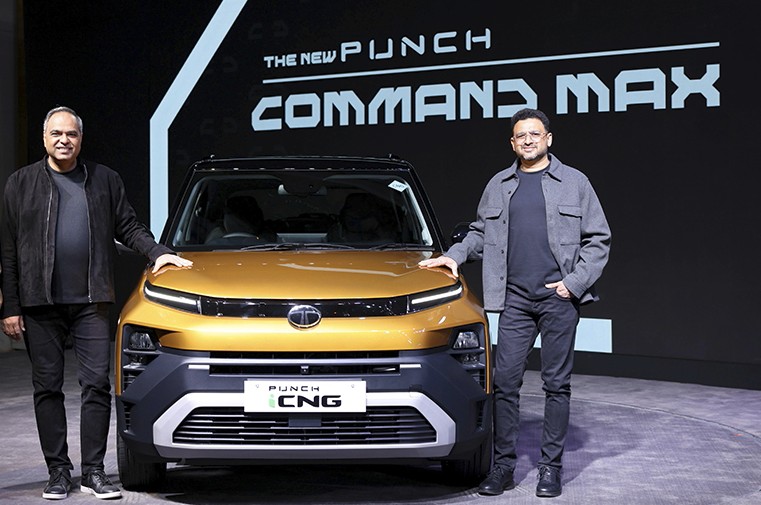
New Delhi, January 13, 2026: Driving its green mobility commitments amid increasing consumer preferences for Compressed Natural Gas (CNG) and Electric Vehicles (EVs), Tata Motors has launched new models for its popular compact SUV Punch with lower emission features.
This innovation addresses urban pollution challenges while aligning with India's CNG infrastructure push and rising fuel prices, the company said. .
As per Tata Motors, the new Punch with twin-cylinder iCNG with AMT has zero tailpipe emissions which makes it more eco-friendly. The twin-cylinder setup and AMT (Automated Manual Transmission) provide for seamless petrol-CNG shifts without performance lags. Environmentally, it cuts CO2 by up to 20% per trip, supporting national goals like 20% CNG blending by 2025, the company said.
The company said that the new eco-friendly products are catering to the growing consumer’s preference and adoption to CNG and electric vehicles.
India's auto sector has seen rapid growth in EV and CNG adoption from 2023 to 2026, driven by policy incentives, infrastructure expansion, and fuel costs, with CNG leading penetration while EVs accelerate. Passenger vehicle (PV) retail totals grew steadily: CY2023 ~4M units (11% YoY), CY2025 4.475M (+9.7% YoY), reflecting eco-shift amid overall 7.7% market rise.
Shailesh Chandra, Managing Director of Tata Motors Passenger Vehicles and Tata Passenger Electric Mobility said that while the overall automobile industry grew 5–6%, the growth of CNG vehicle was over 25%. He added that Tata Motors’ CNG volumes grew about 32% leading to company’s overall CNG penetration to close to 28%. “If you combine CNG and electric, over 40% of our portfolio today comes from lower-emission powertrains,” Chandra Said.
As part of Tata's decarbonization strategy, the company is pioneering India's Electric Vehicle (EV) transition and driving the shift towards sustainable mobility solutions by developing eco-friendly products.
Part of the USD 180 billion Tata group, Tata Motors Limited, a USD 52 billion organization, is a leading global automobile manufacturer of cars, utility vehicles, pick-ups, trucks, and buses, offering an extensive range of integrated, smart, and e-mobility solutions.
Automobile Sector's Eco Shift
India's EV and CNG sectors saw transformative policy shifts from 2023 to 2026, balancing incentives for both while prioritizing EV acceleration amid urban emission curbs. Key measures included national subsidy extensions, tax rationalizations, and regional bans favoring EVs over CNG in high-pollution zones.
As a result, India's passenger vehicle market grew 5-6% in 2025, but CNG sales surged over 25% and EVs at 18%, reaching 81,125 units for Tata alone (14% penetration). CY2025 retail data shows PV CNG share at 21.30% and EV at 3.95%, fueled by policy tailwinds like GST 2.0 incentives and FAME-III subsidies. Tata leads with 32% CNG volume growth, hitting 28% penetration and combined CNG-EV portfolio exceeding 40%.
Tata Motors pioneered India's EV era with Nexon EV (2020), expanding to six models by 2024 including Punch.ev and activ.ev architecture.
National EV Incentives
The government of India launched FAME-III scheme in 2024 which extended demand subsidies up to ₹10,000/kWh (capped at 15% of vehicle cost) through 2026, boosting PV EV sales 77% in 2025, alongside schemes allocating ₹25,938 crore for local battery and component manufacturing. Ministry of Power's 2023 guidelines delicensed EV charging, spurring 20,000+ public stations by 2026.
CNG Support Policies
CNG vehicle expansion has been tied to city gas distribution (CGD) network growth to 8,000+ stations by 2025, with BIS standards for CNG cylinders tightened in 2023 for safety. There were no direct national subsidies, but state-level road tax waivers (e.g., 2-5% in Maharashtra, Gujarat) and green cess proposals (1-2% on petrol/CNG in Delhi, 2025) indirectly favoured CNG as EV bridge fuel.