
FSSAI Authorises 17 r-PET Plants, Unlocking 3 Lakh Tonne Capacity for Circular Packaging
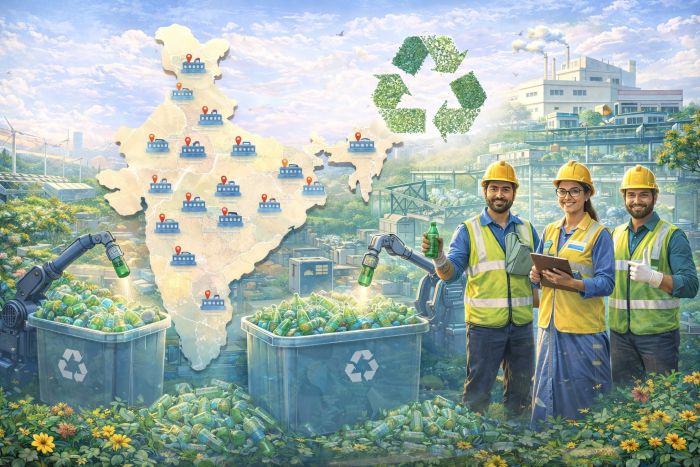
New Delhi, March 16, 2026: The Food Safety and Standards Authority of India (FSSAI) has granted final authorisation to 17 recycled PET (r-PET) manufacturing plants across the country, unlocking an estimated 3 lakh metric tonnes (MT) of annual production capacity for India’s circular packaging economy.
The move is expected to strengthen the country’s packaging supply chain and support the government’s mandate requiring 40% recycled content in PET packaging bottles by 2026–27. Industry stakeholders say the authorisation comes at a crucial time when global supplies of virgin PET and polymers are under pressure due to geopolitical uncertainties, including the ongoing Iran–Israel conflict.
With the new approvals, India now has a combined FSSAI-authorised capacity of 3 lakh MT per annum of food-grade recycled PET, which will be used by the beverage and bottling industries for food-contact packaging.
Companies that have received authorisation include Rungta Eco Extrusions Private Limited, Dodhia Industries Limited, Ganesha Ecopet Private Limited, JB Ecotex Limited, Alpha Ecoplast Private Limited, Ribotl Solutions Private Limited, Dalmia Polypro Industries Private Limited, Revalyu Recycling Limited and Srichakra Polyplast Private Limited, among others.
Welcoming the development, Goutham Jain, Director General of the Association of PET Recyclers (APR) Bharat, said, “The authorization granted by FSSAI to seventeen recycled PET manufacturing plants mark a significant move in the country’s circular packaging economy. The timing could not have been more appropriate when global markets for virgin PET and polymers are facing uncertainty amid geopolitical developments such as the ongoing Iran–Israel conflict.”
He added, “Capacities at these plants will help ensure adequate supply of r-PET in the market, enabling beverage manufacturers to meet the regulatory guideline mandating 40 per cent recycled food-grade plastic content in PET packaging bottles in 2026-27. This move is not only timely but also aligns with the Hon’ble Prime Minister Shri Narendra Modi’s vision of building a circular economy.”
India’s Plastic Waste Management Rules, 2016, mandate the gradual increase of recycled plastic usage in rigid packaging. The rules require 30% recycled content from 2025–26, with the requirement increasing by 10% annually until reaching 60% by 2028–29.
To meet these regulatory targets, 15–18 food-grade r-PET recycling facilities have been established across India with an estimated investment of ₹9,000–10,000 crore. These plants use advanced recycling technologies that comply with safety standards set by the European Food Safety Authority (EFSA) and the US Food and Drug Administration (FDA).
The Ministry of Environment, Forest and Climate Change had earlier permitted the use of recycled PET as food-contact material in September 2021. However, industry demand has remained uncertain due to delays in finalising certain regulatory notifications related to recycled content targets.
Jain noted that the newly authorised plants would help address both regulatory requirements and supply gaps. “With these seventeen recycled PET manufacturing plants receiving final authorizations, there will be surplus r-PET available in the market. This can help fill any gap in the supply of polymers due to the ongoing war and volatility in global markets,” he said.
He also acknowledged the support of policymakers, stating that APR Bharat is grateful to Union Health Minister J.P. Nadda, FSSAI CEO Rajit Punhani, and FSSAI Advisor Dr. Alka Rao for their continued support to the r-PET industry.
The development is expected to accelerate India’s transition toward a circular plastic economy while supporting sustainable packaging practices in the beverage sector.