Why Long-Term Commitment Is the Real Catalyst: Ms. Vinita Singhania, CMD, JK Lakshmi Cement Explains
As India’s manufacturing sector expands across diverse and often resource-constrained regions, the role of industry in driving inclusive and sustainable growth begins to take centre stage. Cement plants, in particular, operate at the intersection of economic growth, environmental responsibility and community wellbeing—making long-term social engagement not just desirable, but essential. JK Lakshmi Cement Ltd has, over decades, built a CSR approach rooted in deep community connect, contextual understanding and continuity of effort across its plant locations.
In this in-depth interaction with TheCSRUniverse, Ms. Vinita Singhania, Chairperson & Managing Director of JK Lakshmi Cement Ltd, shares insights from the company’s extensive on-ground experience across multiple states. She reflects on why long-term, ecosystem-oriented interventions are critical to achieving transformational impact, how programmes like Project Aarambh and Naya Savera have evolved through continuous learning, and what it takes to translate skilling and sustainability initiatives into real livelihood and health outcomes. The conversation also explores water stewardship, circularity, partnerships, and the leadership mindset required to build trust-based, resilient community programmes that grow alongside the business.
Read the full interview for deeper insights on how industry leaders view growth and social responsibility:
Q. JK Lakshmi Cement works in diverse geographies facing persistent challenges. From your leadership vantage point, what structural gaps do you believe companies are uniquely positioned to address in these communities?
A. JK Lakshmi Cement Ltd. is working in and around our cement plants in the states of Rajasthan, Chhattisgarh, Gujarat, Haryana, Odisha. The communities in different geographies vary in terms of not only socio, cultural, economic context but also in the attainment of various developmental parameters. JK Lakshmi’s CSR approach is based on understanding the unique context of a particular community, then designing and delivering their need & aspiration-based CSR projects. Our CSR model is human development centric & accordingly we focus on delivering tailormade CSR projects aimed at improving health, education, skill, livelihoods and rural infrastructure related gaps so that the development is transformational. There is another structural gap in terms of vulnerable communities last-mile-connectivity to access government schemes and projects. Our Company focuses on facilitating marginalised communities to access the government schemes so that the impact gets multiplied. With a very strong community connect we are uniquely positioned to help communities to achieve their true potential through multiple CSR project interventions.
Q. Your long-running initiatives such as Project Aarambh and Naya Savera have been functional for over a decade and more. What factors convinced JK Lakshmi Cement to adopt long-term, ecosystem-oriented interventions across its plant locations?
A. Our on-ground experience showed that real social change cannot be achieved through short-term programmes. As we worked with out-of-school children through Project Aarambh and saw the deep, sustained handholding required to bring tribal, scheduled caste, and low-income learners into mainstream education, it became clear that long -term targeted intervention is needed to bring sustainable impacts and therefore continuity matters. The same learning emerged through Naya Savera, where improving maternal and child health indicators from increasing institutional deliveries and immunisation to reducing infant and maternal mortality demanded steady, multi-year engagement with families and frontline workers. These experiences proved that meaningful, predictable, and sustainable impact is possible only when we commit to long-term, ecosystem-oriented work and build trust-based relationships with the communities we serve.
Q. How do you ensure these programmes remain responsive to changing on-ground realities? Are there any specific examples of adaptations or course corrections that you could share with us?
A. Change is the only constant and this also applies in the case of the communities we work with under CSR. Needs and aspirations of the communities are shaped by various endogenous and exogenous factors. These necessitates that we keep reviewing our CSR projects for its effectiveness. We have a system of internal data based monitoring which helps in keeping the CSR projects result focused. I have also directed our CSR team to undertake external periodic evaluation and impact assessments and integrate the learnings into project cycle. We launched the “Naya Savera” project, which is focused on mother and child health, 20 years ago at Pindwara block of Sirohi. The project has ensured safe, risk free and healthier pregnancies in community and has significantly improved other Reproductive & Child Health Indicators among some of the primitive communities.
In achieving its excellent results the system of concurrent monitoring with focus on key outcome indicators and periodic external project evaluation has helped. We continuously analyse the data and onground realities & do course corrections. The system of plan, do, check & act (PDCA) helps us in continuous improvement of our projects.
Another initiative is Employability Skilling Program which has provided industry specific skilling to and placement to more than 5000 youths. youths have been
One of the problems that we were facing in our job linked employability training program was to build industry specific skill sets in the classroom and to achieve high retention post placement. We did a diagnostic study of the problem which helped us in fixing both the issues. Due to this both training effectiveness and retention has improved drastically. This PDCA approach my team deploy in all projects which has given us high life changing impacts.
Q. Women’s literacy, skilling and micro-enterprise promotion form a significant part of your community work. What have been the most meaningful learnings in enabling women to transition from training to sustained livelihoods?
A. We have supported number of micro-entrepreneurs under small business promotion activities like tailoring units, vegetable shops, tuition centres, vermicompost units, beauty parlours, and E-Mitra kiosks across plant locations. Number of women entrepreneurs received training in business planning, financial literacy, market linkages, and raw material sourcing. The program facilitated the establishment of new and upgradation of existing micro-enterprises which collectively supported the livelihoods of family members, contributing to improved financial stability and diversified income.
The most significant learning is that technical skills alone do not create livelihoods. Confidence, social permission within the household and early market exposure shape the transition far more than the training hours themselves. Peer groups, mentoring and small early wins help families understand the value of supporting women’s work. Market linkage is another decisive factor. When a stitching unit or food-processing group has consistent buyers, participation rises and income stabilises. Livelihoods sustain when skill, confidence and reliable demand come together in the right balance.
Q. JK Lakshmi operates in regions with high water stress. Could you walk us through your approach to village-level water security and sanitation, particularly the models that you see as replicable or scalable?
A. Our water stewardship initiatives have positioned the company at 4.49 times water positive, conserving resources through innovative practices. Additionally, we saved 6.86 lakh tonnes of virgin natural resources by utilising industrial waste-derived raw materials.
In water-stressed districts, practical and community-managed solutions work best. Recharge pits, check dams and revived ponds require minimal external maintenance and last through climate variability. These structures are simple enough for local committees to own and oversee. For sanitation, the focus is on linking hygiene to dignity and long-term wellbeing. Behavioural change becomes easier when people see tangible benefits. Models that rely on low-maintenance infrastructure and active community oversight scale quickly because they do not collapse once the initial funding ends. We also partner with village panchayats and government departments to leverage expertise and resources. This collaborative model with like- minded organizations help in cost and efforts optimization and is highly sustainable and replicable.
Q. Sustainability and circularity are becoming central to the cement industry. How do you connect your renewable energy, waste heat recovery and resource-efficiency practices to tangible community-level outcomes?
A. Our renewable energy push and resource-efficient processes are designed not just to optimise operations, but to create measurable value for the communities around us. With over 49% of our energy now coming from renewables and Durg unit operating at 80%, one of the highest in the country our solar installations and 15 MW waste heat recovery system together cut 85,000+ tonnes of CO₂ annually.
These improved emissions profile directly enhances local air quality, reduces pressure on shared natural resources, and supports a healthier living environment.
By minimizing, reusing, recycling, and recovering materials and energy, the Company is committed to the principles of the circular economy. It has taken initiatives to conserve natural resources, reduce CO2 emissions, and effectively manage waste. The cement plants co-process the all kind of waste and by-products of other industries to minimize potentially unscientific disposal.
Q. Communities around manufacturing plants often expect not just support but partnership. What have been the biggest challenges in creating synergy between company teams, local governments and community institutions?
A. Both from the perspective of creating sustainable impact as well as for creating harmonious co-existence with stakeholders, there is no other way than to collaborate with communities as a partner from the beginning of CSR projects to its delivery and evaluation. Partnership creation with communities, not only make CSR effective in terms of targeting the needy people but also build on the available local knowledge and resources. However partnership creation needs transparent and trust-enhancing continuous engagements and communication.
The only dependable way to build synergy is steady engagement. When every stakeholder sees consistency and transparency, partnership becomes a natural outcome instead of a forced structure.
Q. Could you also touch upon the most significant partnerships and collaborations that have helped the company achieve desired outcomes through its social projects?
A. We collaborate with like-minded public and private organisations for bringing technical expertise and enhanced reach out. On case to case basis we bring NGOs as an implementation partner for delivering CSR projects. Technical partners are engaged for providing career counselling to provide expert guidance, aptitude assessment, and academic support to students. For health interventions, qualified medical institutions and healthcare partners support the organization of health camps, screenings, and awareness programs. Partnerships with experienced agencies facilitate linkages with government schemes, enabling eligible community members to access social security, welfare benefits, and livelihood support. Employability and skill development programs are implemented in collaboration with professional training partners who deliver industry-relevant training, certification, and placement support. Additionally, animal health initiatives are carried out with veterinary and livestock-focused partners to improve animal wellbeing and support rural livelihoods.
These collaborations bring technical expertise, strengthen delivery mechanisms, and enhance the overall effectiveness, sustainability, and reach of the company’s CSR interventions.
Q. Drawing from JK Lakshmi Cement’s decades of community engagement, what recommendations would you offer to companies who are trying to design long-term social development programmes today?
A. Start with a clear understanding of actual needs rather than themes that attract attention. Commit to a time horizon long enough to build trust and see change. Invest in strong field teams because ground-level insight determines whether a programme flourishes or fails. Measure change in behaviour, not just activity numbers. And most importantly, treat communities as equal participants in shaping the programme. When people co-own a solution, the programme becomes resilient.
Q. As the company continues to grow, how do you see your social initiatives evolving in the coming years? Are there any specific goals that the company has set for the near to medium term in this regard?
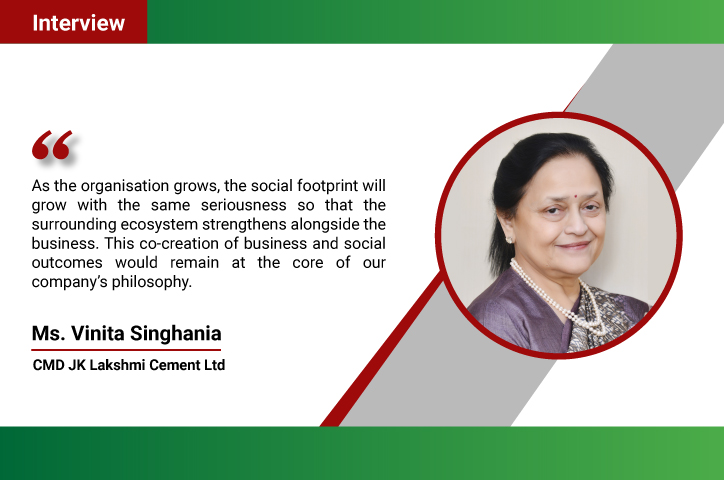
A. As the organisation grows, the social footprint will grow with the same seriousness so that the surrounding ecosystem strengthens alongside the business. This co-creation of business and social outcomes would remain at the core of our company’s philosophy. Programmes will move towards capability-based models using technology where useful, especially in healthcare and education. Water work will align more closely with long-term climate resilience. Livelihood efforts will prepare communities for emerging economic opportunities in the region. For us the most important thing is to bring transformative changes in the lives of the needy and marginalized people around our plant locations. Based on our experience, our focus would be on skill development and livelihoods including employability. Access to quality education and health services are other key areas which would determine if India would harness its demographic dividend. We would also focus on the climate change readiness for the communities as this would have impact on the livelihoods and other areas. India with a huge baggage of gender development deficits, needs huge investment in girls and women and our focus would continue to be on designing CSR projects with gender lens.


.png)