
UNDP India Releases Annual Report 2025 Highlighting Development Outcomes
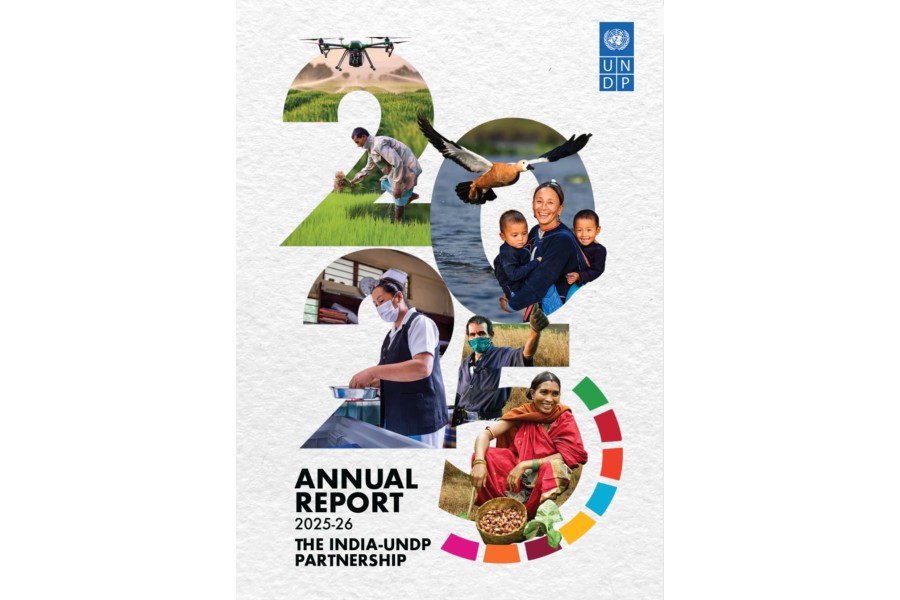
New Delhi, February 05, 2026: The United Nations Development Programme India launched its Annual Report 2025: The India–UNDP Partnership at UN House during the Country Programme Management Board meeting, outlining progress made across health, social protection, livelihoods, and climate action in collaboration with the Government of India.
The report was launched by Anu P. Mathai, Additional Secretary, Department of Economic Affairs, Ministry of Finance, and Angela Lusigi, Resident Representative, UNDP India.
Covering outcomes delivered under the India–UNDP Country Programme (2023–27), the report documents how public systems supported by UNDP reached scale in 2025. According to the report, digital immunisation platforms helped track services for 97 million children and 32 million pregnant women, while crop insurance coverage under the Pradhan Mantri Fasal Bima Yojana expanded to 42 million farmers. Climate-focused livelihood programmes supported over 63,000 people through community-led adaptation initiatives.
Angela Lusigi said, “India’s development progress in 2025 reflects strong government leadership in delivering at scale through public systems. These systems delivered across health, insurance, care, and climate action, reaching women, children, farmers, waste workers, and low-income households. UNDP is proud to have supported these efforts by strengthening technical expertise, helping public programmes function more effectively and respond faster when support was needed.”
The report highlights progress in localising the Sustainable Development Goals (SDGs), with SDG monitoring frameworks operational in 33 of 36 States and Union Territories. UNDP’s SDG coordination and acceleration approach has been institutionalised across key ministries, improving data-driven planning and budgeting.
Digital public infrastructure remained a central focus. Platforms such as U-WIN and eVIN strengthened immunisation delivery by enabling beneficiary tracking and monitoring vaccine stocks and cold-chain temperatures across more than 30,000 cold-chain points, covering over 650 million doses.
In the area of social inclusion, Project Utthaan supported over 34,900 waste workers in accessing identity documents, health insurance, and social protection. Learnings from the programme are informing the rollout of the National Action for Mechanised Sanitation Ecosystem (NAMASTE) scheme, implemented with the Ministry of Social Justice and Empowerment, with UNDP providing technical assistance.
The report also documents progress in urban childcare models that enabled women from low-income households to take up paid work, while contributing to employment in the care economy. Research and pilot programmes helped inform investment pathways and policy design for urban childcare services.
On climate action, UNDP supported India in developing its National Adaptation Plan and a gender-responsive Biodiversity Finance Plan. Restoration and resilience initiatives helped communities reduce vulnerability to climate shocks while sustaining livelihoods.
India’s development approaches were also shared internationally through South–South Cooperation. In partnership with the Ministry of External Affairs, India’s crop insurance model was shared with seven countries, while digital health platforms such as U-WIN and eVIN were adapted for use in Zambia and Lao PDR.
The UNDP India Annual Report 2025 is available here: https://www.undp.org/india/publications/annual-report-2025-26-india-undp-partnership